Reviewed by the HyaluFlow Health Editorial Team | Published: October 5, 2026 | Last Updated: October 5, 2026
Quick Answer: The Fitzpatrick skin type scale is a six-level system used to describe how skin typically responds to ultraviolet (UV) exposure. Types I and II generally burn easily, while Types V and VI tend to tan more readily and burn less easily.
The scale was originally developed for phototherapy and later became widely used in dermatology, cosmetic procedures and research. It is based mainly on sun sensitivity and tanning response rather than simply the visible color of someone's skin. Research on the Fitzpatrick classification explains its development and clinical applications.
Key Takeaways
- The Fitzpatrick scale has six skin phototypes, from I to VI.
- It primarily considers how skin reacts to UV exposure.
- Lower types generally burn more easily.
- Higher types generally tan more easily and burn less readily.
- The scale is useful but does not perfectly describe skin color.
- A darker Fitzpatrick skin type does not mean zero skin-cancer risk.
What Is the Fitzpatrick Skin Type Scale?
The Fitzpatrick skin type scale, also called the Fitzpatrick phototype scale, was developed by dermatologist Thomas B. Fitzpatrick. It categorizes skin according to its tendency to burn and tan after sun exposure.
The original system contained Types I through IV and was later expanded to include Types V and VI. Today, all six types are commonly used in dermatology and photodermatology.
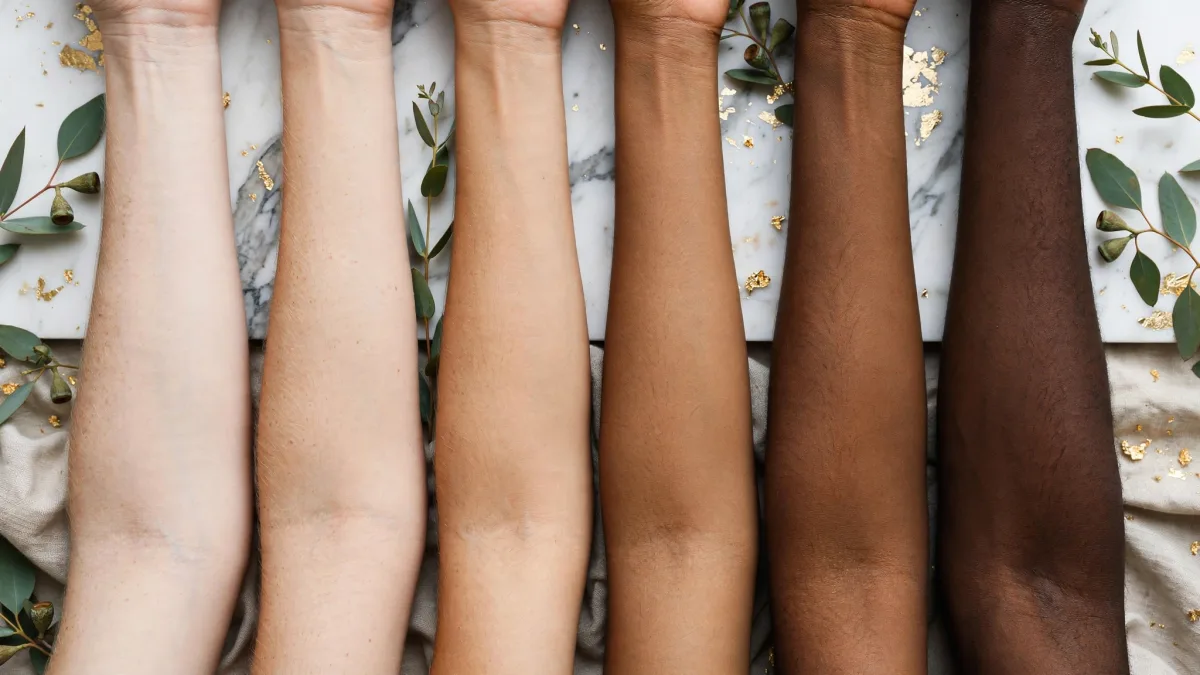
Importantly, Fitzpatrick skin type is not simply a description of whether someone's skin is light, medium or dark. Two people with similar-looking skin can have different phototypes because their responses to sunlight may differ.
Fitzpatrick Skin Types I to VI
Type I
Type I skin generally burns very easily and does not tan. It is usually highly sensitive to UV exposure.
Type II
Type II skin generally burns easily and tans only minimally. Sun protection is particularly important because repeated UV exposure can cause significant damage.
Type III
Type III skin may experience a moderate sunburn and usually develops a gradual tan. It has more UV tolerance than Types I and II but can still experience sun damage.
Type IV
Type IV skin usually tans relatively easily and may burn less frequently. However, UV exposure can still cause skin damage and pigmentation changes.
Type V
Type V skin generally tans easily and rarely burns. It contains more melanin, but this does not provide complete protection against UV-related damage.
Type VI
Type VI skin generally tans deeply and rarely burns. It has high levels of melanin, but people with Type VI skin can still develop skin conditions and skin cancer.
Why Does Fitzpatrick Skin Type Matter?
Fitzpatrick skin type can help dermatology professionals estimate how skin may respond to UV exposure and certain light-based treatments. It has also been used when considering procedures such as lasers and chemical treatments.
A review in Clinical Dermatology notes that skin phototyping can help assess photodamage and guide certain aesthetic procedures, although objective methods can address some limitations of the traditional scale.
Is Fitzpatrick Skin Type the Same as Skin Tone?
No. This is one of the most important distinctions.
Fitzpatrick skin type describes sun reactivity, especially burning and tanning. Skin tone describes the visible color of the skin. These characteristics overlap but are not interchangeable.
Research has found that the Fitzpatrick scale can be inconsistent because it relies partly on a person's self-assessment. A 2026 review also highlighted limitations involving subjective classification and its ability to represent the full diversity of human skin tones. Read the recent review of the Fitzpatrick scale.
Can Darker Skin Still Get Sun Damage?
Yes. Having a higher Fitzpatrick skin type does not eliminate the need for sun protection.
Melanin provides some natural protection against UV radiation, but it does not make skin immune to UV damage. Research has also warned that relying too heavily on Fitzpatrick Types IV to VI may create a false sense of security regarding skin cancer risk. Read the research on skin cancer in Types IV to VI.
Regardless of skin type, use appropriate sun protection, including sunscreen, protective clothing and shade when appropriate.
How to Find Your Fitzpatrick Skin Type
A Fitzpatrick assessment typically asks about your natural skin color, how your skin reacts to sunlight and how easily you tan. Because the result can depend on how questions are interpreted, an online quiz should be considered an estimate rather than a medical diagnosis.
The Bottom Line
The Fitzpatrick skin type scale provides a simple way to classify skin according to its response to sunlight. Types I through VI range from skin that burns very easily to skin that generally tans deeply and rarely burns.
However, the scale has limitations and should not be treated as a complete measurement of skin color, pigmentation or skin-cancer risk. Whatever your skin type, consistent sun protection remains important.