Reviewed by the HyaluFlow Health Editorial Team | Published: June 17, 2026 | Last Updated: August 24, 2026
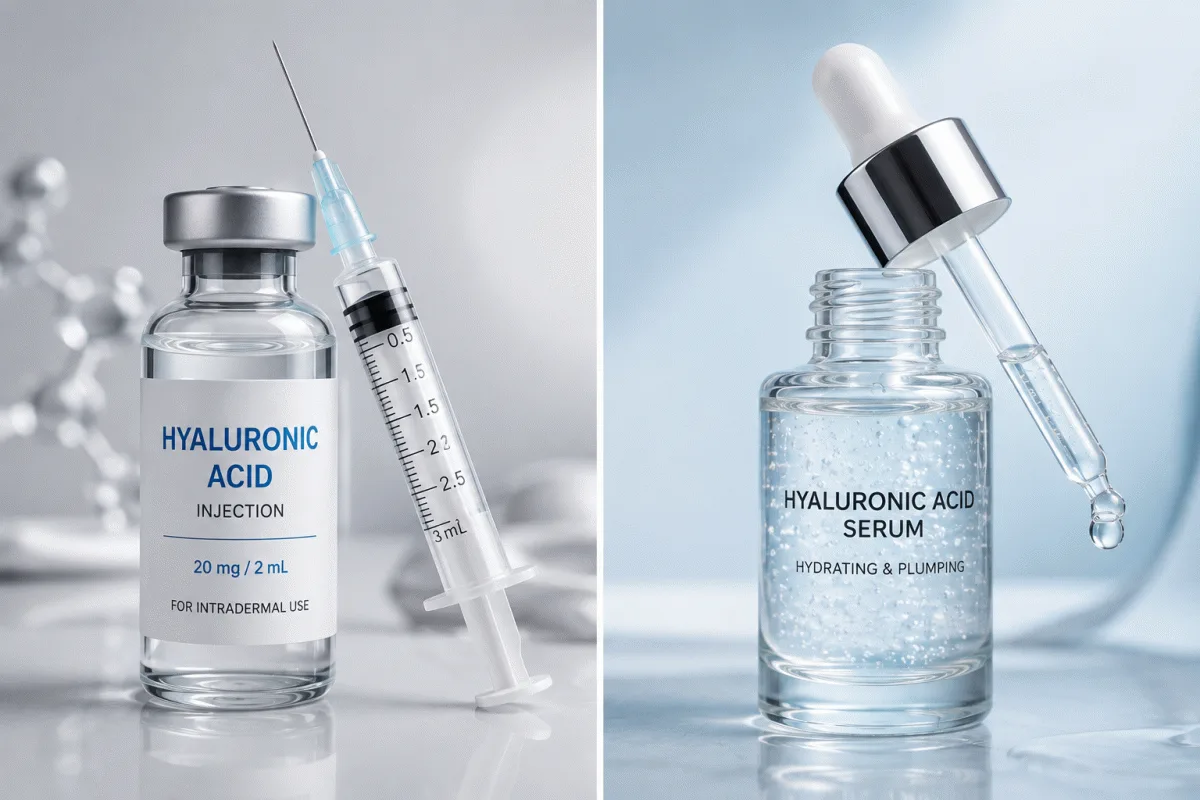
Hyaluronic acid (HA) is used in both skincare products and injectable dermal fillers, but these treatments are not interchangeable. A serum primarily supports surface and epidermal hydration, while an injectable filler is placed beneath the skin to restore or add volume.
Quick Answer
Topical hyaluronic acid can improve skin hydration, smoothness, and the appearance of fine lines caused partly by dryness. Dermal fillers use injectable HA gels to create structural volume and are medical procedures with different benefits and risks.
Molecular weight matters for topical HA because smaller HA molecules can behave differently within the skin. However, a serum should not be assumed to reach the same depth or produce the same volumizing effect as an injectable filler. Benefits of topical hyaluronic acid for skin quality and signs of skin aging: From literature review to clinical evidence
Key Takeaways
- Topical HA mainly targets skin hydration and surface appearance.
- Injectable HA fillers are placed beneath the skin for volume and contouring.
- Lower-molecular-weight HA can show greater skin penetration than high-molecular-weight HA in research.
- Topical serums cannot replicate the structural effect of a dermal filler.
- Injectable fillers provide more substantial volume correction but involve medical risks.
- The best choice depends on whether the goal is hydration or structural volume restoration.
Understanding the Skin Barrier
The outermost layer of skin, the stratum corneum, limits the penetration of many substances. Conventional high-molecular-weight HA has limited ability to cross this barrier, which is one reason topical products primarily provide hydration rather than deep volumization.
Research using Raman spectroscopy found that HA with molecular weights of approximately 20–300 kDa showed greater penetration through the stratum corneum than HA in the 1000–1400 kDa range. Human skin penetration of hyaluronic acid of different molecular weights as probed by Raman spectroscopy
How Topical Hyaluronic Acid Works
Topical HA is a humectant that binds water and can improve the hydration of the skin. Better hydration can temporarily make the skin surface appear smoother and fine lines less noticeable.
Formulation also matters. Different HA molecular weights may have different interactions with the skin, and some experimental formulations have demonstrated penetration beyond the outermost layer. Topical Hyaluronic Acid Facial Cream with New Micronized Molecule Technology Effectively Penetrates and Improves Facial Skin Quality
Hyaluronic Acid Injections: Dermal Fillers
HA dermal fillers are injectable gels placed into specific tissue layers to create a fuller or smoother appearance. Unlike a topical serum, the filler is physically positioned beneath the skin rather than relying on the skin barrier to deliver the ingredient.
The FDA has approved certain dermal fillers for specific facial indications, including correction of moderate-to-severe facial wrinkles and folds and increasing fullness in areas such as the lips, cheeks, chin, and under-eye hollows. FDA-Approved Dermal Fillers
Hydration vs Volume Restoration
The biggest difference is the treatment goal. A topical HA serum is best viewed as a hydration-focused skincare product, while an HA filler is designed to change tissue volume and contour.
That does not make one universally better. Someone concerned mainly with dehydrated skin may benefit from a well-formulated topical product, while someone seeking correction of lost facial volume would need a discussion with a qualified medical professional about appropriate treatment options.
What the Science Says
Clinical literature supports topical HA as a useful ingredient for improving skin hydration and certain visible signs of aging. Evidence also shows that molecular weight and formulation can influence how HA interacts with skin, although deeper penetration does not automatically mean greater clinical benefit.
Injectable HA fillers have a different evidence base because they are medical devices evaluated for specific uses. Their effects are generally temporary because the body eventually breaks down and absorbs the filler material. Dermal Filler Do's and Don'ts for Wrinkles, Lips and More
Common Myths
Myth: A high-quality serum can replace filler
No. Even an advanced HA serum cannot reproduce the volume-restoring effect of an injectable filler because the two products act in fundamentally different ways.
Myth: Smaller HA always penetrates deeper and works better
Lower molecular weight can increase penetration in some studies, but molecular size alone does not determine whether a product will produce superior visible results. Formula, concentration, skin condition, and clinical evidence also matter.
Myth: HA fillers are risk-free because HA occurs naturally
Natural occurrence does not eliminate procedural risk. The FDA reports common effects such as swelling and bruising and rare but serious complications, including accidental injection into a blood vessel that can cause tissue death, vision problems, or stroke. Dermal Fillers (Soft Tissue Fillers)
Who Should Pay Attention?
Topical HA may suit people seeking additional hydration, smoother-looking skin, or support for a dry skin barrier. It can generally be incorporated into a broader skincare routine without the procedural risks associated with injections.
Anyone considering injectable HA should treat it as a medical procedure, not simply an upgraded skincare product. In the U.S., the FDA recommends working with a licensed healthcare provider experienced with dermal fillers and facial anatomy.
Evidence Strength Summary
Strong evidence: HA fillers can provide temporary volume and correction for approved indications, while topical HA can improve skin hydration.
Moderate evidence: HA molecular weight influences topical skin penetration and behavior.
Limited evidence: Claims that a particular molecular weight or serum formula can reproduce the effects of injectable fillers.
Bottom Line
Hyaluronic acid injections and topical HA serums solve different problems. Serums are primarily about hydration and surface-level skin improvement, while fillers are designed to restore or add volume beneath the skin.
If your goal is hydrated, smoother-looking skin, a topical HA product may be enough. If your goal is meaningful facial volume correction, only an appropriately performed injectable treatment can provide that type of structural change.