Quick Answer
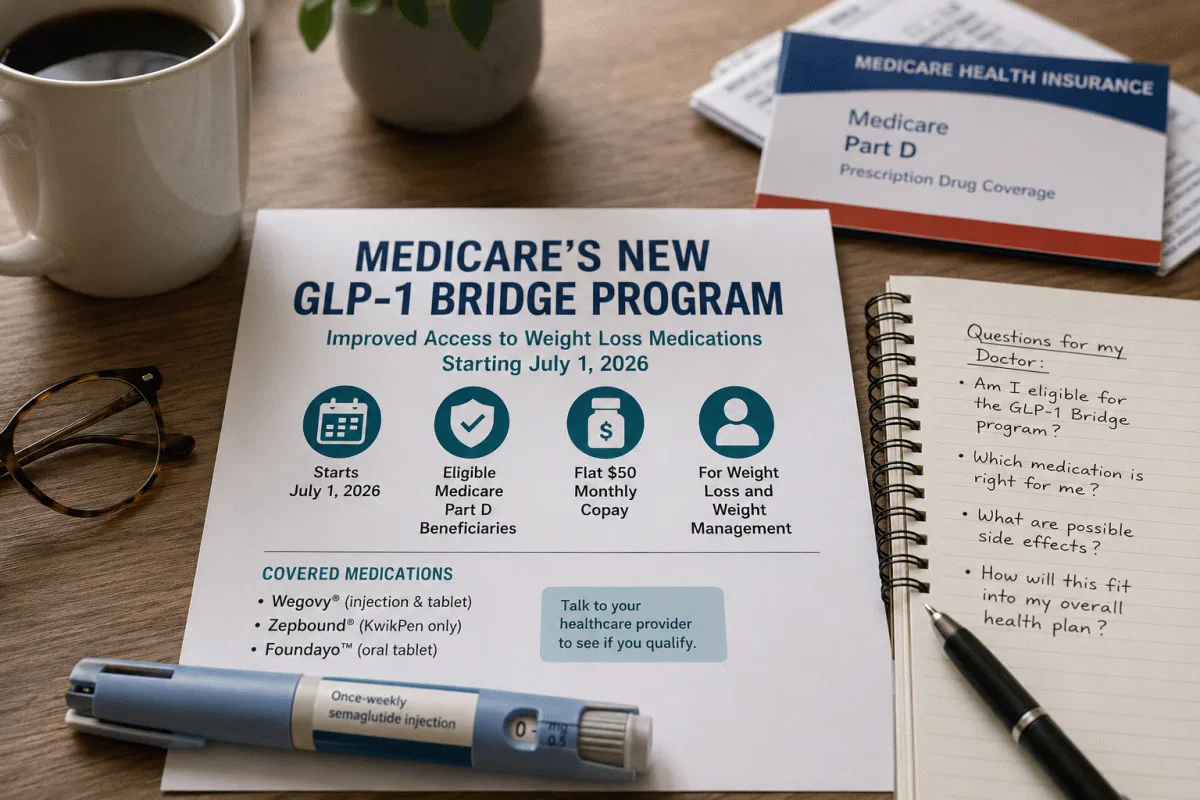
Beginning July 1, 2026, the Medicare GLP-1 Bridge program allows eligible Medicare Part D beneficiaries to receive select FDA-approved GLP-1 weight-loss medications for a flat $50 monthly copay. The temporary demonstration program runs through December 31, 2027 and currently covers Wegovy, Zepbound (KwikPen only), and Foundayo, provided participants meet the eligibility requirements.
Key Takeaways
- Eligible Medicare Part D beneficiaries can access select GLP-1 weight-loss medications for a flat $50 monthly copay.
- The program launched on July 1, 2026, and is scheduled to continue through December 31, 2027.
- Coverage currently includes Wegovy, Zepbound (KwikPen only), and Foundayo.
- Prior authorization from a healthcare provider is required before treatment begins.
- The program is designed for obesity treatment and weight management, not conditions already covered under standard Medicare Part D.
Introduction
For many Medicare beneficiaries, the high cost of GLP-1 medications has made effective obesity treatment financially out of reach. Although these medications have transformed weight management in recent years, Medicare traditionally offered limited coverage when they were prescribed solely for weight loss.
That changed on July 1, 2026, when the Centers for Medicare & Medicaid Services (CMS) launched the Medicare GLP-1 Bridge. This temporary demonstration program gives eligible beneficiaries access to select GLP-1 medications for a predictable $50 monthly copay, replacing the often four-figure monthly retail price.
The program arrives as demand for GLP-1 medications continues to grow across the United States. Millions of Americans now use these medications for obesity treatment, while researchers continue studying their broader health benefits. Here's what the Medicare GLP-1 Bridge covers, who qualifies, how to apply, and what beneficiaries should know before enrolling.
Why This Matters
GLP-1 receptor agonists mimic a naturally occurring hormone that helps regulate appetite, slow stomach emptying, and increase feelings of fullness after eating. These effects have made them among the most effective prescription medications currently available for long-term weight management.
Despite their clinical success, affordability has remained one of the biggest barriers to treatment. Without insurance coverage, many GLP-1 medications cost well over $1,000 per month, making long-term use unrealistic for many older adults.
The Medicare GLP-1 Bridge represents the first federal initiative specifically designed to improve access to GLP-1 medications prescribed solely for obesity treatment rather than diabetes or another qualifying medical condition. According to estimates from KFF, approximately 3.8 million Medicare beneficiaries could potentially qualify under the program's eligibility criteria.
What Is the Medicare GLP-1 Bridge?
The Medicare GLP-1 Bridge is a temporary demonstration program created by CMS rather than a permanent change to Medicare law. Instead of operating through the traditional Medicare Part D payment system, the program uses its own centralized processing system to simplify approvals and ensure consistent access nationwide.
Unlike standard Medicare Part D benefits, the Bridge program operates independently of your normal deductible and coverage phases. Once approved, eligible beneficiaries pay a fixed $50 monthly copay for covered medications regardless of where they are in their Part D benefit.
CMS processes prior authorizations, pharmacy claims, and payments through a centralized system using Humana's Limited Income Newly Eligible Transition infrastructure. This standardized approach is intended to provide consistent access for beneficiaries across all U.S. states and territories.
Who Qualifies?
To qualify for the Medicare GLP-1 Bridge program, beneficiaries must meet all eligibility requirements established by CMS.
- Be enrolled in Medicare Part D through either a standalone Prescription Drug Plan or a Medicare Advantage plan that includes prescription drug coverage.
- Receive a prescription for a covered GLP-1 medication specifically for obesity treatment or weight-loss maintenance alongside nutrition and lifestyle modifications.
- Not already qualify for GLP-1 coverage through standard Medicare Part D because of another approved medical condition, such as type 2 diabetes, moderate-to-severe obstructive sleep apnea, or metabolic dysfunction-associated steatohepatitis (MASH).
- Have a healthcare provider submit and receive approval for a prior authorization confirming that all clinical eligibility requirements, including body mass index (BMI) criteria, have been met.
If you already qualify for Medicare coverage because of another approved medical condition, your prescription will generally be processed through your regular Medicare Part D benefit rather than the Bridge program.
Which Medications Are Covered?
As of the program's launch on July 1, 2026, three FDA-approved medications are included.
| Medication | Covered Formulation | Monthly Copay |
|---|---|---|
| Wegovy | Covered formulation(s) approved by CMS | $50 |
| Zepbound | KwikPen only | $50 |
| Foundayo | Oral once-daily tablet | $50 |
Manufacturer coupons, savings cards, and other discount programs cannot be combined with the Medicare GLP-1 Bridge benefit. The program also acts as the primary payer for covered prescriptions and generally does not coordinate benefits with other insurance plans.
How the Application Process Works
- Discuss treatment with your healthcare provider. Your doctor will determine whether a GLP-1 medication is appropriate based on your medical history, weight-loss goals, and current medications.
- Prior authorization is submitted. Your provider sends the required clinical documentation to the program's centralized processing system for review.
- Receive approval. Once approved, you can fill your prescription at a participating pharmacy for the program's flat $50 monthly copay.
- Continue treatment. In most cases, additional prior authorizations are not required for routine refills unless you change to another covered GLP-1 medication or your eligibility changes.
Approvals granted during the demonstration generally remain valid throughout the program unless CMS changes eligibility requirements or the participant switches medications.
The Bigger Picture: GLP-1 Use Continues to Grow
The Medicare GLP-1 Bridge launches at a time when GLP-1 medications are becoming increasingly common across the United States. Once used primarily to manage type 2 diabetes, these medications are now widely prescribed for obesity treatment because of their ability to support significant, sustained weight loss when combined with healthy lifestyle changes.
According to Gallup's 2026 National Health and Well-Being Index, approximately 11% of U.S. adults—about 40 million people—currently use a GLP-1 medication for weight loss. That's a substantial increase from just 3% in 2024. Another 15% report having used a GLP-1 medication at some point.
Public awareness has also risen dramatically. More than nine in ten Americans surveyed in 2026 said they knew GLP-1 medications could be used for weight management. Researchers believe this growing awareness, combined with expanding access and improving affordability, is changing how obesity is treated nationwide.
The same Gallup analysis also found that the U.S. obesity rate declined from 39.9% in 2022 to 36.4% in 2026. While many factors likely contributed, researchers believe increased GLP-1 use may have played an important role.
Affordability remains one of the biggest challenges. Many people discontinue treatment because insurance coverage is limited or monthly costs are too high. Gallup found that more than one-third of people using compounded GLP-1 medications had previously switched from brand-name drugs because of cost. By offering eligible Medicare beneficiaries a predictable $50 monthly copay, the Bridge program aims to reduce one of the largest barriers to long-term treatment.
The GLP-1 market is also evolving rapidly. Clinical trials continue to evaluate new oral medications that could provide similar benefits without injections. As additional drugs receive FDA approval, CMS may update the list of medications covered under the Medicare GLP-1 Bridge.
Benefits of the Medicare GLP-1 Bridge
- Predictable monthly cost. Eligible beneficiaries pay a flat $50 monthly copay regardless of their Medicare Part D benefit phase.
- Improved access. The program expands Medicare coverage specifically for obesity treatment, allowing more eligible adults to receive evidence-based care.
- Simplified administration. A centralized approval system helps create a more consistent process nationwide.
- Long-term authorization. Once approved, beneficiaries generally do not need repeated prior authorizations unless they switch medications or their eligibility changes.
- Nationwide availability. The demonstration program operates across all U.S. states and territories.
Risks and Limitations
Although the Medicare GLP-1 Bridge improves affordability, it is not a permanent benefit. The demonstration program is currently scheduled to end on December 31, 2027. Unless CMS extends the initiative or Congress changes Medicare law, coverage may end after that date.
Like all prescription medications, GLP-1 drugs can cause side effects. The most common include nausea, vomiting, diarrhea, constipation, and stomach discomfort, particularly during the first few weeks of treatment. Many people find these symptoms improve over time, but some may require dose adjustments or discontinuation.
More serious complications are uncommon but have been reported, including pancreatitis, gallbladder disease, severe gastrointestinal problems, and possible thyroid-related concerns in certain individuals. Patients should promptly report persistent abdominal pain, severe vomiting, or other concerning symptoms to their healthcare provider.
GLP-1 medications work best when combined with healthy eating, regular physical activity, and ongoing medical supervision rather than being viewed as a standalone solution for weight loss.
Who Should Be Careful?
Not every Medicare beneficiary qualifies for the GLP-1 Bridge. Certain Medicare arrangements, including some private fee-for-service plans, Section 1876 cost contract plans, Section 1833 prepayment plans, and PACE organizations, may not be eligible unless beneficiaries also have qualifying Medicare Part D coverage.
Individuals who already qualify for GLP-1 medications through standard Medicare Part D because of conditions such as type 2 diabetes, moderate-to-severe obstructive sleep apnea, or MASH should generally continue receiving coverage through their existing Medicare drug benefit instead of the Bridge program.
People with a history of pancreatitis, medullary thyroid carcinoma, Multiple Endocrine Neoplasia syndrome type 2 (MEN2), severe gastrointestinal disease, or those taking multiple prescription medications should discuss the potential risks and benefits with their healthcare provider before starting treatment.
Weight-loss medications are most effective when used as part of a comprehensive treatment plan that includes nutrition, physical activity, behavioral support, and regular medical follow-up.
Key Takeaways
- The Medicare GLP-1 Bridge launched on July 1, 2026, providing eligible beneficiaries with select GLP-1 weight-loss medications for a flat $50 monthly copay.
- Current covered medications include Wegovy, Zepbound (KwikPen only), and Foundayo.
- Enrollment requires Medicare Part D coverage, a qualifying prescription, and prior authorization from a healthcare provider.
- The demonstration program is scheduled to continue through December 31, 2027.
- The initiative represents Medicare's most significant expansion of obesity medication access to date and may improve affordability for millions of eligible beneficiaries.
References
- Centers for Medicare & Medicaid Services (CMS). Medicare GLP-1 Bridge Program.
- Centers for Medicare & Medicaid Services. CMS Launches Medicare GLP-1 Bridge, Expanding Access to GLP-1 Medications. July 2026.
- Gallup. National Health and Well-Being Index. July 2026.
- KFF. Medicare Coverage Analysis for GLP-1 Weight-Loss Medications.
- Medicare Rights Center. GLP-1 Weight-Loss Drug Demonstration Program.
- The Conversation via ScienceDaily. New Oral GLP-1 Weight-Loss Medications and Emerging Research. July 2026.