Reviewed by the HyaluFlow Health Editorial Team | Published: June 22, 2026 | Last Updated: August 30, 2026
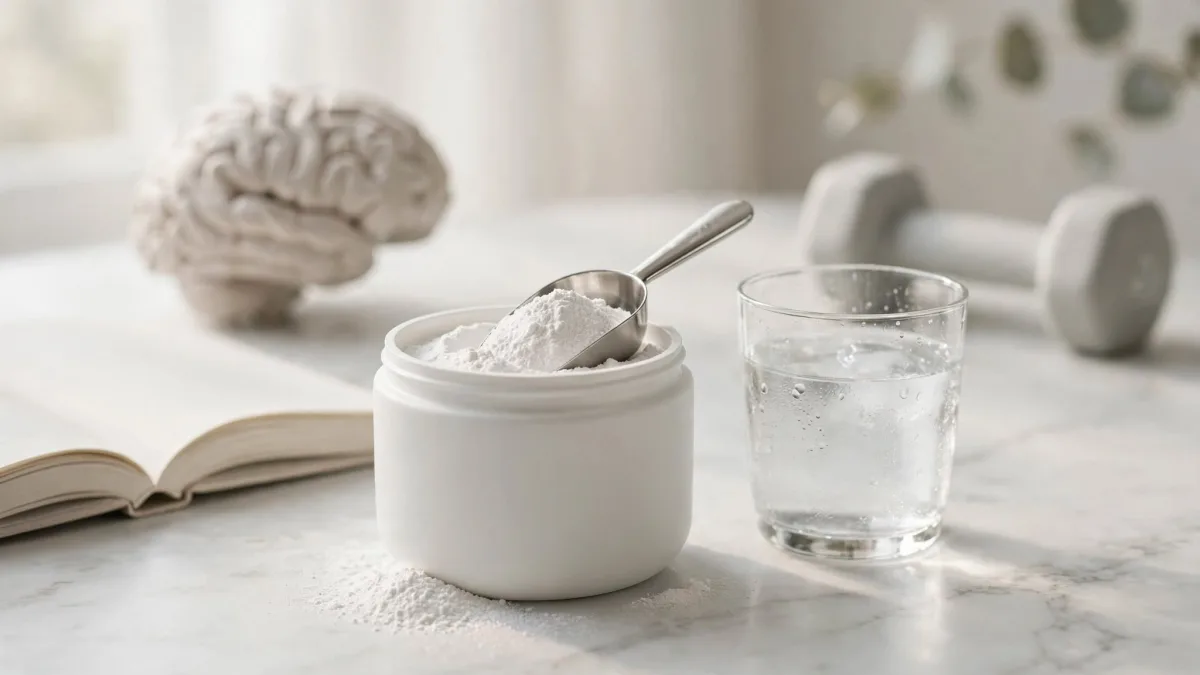
Creatine monohydrate is best known for helping people gain strength and lean mass, but its role is broader. Research also examines creatine for repeated high-intensity exercise, cognitive performance, and healthy aging.
The strongest evidence supports exercise performance and training adaptations, while evidence for brain health is still developing.
Quick Answer
Creatine monohydrate increases phosphocreatine availability, helping cells regenerate ATP during demanding activity. For healthy adults, the best-supported benefits are greater strength, power, and training capacity. Possible cognitive and healthy-aging benefits are promising but less certain.
Key Takeaways
- Creatine monohydrate is the most studied creatine form.
- It supports strength, power, and high-intensity exercise.
- It can increase lean mass when paired with resistance training.
- Cognitive benefits are possible, but results are mixed.
- Older adults may benefit when creatine is combined with resistance exercise.
What Is Creatine and How Does It Work?
Creatine is made naturally from amino acids and is also found in foods such as meat and fish. Most is stored in skeletal muscle, where phosphocreatine helps replenish ATP.
Creatine monohydrate has the strongest research base. The International Society of Sports Nutrition position stand on creatine identifies it as effective for improving high-intensity exercise capacity and lean mass during training.
Creatine for Strength and Exercise Performance
Strength and power are the clearest benefits of creatine. It can improve repeated high-intensity efforts, potentially allowing more quality work during training.
Over weeks of resistance training, that added capacity can contribute to greater strength and lean-mass gains. The ISSN safety and efficacy position stand supports these outcomes.
Could Creatine Support Brain Function?
The brain depends heavily on cellular energy, so researchers have studied creatine for cognitive performance. A 2024 systematic review and meta-analysis of 16 randomized trials found improvements in memory and some measures of attention and processing speed, but not overall cognition or executive function.
The 2024 systematic review in Frontiers in Nutrition found moderate-certainty evidence for memory but lower certainty for several other outcomes. More research is needed.
Creatine and Healthy Aging
Age-related muscle loss can reduce strength and physical function. Research suggests creatine may enhance some adaptations to resistance training in older adults.
A meta-analysis of randomized trials found that adding creatine to resistance training improved muscle strength and fat-free mass compared with resistance training alone. Creatine works best here as an addition to exercise, not a substitute for it.
What the Science Says About Dosing
For healthy adults, a dose of 3–5 grams of creatine monohydrate is commonly used. Loading can raise muscle creatine stores faster, but it is optional, and consistent daily use matters more than workout timing.
If hydration is part of your training routine, the HyaluFlow Hydration Calculator can help you review your daily fluid needs.
Is Creatine Safe? Common Myths
For healthy adults, creatine monohydrate has a strong safety record. A 2026 systematic review found no meaningful adverse effect on kidney function measures, although serum creatinine can rise because creatine metabolism affects that marker.
Myth: Creatine is a steroid. False. It is a naturally occurring compound, not an anabolic steroid. Myth: Creatine causes dehydration. Current evidence does not support routine dehydration from standard use.
Myth: You must cycle creatine. There is no established requirement for healthy adults to cycle standard doses.
People with kidney disease, reduced kidney function, pregnancy, or other medical concerns should discuss supplementation with a qualified healthcare professional.
Who Should Pay Attention?
Creatine may be especially relevant to people doing resistance training, sprint or interval sports, and older adults using strength exercise. People who eat little or no animal food are being studied, but cognitive benefits should not be assumed.
Evidence strength summary: strong for strength, power, high-intensity exercise capacity, and lean-mass support with resistance training; promising but less certain for memory, attention, processing speed, and healthy aging.
Bottom Line
Creatine monohydrate is more than a muscle-building supplement. Its strongest evidence supports better strength, power, repeated high-intensity performance, and training-related lean-mass gains.
Brain and healthy-aging research is encouraging but not definitive. For healthy adults, 3–5 grams daily is a well-studied approach when paired with exercise, nutrition, sleep, and recovery.