Reviewed by the HyaluFlow Health Editorial Team | Published: August 21, 2026 | Last Updated: August 21, 2026
Korean hair care is increasingly treating the scalp like facial skin, with routines built around gentle cleansing, hydration, targeted ingredients, and regular maintenance. This approach may support a healthier scalp, but it should not be confused with a proven hair-loss treatment.
So, does Korean scalp care actually help hair growth? The answer depends on the ingredients, the scalp problem being addressed, and whether underlying hair loss is present.
Quick Answer
Korean scalp care may help with oil, dryness, product buildup, and mild scalp discomfort. However, most scalp serums, exfoliators, and massage tools have not been clinically proven to regrow hair.
For thinning hair, the cause matters more than whether a product comes from a Korean beauty routine. Pattern hair loss, inflammatory conditions, and other causes may require evidence-based medical treatment.
Key Takeaways
- Korean scalp care emphasizes scalp health rather than simply styling the hair.
- Scalp serums may improve hydration or comfort depending on their ingredients.
- Gentle exfoliation can help manage buildup but excessive scrubbing may irritate the scalp.
- Rosemary oil has limited clinical evidence for androgenetic alopecia.
- Scalp massage has shown a possible effect on hair thickness in a very small study.
- Persistent or sudden hair loss deserves professional evaluation.
What Is Korean Scalp Care?
Korean scalp care applies the preventive philosophy of K-beauty to the scalp. Instead of waiting for visible hair problems, the routine focuses on keeping the scalp clean, comfortable, hydrated, and free from excess buildup.
Common products include scalp shampoos, exfoliating treatments, lightweight tonics, serums, masks, and massage tools. The goal is better scalp maintenance, not automatically faster hair growth.
Do Scalp Serums Really Work?
Scalp serums can be useful for specific cosmetic concerns, but improved scalp condition does not necessarily mean new hair growth. Humectants and soothing ingredients may help support skin hydration and comfort.
Ingredients such as panthenol, niacinamide, and centella asiatica are commonly used in cosmetic formulations. However, evidence supporting most commercial scalp serums as treatments for androgenetic alopecia remains limited.
For established pattern hair loss, treatments with stronger clinical evidence should not be replaced by cosmetic scalp products. The American Academy of Dermatology Association's hair-loss diagnosis and treatment guidance emphasizes identifying the cause before choosing treatment.
Can Scalp Exfoliation Help Hair Health?
Scalp exfoliation can remove excess oil, dead skin, styling residue, and product buildup. If buildup is making the scalp feel uncomfortable, a suitable exfoliating product may improve how clean and comfortable it feels.
More is not better, though. Aggressive scrubbing or frequent use of strong exfoliating acids can irritate the scalp and increase dryness or sensitivity.
There is not strong clinical evidence that removing buildup directly stimulates hair regrowth. Exfoliation is better viewed as scalp maintenance than as a treatment for hair loss.
What About Rosemary Oil for Hair Growth?
Rosemary oil is one of the few natural scalp ingredients with human clinical research for pattern hair loss. In a randomized trial of 100 men with androgenetic alopecia, rosemary oil and 2% minoxidil both produced significant increases in hair count after six months, with no significant difference between groups at that point. Panahi et al., Skinmed, 2015.
That result is interesting but not enough to establish rosemary oil as equivalent to modern hair-loss treatments. A 2024 review concluded that natural alternatives, including rosemary oil, remain promising but need additional high-quality research. Bin Rubaian et al., Clinical, Cosmetic and Investigational Dermatology, 2024.
Does Scalp Massage Stimulate Hair Growth?
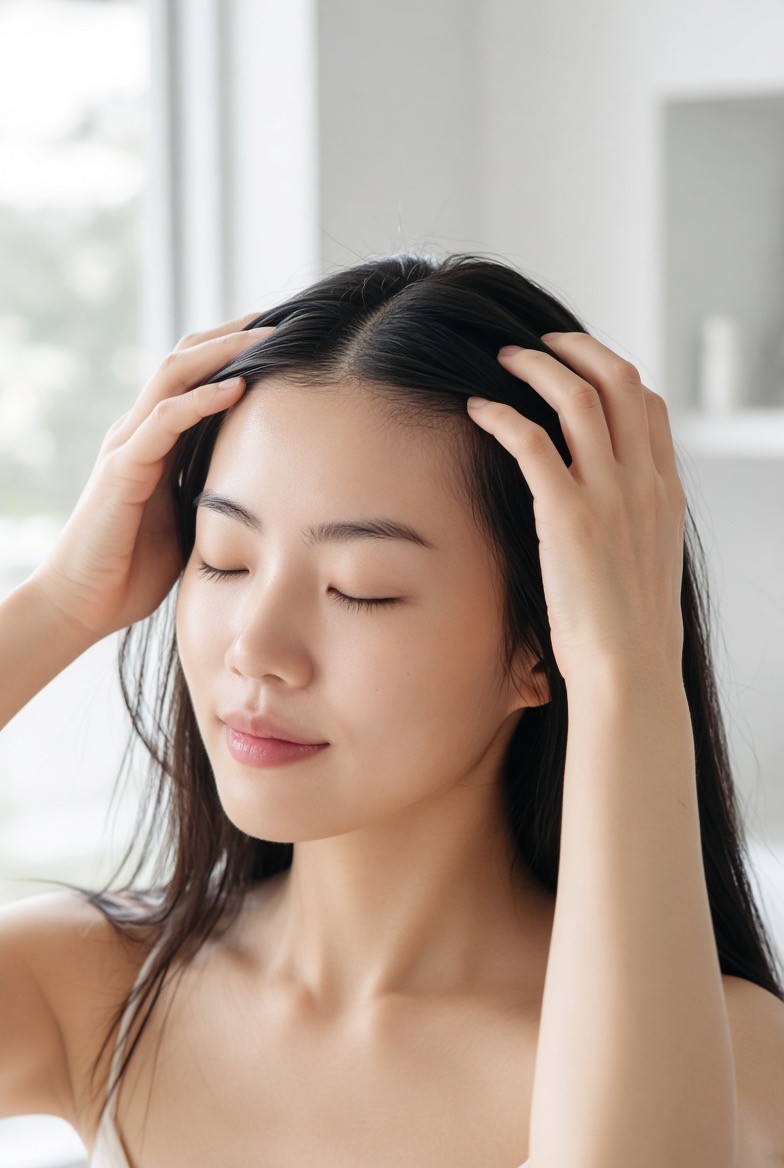
Scalp massage may feel relaxing, but evidence for meaningful hair regrowth is still limited. A small study involving nine healthy men found that four minutes of standardized daily scalp massage for 24 weeks increased hair thickness.
However, the researchers did not find a significant increase in hair growth rate, and the study was too small to establish massage as a treatment for androgenetic alopecia. Koyama et al., ePlasty, 2016.
Common Myths About Korean Scalp Care
Myth: A cleaner scalp automatically grows more hair
Good scalp hygiene can support comfort and healthy hair care, but it cannot reverse genetic, hormonal, autoimmune, or scarring causes of hair loss.
Myth: Tingling means a scalp serum is working
Cooling or tingling sensations do not prove follicle stimulation. Persistent burning, redness, or irritation is a reason to stop using a product.
Myth: Scalp serums replace hair-loss treatments
Most scalp serums are cosmetic products. Progressive thinning requires attention to the underlying cause rather than relying solely on a beauty routine.
Who Should Pay Attention?
Korean scalp care may suit people dealing with dryness, oiliness, mild buildup, or general scalp discomfort. It can also be useful for creating a consistent routine when styling products are used frequently.
But a widening part, receding hairline, bald patches, sudden shedding, intense itching, burning, tenderness, scaling, or inflammation can point to an underlying condition. American Academy of Dermatology Association: Hair Loss Signs and Symptoms lists several of these changes as signs that may warrant evaluation.
Finding the cause is especially important because different types of hair loss require different approaches. A dermatologist can examine the scalp and hair and may recommend additional testing when needed. American Academy of Dermatology Association: Hair Loss Diagnosis and Treatment.
Evidence Strength Summary
- General scalp care: Reasonable for hygiene and comfort, but not proven to regrow lost hair.
- Scalp serums: Benefits depend on ingredients; evidence for treating hair loss is limited.
- Scalp exfoliation: May help with buildup, but evidence for hair growth is lacking.
- Rosemary oil: Promising early human evidence, but larger trials are needed.
- Scalp massage: Limited evidence for increased hair thickness from one very small study.
Bottom Line
Korean scalp care is a sensible approach to maintaining the scalp, especially when dryness, oil, or buildup is the main concern. Gentle cleansing, appropriate hydration, and non-irritating products can make hair care more consistent.
But a sophisticated scalp routine cannot replace diagnosis or proven treatment for progressive hair loss. If your hair is steadily thinning, focus first on finding the cause rather than buying more scalp products.