Reviewed by the HyaluFlow Health Editorial Team | Published: September 2, 2026 | Last Updated: September 2, 2026
Quick Answer
Tart cherry juice may help some people sleep better, but it is not a proven treatment for insomnia. Small human studies have reported improvements in sleep duration, sleep efficiency, or insomnia symptoms, while a 2025 systematic review found the overall evidence limited and inconsistent.
Key Takeaways
- Tart cherries naturally contain melatonin and polyphenols such as anthocyanins.
- Small clinical trials have reported improvements in some sleep measures.
- Not every study has found the same sleep or melatonin benefits.
- There is no established dose or timing specifically for treating insomnia.
- Tart cherry juice can contribute sugar and calories to your diet.
Why Is Tart Cherry Juice Linked to Sleep?
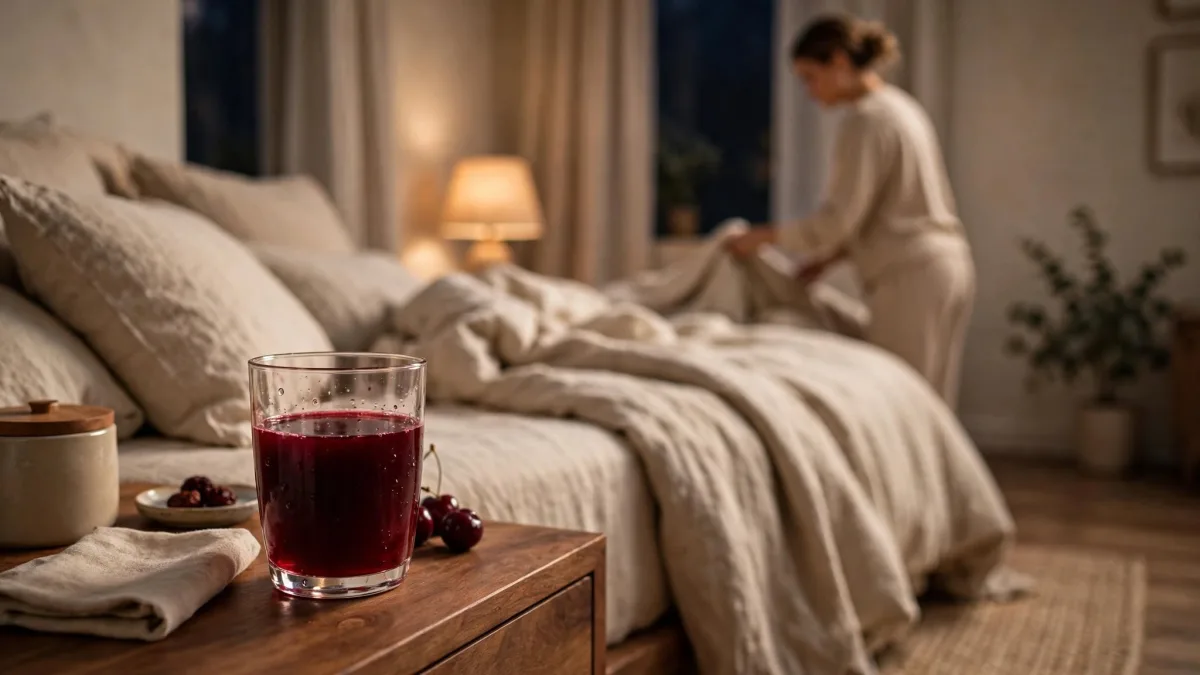
The interest in tart cherry juice for sleep comes partly from its naturally occurring melatonin. Tart cherries also contain anthocyanins and other plant compounds.
Melatonin helps regulate the sleep-wake cycle. But food-based melatonin is not the same as a standardized supplement, and amounts can vary between products.
In a randomized, double-blind crossover study of 20 healthy adults, tart cherry juice concentrate increased urinary melatonin and improved total sleep time and sleep efficiency. The intervention lasted seven days, so long-term effects remain unknown.
Howatson et al., European Journal of Nutrition
Does Tart Cherry Juice Actually Improve Sleep?
Some research suggests tart cherry juice may improve sleep, particularly in people with sleep difficulties. However, most studies are small, limiting how broadly the results can be applied.
A pilot trial involving 15 older adults with chronic insomnia found modest improvements in some sleep measures. Compared with placebo, the clearest benefit involved less time awake after sleep onset, while several other outcomes were not significantly different.
Another small study in adults over 50 with insomnia used polysomnography and found increased sleep time. Only eight participants completed the analysis, making the result preliminary.
Pigeon et al., Journal of Medicinal Food
Losso et al., American Journal of Therapeutics
What the Science Says
The overall evidence is encouraging but not strong enough to call tart cherry juice a reliable natural sleep aid. A 2025 systematic review identified seven interventional studies examining tart cherry consumption and sleep-related outcomes.
Three studies reported improvements in sleep duration, efficiency, or sleep onset, but results were not uniform. The review also found major differences in participant groups, doses, products, and intervention periods.
These differences matter. Results from a concentrated product cannot automatically be applied to every bottled juice. Larger, standardized trials are needed before firm recommendations can be made.
Barforoush et al., Food Science & Nutrition systematic review
Can Tart Cherry Juice Raise Melatonin?
Yes, tart cherries contain measurable melatonin, and the controlled study by Howatson and colleagues found increased urinary melatonin after participants consumed tart cherry juice concentrate.
However, this does not prove that melatonin is the only reason sleep may improve. Other compounds in tart cherries could also contribute.
Results are not always consistent. A randomized trial involving 19 elite female field hockey players found no significant group-by-time difference in melatonin levels, although some sleep variables changed between groups.
How Much Tart Cherry Juice for Sleep?
There is no universally established dose of tart cherry juice for insomnia. Clinical studies have used different amounts, concentrations, and schedules, so one study's serving cannot be treated as a standard medical recommendation.
If you try tart cherry juice, check the label. Concentrates may need dilution, and ready-to-drink products can vary in sugar and calories.
Common Myths About Tart Cherry Juice
Myth: Tart cherry juice works like a sleeping pill.
Current evidence does not support treating it as equivalent to sleep medication or established insomnia therapy.
Myth: More tart cherry juice means better sleep.
No clinical evidence shows that increasing the amount produces proportionally greater sleep benefits.
Myth: Tart cherry juice can cure chronic insomnia.
That claim goes beyond the evidence. Existing studies are generally small, short, and methodologically different.
Who Should Pay Attention?
Tart cherry juice may be one food-based option for healthy sleep. It should not replace proven approaches for persistent insomnia.
If difficulty falling asleep, staying asleep, or waking too early happens regularly and affects daytime functioning, speak with a healthcare professional. Food-based strategies should not delay appropriate care.
Evidence Strength Summary
Evidence strength: Low. Human studies provide a plausible signal that tart cherry consumption may improve certain sleep outcomes, but the trials are small and use different products, doses, populations, and study periods. The 2025 systematic review also described the evidence as limited and heterogeneous.
Bottom Line
Tart cherry juice may modestly support sleep for some people, and the idea is backed by legitimate human research. However, the current evidence is not strong enough to describe it as a proven natural treatment for insomnia.
If you try it, treat tart cherry juice as an optional part of a healthy sleep routine rather than a quick fix. Consistent sleep habits and appropriate treatment for ongoing insomnia remain more important than any single food or drink.