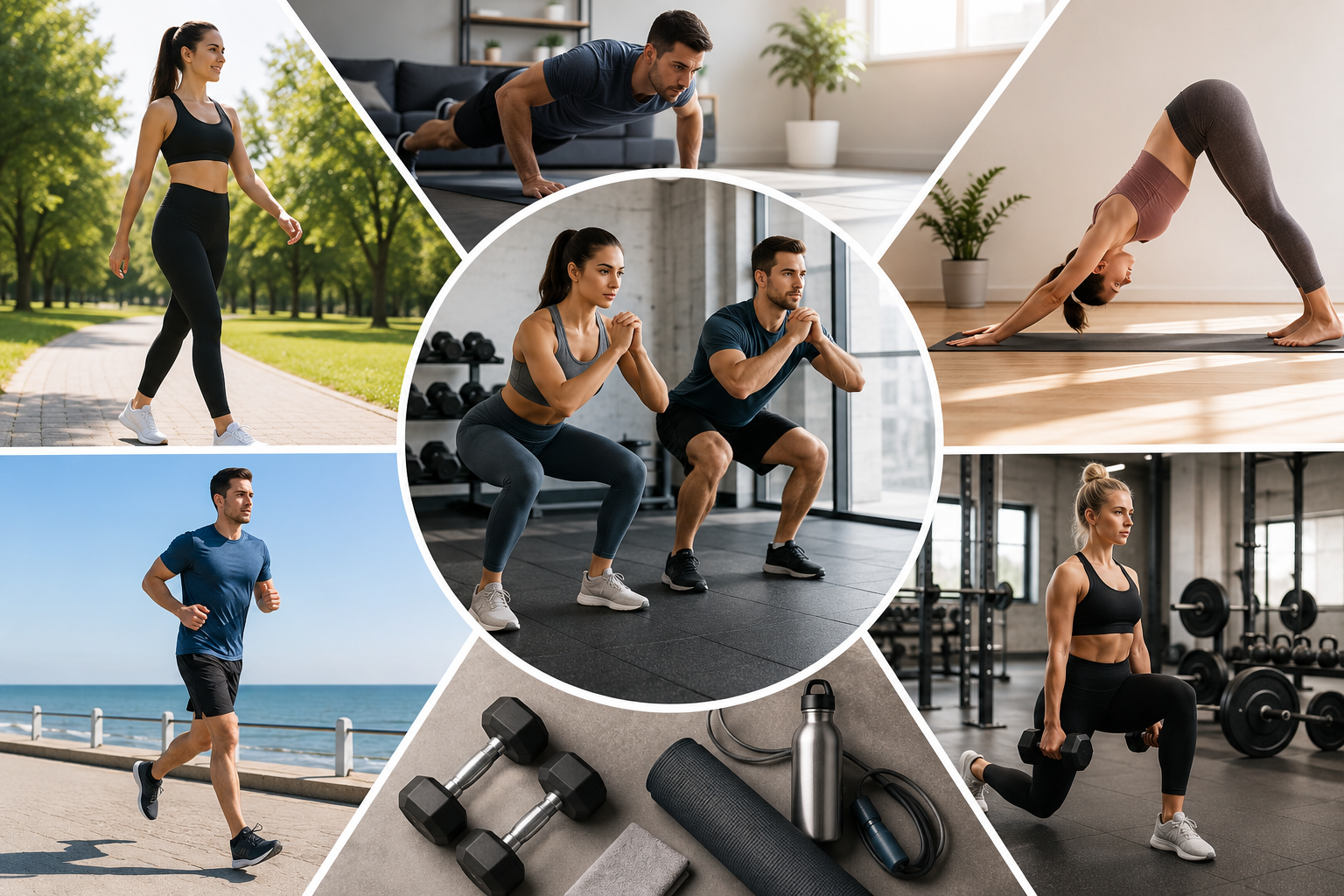
10 Best Workout Routines for Beginners (2026)
Quick Answer: The best workout routines for beginners combine full-body strength training, walking, cardio, mobility, and proper recovery. Health organizations recommend at least 150 minutes of moderate-intensity physical activity plus two strength-training sessions weekly to improve fitness, build muscle, and reduce the risk of chronic disease.[1][2]
Key Takeaways
- Beginners achieve the best results through consistency rather than high-intensity workouts.
- Full-body strength training performed two to three times per week is highly effective for building muscle and improving overall fitness.
- Walking remains one of the safest and most evidence-based exercises for improving cardiovascular health.
- Proper recovery, nutrition, hydration, and sleep are just as important as training.
- Updated for 2026, this guide follows recommendations from leading health and sports medicine organizations.
Think you need expensive gym equipment or two-hour workouts to get fit? Think again. One of the biggest mistakes beginners make is believing that more exercise always leads to better results. In reality, simple, consistent workouts often produce the greatest long-term improvements.
Starting a fitness journey can feel overwhelming when social media is filled with advanced training programs and unrealistic body transformations. Fortunately, exercise science tells a different story. Building strength and improving fitness begins with mastering basic movement patterns, progressing gradually, and allowing your body enough time to recover.
Updated for 2026, this comprehensive HyaluFlow guide explains the best beginner workout routines supported by current scientific evidence. Whether your goal is weight management, muscle building, better heart health, increased energy, or improved overall wellness, these routines provide a safe and effective starting point.
Why Exercise Matters
Regular physical activity affects nearly every organ system in the body. According to the World Health Organization (WHO) and the American College of Sports Medicine (ACSM), consistent exercise helps:
- Improve cardiovascular health.
- Increase muscle strength and endurance.
- Maintain healthy body weight.
- Improve insulin sensitivity.
- Reduce the risk of type 2 diabetes.
- Strengthen bones and joints.
- Enhance mental health and reduce symptoms of anxiety and depression.
- Support healthier aging and longer life expectancy.
Adults who remain physically active have significantly lower risks of heart disease, stroke, several cancers, and premature death compared with sedentary individuals.[1][2][3]
How Beginners Should Start Exercising
One of the most common reasons people quit exercising is doing too much too soon. Muscles, tendons, joints, and the cardiovascular system all need time to adapt to increased physical activity.
Sports medicine experts recommend following the principle of "start low and progress slowly." Instead of training every day at maximum intensity, begin with manageable sessions that allow proper recovery.
A beginner program should include:
- Strength training 2–3 times weekly.
- Moderate cardio on most days.
- Mobility or flexibility exercises.
- At least one complete recovery day each week.
The best workout plan is not the hardest one—it's the one you can consistently follow for months and years.[2][4]
Comparison of Beginner Workout Types
| Workout Type | Best For | Equipment | Difficulty |
|---|---|---|---|
| Full-Body Strength | Building muscle and strength | Optional | Beginner |
| Walking | Heart health and weight management | None | Very Easy |
| Bodyweight Training | Home workouts | None | Easy |
| Cardio Training | Endurance and calorie burning | Optional | Easy |
| Yoga | Mobility and flexibility | Yoga mat | Easy |
1. Full-Body Strength Training
Full-body strength training remains one of the most effective beginner workout routines because it trains all major muscle groups during each session. Rather than isolating individual muscles, compound movements improve coordination, balance, functional strength, and overall fitness.
Research consistently shows that beginners respond exceptionally well to full-body resistance training performed two to three times per week.[4][5]
Recommended Exercises
- Bodyweight or Goblet Squats
- Push-ups (wall, knee, or standard)
- Walking Lunges
- Bent-Over Dumbbell Rows
- Planks
Suggested routine: Perform 2–3 sets of 8–12 repetitions for each exercise while maintaining proper form. Rest 60–90 seconds between sets.
2. Walking Routine
Walking is one of the safest, simplest, and most evidence-based exercises for beginners. It requires no special equipment, places minimal stress on the joints, and can significantly improve cardiovascular health, endurance, and overall longevity.
Large-scale research involving thousands of adults has shown that increasing daily walking volume is associated with lower risks of cardiovascular disease, diabetes, and all-cause mortality.[6][7]
Beginner Walking Plan
- Week 1: 20 minutes, 5 days per week.
- Week 2: Increase to 25–30 minutes.
- Week 3–4: Aim for 30–45 minutes while increasing pace gradually.
- Add hills or intervals once basic endurance improves.
Walking also serves as an excellent recovery workout between strength-training sessions, helping improve circulation without placing excessive stress on muscles and joints.
3. Bodyweight Workout
Bodyweight training is one of the best ways for beginners to build strength before progressing to heavier resistance. It improves muscular endurance, coordination, balance, and movement quality while minimizing equipment costs. Research from the American College of Sports Medicine (ACSM) supports bodyweight exercises as an effective starting point for improving overall fitness and functional strength.[2][5]
Another advantage is convenience. You can perform these exercises at home, while traveling, or outdoors without needing a gym membership.
Recommended Exercises
- Bodyweight Squats
- Incline or Knee Push-ups
- Glute Bridges
- Mountain Climbers
- Front Planks
Beginner routine: Complete 2–3 rounds of the exercises above. Perform each movement for 10–15 repetitions, or hold planks for 20–30 seconds. Rest for 60–90 seconds between rounds.
Bodyweight exercises teach proper movement mechanics, creating a strong foundation before progressing to heavier resistance training.[5]
4. Cardio Training
Cardiovascular exercise strengthens the heart, lungs, and blood vessels while improving endurance and supporting healthy weight management. According to the World Health Organization, adults should accumulate at least 150–300 minutes of moderate-intensity aerobic activity each week for substantial health benefits.[1]
Cardio also helps improve blood pressure, cholesterol levels, insulin sensitivity, mood, and cognitive function. Beginners should choose enjoyable activities to improve long-term consistency.
Best Cardio Options
- Brisk Walking
- Cycling
- Swimming
- Light Jogging
- Elliptical Trainer
Recommended plan: Perform 20–40 minutes of moderate-intensity cardio three to five days per week. You should be breathing harder than usual but still able to hold a conversation.
5. Circuit Training
Circuit training combines resistance exercises with short rest periods, allowing beginners to improve muscular strength and cardiovascular fitness simultaneously. Because multiple muscle groups work continuously, circuit workouts are efficient and time-saving.
Research suggests circuit-based training can improve body composition, aerobic capacity, muscular endurance, and overall physical fitness while keeping workouts engaging.[8]
Sample Beginner Circuit
- 15 Jumping Jacks
- 12 Bodyweight Squats
- 10 Push-ups (modified if necessary)
- 30-Second Plank
- 20 High Knees
Complete the circuit 2–4 times depending on your fitness level. Rest for 90 seconds between rounds.
6. Dumbbell Workout
Light dumbbells allow beginners to increase resistance gradually while improving muscular strength, coordination, and bone health. Free weights also recruit stabilizing muscles, making everyday movements easier and reducing injury risk when performed correctly.[2][5]
Choose a weight that allows you to complete each repetition with proper technique while still feeling challenged during the final few repetitions.
Recommended Beginner Dumbbell Exercises
- Dumbbell Goblet Squats
- Dumbbell Shoulder Press
- Dumbbell Chest Press
- Single-Arm Dumbbell Rows
- Dumbbell Biceps Curls
Training recommendation: Perform 2–3 sets of 8–12 repetitions for each exercise, resting approximately 60–90 seconds between sets.
Progress gradually by increasing weight only after you can comfortably complete all prescribed repetitions with excellent form. Small, consistent increases produce safer and more sustainable long-term strength gains than attempting large jumps in resistance.[4][5]
7. Core Strength Routine
A strong core is about much more than visible abdominal muscles. Your core includes the abdominal muscles, lower back, hips, pelvis, and deep stabilizing muscles that support nearly every movement you perform. Strengthening these muscles improves posture, balance, lifting technique, athletic performance, and may help reduce the risk of lower back discomfort.[2][9]
For beginners, core exercises should focus on stability and control rather than high repetitions. Mastering proper technique helps build a solid foundation before progressing to more advanced movements.
Recommended Core Exercises
- Front Plank
- Bird Dog
- Dead Bug
- Side Plank
- Glute Bridge
Suggested routine: Perform each exercise for 20–40 seconds or 10–12 controlled repetitions. Complete two to three rounds while maintaining slow, controlled movements.
Core stability improves movement efficiency and helps transfer force between the upper and lower body during everyday activities and resistance training.[9]
8. Beginner Yoga
Yoga offers an excellent complement to strength and cardiovascular training by improving flexibility, mobility, balance, breathing, and mental well-being. Studies show that regular yoga practice may reduce stress, improve sleep quality, increase joint mobility, and enhance overall quality of life.[10]
Many beginners mistakenly believe they need to be flexible before starting yoga. In reality, flexibility develops through consistent practice over time.
Beginner-Friendly Yoga Poses
- Mountain Pose
- Child's Pose
- Cat-Cow Stretch
- Downward-Facing Dog
- Warrior I
Recommended routine: Practice yoga for 20–30 minutes two to three times per week. Focus on slow breathing, proper posture, and controlled movements instead of stretching to your maximum range.
9. HIIT for Beginners
High-Intensity Interval Training (HIIT) alternates short bursts of exercise with recovery periods. Research suggests HIIT can improve cardiovascular fitness, insulin sensitivity, and aerobic capacity while requiring less total exercise time than traditional steady-state cardio.[11]
However, beginners should approach HIIT cautiously. Building a base level of fitness first helps reduce injury risk and allows better exercise technique during higher-intensity intervals.
Simple Beginner HIIT Session
- 30 seconds Jumping Jacks
- 30 seconds Rest
- 30 seconds Bodyweight Squats
- 30 seconds Rest
- 30 seconds Marching or High Knees
- 30 seconds Rest
Repeat the circuit for 10–15 minutes. As your fitness improves, gradually increase the work period or reduce the recovery time rather than making large changes all at once.
10. Weekly Beginner Workout Plan
Following a structured weekly routine helps beginners develop consistency while allowing adequate recovery between workouts. Recovery is essential because muscles become stronger during rest—not during exercise itself.[2][5]
| Day | Workout | Duration |
|---|---|---|
| Monday | Full-Body Strength Training | 45 Minutes |
| Tuesday | Brisk Walking | 30 Minutes |
| Wednesday | Core Strength Routine | 30 Minutes |
| Thursday | Yoga and Mobility | 30 Minutes |
| Friday | Full-Body Strength Training | 45 Minutes |
| Saturday | Moderate Cardio or Beginner HIIT | 30 Minutes |
| Sunday | Rest, Walking, or Gentle Stretching | 20–30 Minutes |
This balanced schedule develops strength, endurance, mobility, and recovery while reducing the likelihood of overtraining. Most beginners can safely follow this routine for 8–12 weeks before progressing to more advanced programs.[2][5]
Fitness Tips for Beginners
Success in fitness depends more on consistency than perfection. Scientific research shows that small, sustainable lifestyle changes produce better long-term results than extreme workout plans that are difficult to maintain.[1][2]
1. Start Slowly
Avoid increasing workout duration or intensity too quickly. Gradually adding volume allows your muscles, joints, tendons, and cardiovascular system to adapt safely while reducing the risk of injury.
2. Prioritize Proper Form
Good exercise technique is more important than lifting heavier weights. Learning correct movement patterns improves muscle activation and decreases the likelihood of strains or overuse injuries.
3. Warm Up Before Every Workout
Spend 5–10 minutes performing light cardio and dynamic mobility exercises before training. A proper warm-up increases blood flow, prepares muscles for exercise, and improves movement quality.
4. Cool Down After Exercise
Finish each workout with light walking and gentle stretching for 5–10 minutes. Cooling down gradually lowers heart rate and may help reduce muscle stiffness after exercise.
5. Stay Hydrated
Water plays an essential role in regulating body temperature, transporting nutrients, and supporting physical performance. Drink fluids throughout the day and replace additional losses during prolonged or intense exercise.
6. Eat Enough Protein
Protein supports muscle repair and growth after exercise. Most physically active adults benefit from spreading adequate protein intake throughout the day while also consuming balanced meals that include healthy carbohydrates and fats.[12]
7. Get Quality Sleep
Recovery occurs primarily during sleep. Adults should aim for 7–9 hours of quality sleep each night to support muscle recovery, hormone regulation, cognitive performance, and immune function.[13]
8. Track Your Progress
Rather than focusing only on body weight, monitor improvements in strength, endurance, energy levels, workout consistency, and how your clothes fit. These indicators often reflect meaningful progress before major physical changes become visible.
Common Beginner Workout Mistakes
- Doing too much exercise during the first few weeks.
- Skipping warm-ups and cool-downs.
- Using poor lifting technique.
- Ignoring recovery days.
- Comparing your progress with experienced athletes.
- Changing workout programs too frequently.
- Expecting visible results within a few days.
Avoiding these mistakes improves long-term adherence and significantly lowers injury risk while helping beginners build confidence with each workout.
What the Science Says
Current evidence consistently supports combining resistance training, aerobic exercise, flexibility work, and adequate recovery to improve overall health. Position statements from the American College of Sports Medicine (ACSM), the World Health Organization (WHO), and the U.S. Physical Activity Guidelines recommend adults perform at least 150–300 minutes of moderate aerobic activity weekly along with muscle-strengthening exercises on two or more days each week.[1][2][3]
Research also demonstrates that beginners experience the greatest improvements during the first several months of consistent training because the body adapts rapidly to new physical demands. These improvements include increased muscular strength, better cardiovascular fitness, improved insulin sensitivity, enhanced mental health, and reduced risk of chronic disease.[4][5]
Who Should Speak With a Healthcare Professional First?
Exercise is safe for most healthy adults. However, medical clearance is recommended before beginning a new fitness program if you have:
- Known heart disease or chest pain during physical activity.
- Uncontrolled high blood pressure.
- Recent surgery or serious injury.
- Severe joint or mobility limitations.
- Diabetes requiring medication adjustments.
- Chronic kidney, lung, or neurological disease.
- Pregnancy with medical complications.
A healthcare professional or qualified exercise specialist can recommend appropriate modifications based on your individual health status and fitness goals.
Evidence Strength
- High: Regular resistance training improves muscular strength, bone health, body composition, and functional fitness.[1][2][4][5]
- High: At least 150–300 minutes of moderate aerobic activity weekly lowers the risk of cardiovascular disease, type 2 diabetes, several cancers, and premature death.[1][3]
- High: Combining strength training with aerobic exercise provides greater overall health benefits than either type of exercise alone.[2][3]
- Moderate: Yoga and mobility training improve flexibility, balance, mental well-being, and quality of life.[10]
- Moderate: HIIT can improve cardiovascular fitness efficiently, but beginners should first establish a foundation of basic fitness.[11]
Bottom Line
Building strength and improving fitness does not require complicated programs or expensive equipment. Beginners achieve the best long-term results by combining full-body resistance training, regular walking or cardio, mobility work, proper recovery, and healthy nutrition.
The most effective workout routine is the one you can perform consistently every week. Start with manageable sessions, focus on proper technique, gradually increase difficulty, and allow your body enough time to recover. Over weeks and months, these small, sustainable habits can produce significant improvements in strength, endurance, body composition, energy levels, and overall health.
References
- World Health Organization. WHO Guidelines on Physical Activity and Sedentary Behaviour. Geneva: WHO; 2020.
- American College of Sports Medicine. ACSM's Guidelines for Exercise Testing and Prescription. 11th Edition. Wolters Kluwer; 2021.
- U.S. Department of Health and Human Services. Physical Activity Guidelines for Americans. 2nd Edition.
- American College of Sports Medicine Position Stand. Progression Models in Resistance Training for Healthy Adults. Medicine & Science in Sports & Exercise.
- Schoenfeld BJ, Grgic J, Ogborn D, Krieger JW. Strength and Hypertrophy Adaptations Between Low- vs High-Load Resistance Training: A Systematic Review and Meta-analysis. Journal of Strength and Conditioning Research.
- Paluch AE, et al. Daily Steps and All-Cause Mortality: A Meta-analysis. The Lancet Public Health.
- Saint-Maurice PF, et al. Association of Daily Step Count and Step Intensity With Mortality. JAMA.
- Myers J, et al. Exercise and Cardiovascular Health. Circulation.
- Akuthota V, Nadler SF. Core Strengthening. Archives of Physical Medicine and Rehabilitation.
- Cramer H, et al. Yoga for Improving Health-Related Quality of Life, Mental Health and Physical Function. BMC Complementary Medicine and Therapies.
- Weston KS, Wisløff U, Coombes JS. High-Intensity Interval Training in Patients With Lifestyle-Induced Cardiometabolic Disease. British Journal of Sports Medicine.
- Morton RW, et al. A Systematic Review, Meta-analysis and Meta-regression of Protein Supplementation on Resistance Training-Induced Gains in Muscle Mass and Strength. British Journal of Sports Medicine.
- Watson NF, et al. Recommended Amount of Sleep for a Healthy Adult. Sleep.