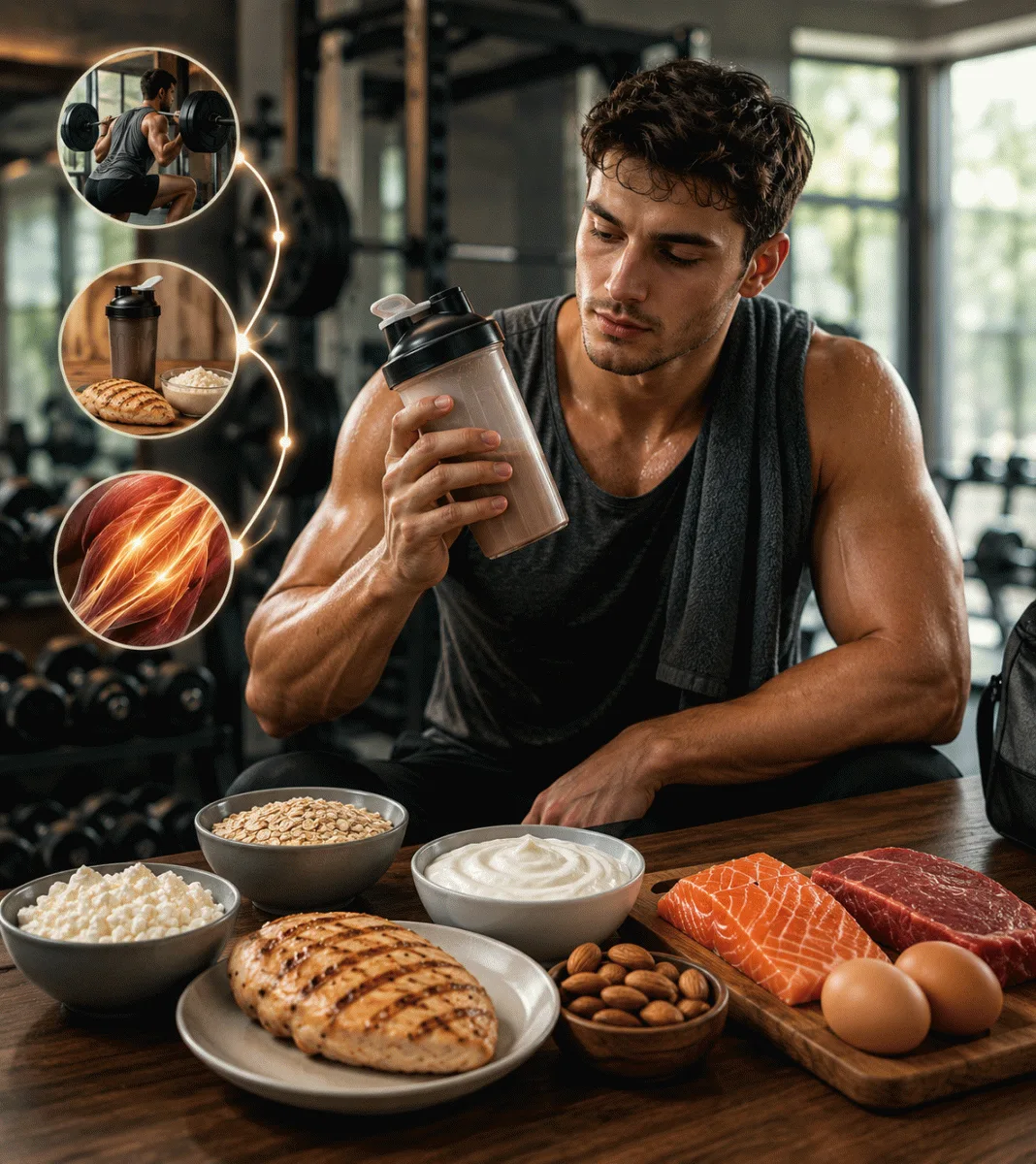
Quick Answer: Total daily protein intake has a greater impact on muscle growth than consuming protein immediately after exercise. Current evidence suggests the anabolic window lasts several hours, making consistent daily protein intake and balanced meal distribution more important than a strict 30-minute post-workout rule.[1–5]
Key Takeaways
- Total daily protein intake is the strongest nutritional predictor of muscle growth.
- The anabolic window is wider than previously believed, typically lasting two to four hours after resistance exercise.
- Consuming approximately 20–40 g of high-quality protein every 3–4 hours helps maximize muscle protein synthesis.
- Pre-sleep protein may improve overnight muscle recovery in active individuals.
- Consistency in training, nutrition, sleep, and recovery matters more than perfect meal timing.
Introduction
For years, gym-goers have been told that drinking a protein shake within 30 minutes after a workout is essential for building muscle. This belief, commonly known as the anabolic window, has become one of the most widely repeated recommendations in sports nutrition.
Recent scientific evidence, however, paints a more balanced picture. While protein remains essential for repairing and building muscle tissue, research suggests that the exact minute you consume it is far less important than your overall daily protein intake and eating pattern.[1][2]
Instead of rushing to the locker room with a shaker bottle, most people will achieve better long-term results by meeting their daily protein needs, distributing protein evenly across meals, and maintaining a consistent resistance-training program.
Why Protein Timing Matters
Resistance training creates microscopic damage to muscle fibers. During recovery, the body repairs this damage through a process called muscle protein synthesis (MPS), allowing muscles to become stronger and larger over time.
Dietary protein supplies the essential amino acids needed for this repair process. Among them, leucine acts as a key trigger for activating MPS through the mTOR signaling pathway, making high-quality protein especially valuable after exercise.[3]
The real question is not whether protein supports muscle growth—it clearly does. Instead, researchers have asked whether consuming protein immediately after training produces significantly greater gains than consuming the same amount a few hours later.
Evidence-based insight: Modern research indicates that total protein intake consistently has a greater influence on muscle growth than consuming protein within an arbitrary 30-minute post-workout window.[1][2][4]
What Is the Anabolic Window?
The anabolic window refers to the period after resistance exercise when muscles are believed to be especially responsive to amino acids. During this time, muscle protein synthesis increases, creating an environment that supports recovery and muscle growth.
The traditional belief that this window closes within 30 to 60 minutes originated from early studies involving specific populations, particularly older adults exercising in a fasted state. While these findings contributed valuable insights, they were later generalized beyond the conditions under which they were originally studied.[5]
More recent systematic reviews demonstrate that amino acids from a meal consumed before exercise remain available in the bloodstream during and after training. As a result, the opportunity to stimulate muscle protein synthesis extends well beyond the immediate post-workout period for most healthy individuals.[1][2]
Why the 30-Minute Rule Became Popular
The fitness industry quickly embraced the idea of a narrow anabolic window because it was simple to understand and easy to market. Protein shakes became synonymous with post-workout recovery, and athletes were encouraged to consume them immediately after every training session.
Although post-workout protein remains beneficial, today's evidence suggests that missing a shake by an hour or two does not significantly reduce muscle-building potential when total daily protein intake is already sufficient.[1][4]
What the Research Actually Shows
Over the past decade, researchers have revisited the anabolic window using larger studies and systematic reviews. The strongest evidence shows that while consuming protein after exercise supports recovery, there is little proof that doing so within exactly 30 minutes produces superior muscle growth compared with eating protein within the next several hours.[1][2]
One of the most influential reviews, published in the Journal of the International Society of Sports Nutrition, evaluated dozens of clinical studies on nutrient timing. Researchers concluded that the importance of immediate post-workout protein had been overstated. For individuals who consumed a protein-rich meal before training, amino acids remained available in the bloodstream long after exercise ended, extending the opportunity for muscle protein synthesis.[1]
Similarly, meta-analyses comparing different protein timing strategies have found that once total daily protein intake is matched, the timing of protein consumption has little additional effect on long-term increases in muscle mass or strength for most healthy adults.[2][3]
What the evidence says: The anabolic window is not a 30-minute deadline. For most people, it extends approximately two to four hours before and after resistance exercise, especially when regular meals are consumed.[1][2]
Total Daily Protein Matters Most
The most consistent finding in sports nutrition research is that total daily protein intake has a much greater influence on muscle growth than precise meal timing. Regardless of whether protein is consumed immediately after training or slightly later, people who consistently meet their daily protein requirements achieve similar improvements in muscle hypertrophy and strength.[2][4]
Current evidence suggests that adults performing regular resistance training benefit from consuming approximately 1.6 to 2.2 g of protein per kilogram of body weight each day. Intakes within this range maximize muscle protein synthesis for most healthy individuals while supporting recovery from training.[3][4]
For example:
| Body Weight | Recommended Daily Protein |
|---|---|
| 60 kg | 96–132 g |
| 70 kg | 112–154 g |
| 80 kg | 128–176 g |
| 90 kg | 144–198 g |
If your total daily protein intake falls below these recommendations, perfect meal timing cannot fully compensate for the deficit. Meeting your daily target should always be the first nutritional priority.[2][4]
Does Protein Quality Matter?
Not all protein sources stimulate muscle protein synthesis equally. High-quality proteins contain all nine essential amino acids and provide adequate amounts of leucine, the amino acid that plays a major role in activating the mTOR pathway responsible for initiating muscle protein synthesis.[5]
Excellent protein sources include:
- Whey protein
- Greek yogurt
- Eggs
- Lean poultry
- Fish
- Lean beef
- Milk and cottage cheese
- Soy foods such as tofu and tempeh
Plant-based athletes can also maximize muscle growth by consuming a variety of protein-rich foods throughout the day or choosing fortified plant protein powders that provide sufficient leucine and essential amino acids.[4][5]
Does Protein Distribution Throughout the Day Matter?
While total daily protein intake is the primary driver of muscle growth, research suggests that how you distribute protein across the day can further optimize muscle protein synthesis (MPS). Instead of consuming most of your protein at dinner, spreading it evenly across multiple meals appears to stimulate muscle-building signals more consistently.[2][3]
A landmark study published in The Journal of Physiology by Areta and colleagues compared different protein-feeding patterns after resistance exercise. Participants consumed the same total amount of protein but in different meal distributions. Moderate servings of protein every three to four hours produced a greater cumulative MPS response than consuming the same protein in either very large or very small doses.[3]
For most active adults, aiming for 20–40 g of high-quality protein per meal, depending on body size and total daily requirements, is a practical strategy for supporting muscle recovery and growth.
Pre-Workout or Post-Workout: Which Is Better?
Many people worry about choosing between a pre-workout meal and a post-workout shake. Fortunately, current evidence suggests that both approaches can be effective.
If you eat a balanced meal containing protein one to three hours before training, amino acids remain available during and after your workout. In this situation, rushing to consume another protein shake immediately afterward is unlikely to provide significant additional benefit.[1][2]
However, if you train early in the morning or after a long fast, eating protein soon after exercise becomes more important because circulating amino acid levels are lower. This helps support muscle protein synthesis during recovery.
| Training Situation | Recommended Strategy |
|---|---|
| Protein-rich meal before training | Eat your next protein-containing meal within the next few hours. |
| Fasted morning workout | Consume 20–40 g of high-quality protein soon after training. |
| Multiple training sessions per day | Prioritize protein intake after each session and distribute protein evenly throughout the day. |
| General recreational training | Focus on meeting total daily protein needs rather than exact timing. |
Can Pre-Sleep Protein Improve Recovery?
During sleep, the body goes several hours without food, reducing the supply of circulating amino acids. Researchers have investigated whether consuming protein before bed can help maintain muscle protein synthesis overnight.
Studies led by Trommelen and colleagues found that consuming approximately 30–40 g of casein protein before sleep increases overnight muscle protein synthesis and supports recovery following evening resistance exercise.[4]
This strategy appears particularly useful for athletes, people with high training volumes, and those who finish their last meal several hours before bedtime. While the benefits are modest, they may contribute to long-term muscle development when combined with adequate daily protein intake.
A Practical Protein Timing Strategy
You do not need to organize your entire day around a stopwatch. Instead, follow a simple evidence-based routine that prioritizes consistency over perfection.
- Meet your daily protein target based on your body weight and training goals.
- Spread protein across three to four meals throughout the day.
- Aim for approximately 20–40 g of high-quality protein per meal.
- Eat a protein-containing meal within about two hours before or after resistance training.
- If you train fasted, prioritize protein intake after your workout.
- Consider a slow-digesting protein source before bed if there is a long overnight fasting period.
- Stay consistent with resistance training, sleep, hydration, and overall calorie intake.
Practical takeaway: Building muscle depends far more on consistently meeting your daily protein requirements than on drinking a protein shake within exactly 30 minutes after lifting weights.[1–5]
Benefits of Smart Protein Timing
Although protein timing is not the primary factor driving muscle growth, using a sensible meal schedule can help maximize recovery and make it easier to meet your daily protein goals.
- Supports muscle protein synthesis throughout the day.
- Improves recovery following resistance training.
- Helps preserve lean muscle during calorie restriction.
- Reduces long periods without dietary amino acids.
- Makes daily protein intake easier to achieve consistently.
- May improve overnight muscle recovery when protein is consumed before sleep.
These benefits become increasingly valuable for athletes, older adults, and individuals training several times per day, where recovery demands are higher.[1–5]
Risks and Limitations
Protein timing research continues to evolve, and several limitations should be considered when interpreting current evidence.
- Many studies last only a few weeks or months rather than several years.
- Participants are often healthy young adults, making it difficult to generalize findings to every population.
- Training programs, calorie intake, sleep quality, and exercise intensity differ between studies.
- Muscle protein synthesis measured in laboratory settings does not always translate directly into greater long-term muscle growth.
In addition, protein timing cannot compensate for poor training, insufficient calories, inadequate sleep, or inconsistent exercise habits. These factors continue to have a much greater influence on body composition than precise meal timing.[2][3]
Who Should Pay Attention?
While most healthy adults do not need to obsess over the anabolic window, certain groups may benefit from paying closer attention to protein timing.
- Older adults: Age-related anabolic resistance may reduce the muscle-building response to protein, making evenly distributed, protein-rich meals particularly important.
- People who train fasted: Consuming protein soon after exercise helps provide amino acids when none were available before training.
- Athletes with multiple daily workouts: More frequent protein intake can support repeated recovery between training sessions.
- Individuals recovering from injury: Adequate protein intake supports tissue repair and helps minimize muscle loss during periods of reduced activity.
- People with chronic kidney disease: High-protein diets may not be appropriate. Protein targets should always be discussed with a qualified healthcare professional.[4][5]
What the Science Says
Modern sports nutrition research has shifted the focus away from a strict post-workout deadline. Multiple systematic reviews and randomized controlled trials consistently demonstrate that meeting total daily protein requirements is the strongest nutritional predictor of muscle growth. Protein timing can provide additional benefits, but its effect is relatively small once daily intake is adequate.[1][2]
Researchers also agree that evenly distributing protein across several meals helps maintain repeated stimulation of muscle protein synthesis throughout the day. Combined with progressive resistance training, sufficient sleep, and adequate calorie intake, this strategy offers a practical and sustainable approach to supporting muscle growth.[2][3][4]
Evidence Strength Summary
| Claim | Evidence |
|---|---|
| Total daily protein is the strongest predictor of muscle growth. | Strong - Supported by systematic reviews and meta-analyses. |
| The anabolic window lasts longer than 30 minutes. | Strong - Consistently supported by modern sports nutrition research. |
| Even protein distribution improves muscle protein synthesis. | Moderate to Strong - Supported by randomized controlled trials. |
| Pre-sleep protein improves overnight recovery. | Moderate - Supported by several controlled clinical studies. |
| Precise protein timing is more important than total daily intake. | Weak - Current evidence does not support this claim. |
Bottom Line
The idea that you must consume protein within 30 minutes after every workout is no longer supported by the strongest available evidence. For most healthy adults, building muscle depends far more on consuming enough high-quality protein throughout the day than on perfect post-workout timing.
A practical strategy is to consume approximately 20–40 g of protein across three to four meals, meet your daily protein target, and include a protein-rich meal within a few hours of resistance training. Combined with progressive exercise, adequate sleep, and consistent recovery, these habits provide the best foundation for long-term muscle growth.[1–5]
References
- Aragon AA, Schoenfeld BJ. Nutrient Timing Revisited: Is There a Post-Exercise Anabolic Window? Journal of the International Society of Sports Nutrition.
- Morton RW, Murphy KT, McKellar SR, et al. A Systematic Review, Meta-analysis and Meta-regression of Protein Supplementation on Resistance Training-Induced Gains in Muscle Mass and Strength. British Journal of Sports Medicine.
- Areta JL, Burke LM, Ross ML, et al. Timing and Distribution of Protein Ingestion During Prolonged Recovery From Resistance Exercise Alters Myofibrillar Protein Synthesis. The Journal of Physiology. 2013.
- Trommelen J, van Loon LJC. Pre-Sleep Protein Ingestion to Improve the Skeletal Muscle Adaptive Response to Exercise Training. Nutrients.
- International Society of Sports Nutrition Position Stand: Protein and Exercise. Journal of the International Society of Sports Nutrition.