Medically reviewed by the HyaluFlow Health Editorial Team | Published: August 8, 2026 | Last Updated: August 8, 2026
Key Takeaways
- Bemotrizinol is a broad-spectrum organic UV filter.
- It absorbs portions of both UVA and UVB radiation.
- FDA added it to the U.S. OTC sunscreen monograph in 2026.
- The monograph permits concentrations up to 6% under specified conditions.
- Bemotrizinol is highly photostable.
- It helps protect against UV exposure but does not erase wrinkles.
- It does not make mineral or older sunscreen filters obsolete.
What Is Bemotrizinol?
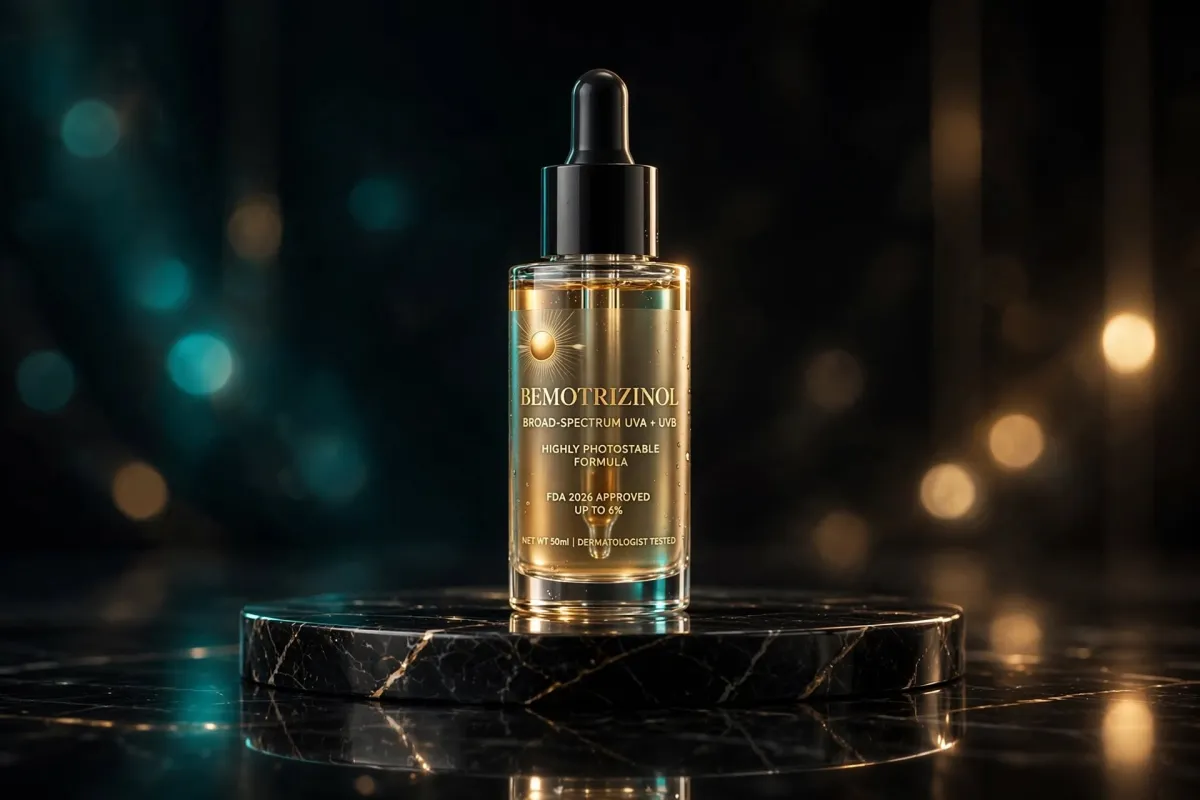
Bemotrizinol, also known as BEMT, is an organic sunscreen filter that absorbs ultraviolet radiation. It has been used internationally in sunscreen products for years.
Its absorption profile covers important portions of both UVA and UVB wavelengths, making it useful for broad-spectrum sunscreen formulations. FDA Scientific Assessment of Bemotrizinol
Why Is Bemotrizinol Important in the U.S.?
The major development is regulatory rather than the discovery of a new molecule. In June 2026, FDA added bemotrizinol to the U.S. OTC sunscreen monograph.
The final administrative order permits concentrations up to 6% under specified conditions. The change gives U.S. manufacturers another modern UV-filter option. FDA Final Administrative Order OTC000039
Bemotrizinol is not a new anti-aging treatment. Its importance is that U.S. sunscreen formulators now have another broad-spectrum UV filter to work with.
How Does Bemotrizinol Protect Skin?
Bemotrizinol protects skin by absorbing ultraviolet radiation before it can interact with skin tissue. Its broad absorption range includes portions of UVA and UVB radiation.
It is also highly photostable, meaning it remains relatively stable when exposed to sunlight. This is useful because sunscreen filters need to maintain their protective properties during UV exposure. FDA Scientific Review
Can Bemotrizinol Prevent Skin Aging?
Bemotrizinol should not be described as an anti-wrinkle treatment. It does not directly rebuild collagen or remove established wrinkles.
Its potential anti-aging benefit is preventive. Repeated UV exposure contributes to photoaging, including changes in collagen, pigmentation, and skin texture, so reducing UV exposure can help limit additional sun-related damage.
FDA states that sunscreen can help protect against sunburn, skin cancer, and premature skin aging caused by the sun. FDA: Sunscreen and Sun Protection
Is Bemotrizinol Safe?
FDA reviewed safety and effectiveness information before adding bemotrizinol to the OTC sunscreen monograph.
A maximum-use pharmacokinetic study of a 6% bemotrizinol formulation found low systemic exposure, with plasma concentrations generally remaining below the FDA threshold that triggers additional systemic safety studies. Regulatory Toxicology and Pharmacology: Clinical Pharmacokinetic Evaluation of Bemotrizinol
These findings support the regulatory assessment, but no sunscreen ingredient should be described as completely risk-free.
Bemotrizinol vs Mineral Sunscreens
| Feature | Bemotrizinol | Zinc Oxide | Titanium Dioxide |
|---|---|---|---|
| Filter type | Organic | Mineral | Mineral |
| UVA protection | Yes | Yes | More limited |
| UVB protection | Yes | Yes | Yes |
| Photostability | High | High | High |
There is no universal winner. Different filters have different absorption profiles and formulation properties, allowing manufacturers to create products with different textures and protection characteristics.
What Should You Do Now?
You do not need to replace an effective sunscreen simply because bemotrizinol is now permitted in the United States.
When products containing it become available, evaluate the finished sunscreen rather than focusing on one ingredient. Look for appropriate SPF, broad-spectrum labeling, good skin compatibility, and a formula you can use consistently.
Use Sunscreen Consistently
Apply broad-spectrum sunscreen to exposed skin according to the product directions. Remember commonly missed areas such as the ears, neck, hands, and upper chest.
Reapply When Needed
Swimming, sweating, and towel drying can reduce sunscreen coverage. Follow the product label for reapplication during prolonged outdoor exposure.
Add Other Sun Protection
Sunscreen is only one part of sun protection. Shade, protective clothing, sunglasses, and limiting prolonged exposure during intense sunlight can further reduce UV exposure. FDA Sun-Safety Guidance
What the Science Says
The strongest evidence supports bemotrizinol as a broad-spectrum, highly photostable UV filter and supports its authorization under the U.S. OTC sunscreen system.
Human pharmacokinetic research also supports low systemic exposure after maximum-use application of a 6% formulation. PubMed Clinical Study
What the evidence does not establish is that bemotrizinol independently reverses wrinkles, rebuilds damaged collagen, or makes other sunscreen filters inferior.
Common Myths
Myth: Bemotrizinol was invented in 2026.
Fact: It was newly added to the U.S. OTC sunscreen monograph in 2026, but it has been used internationally for years.
Myth: Bemotrizinol reverses wrinkles.
Fact: It is a UV filter. Its potential anti-aging value comes from preventing additional UV-related damage.
Myth: Bemotrizinol automatically creates SPF 50.
Fact: SPF is determined by testing the finished sunscreen product, not by one ingredient alone.
Myth: Bemotrizinol makes mineral sunscreen obsolete.
Fact: Mineral filters remain useful. Bemotrizinol simply expands formulation options.
Who Should Pay Attention?
Bemotrizinol is worth watching if you are interested in sunscreen technology, photoaging prevention, or new UV-filter options in the United States.
However, there is no reason to wait for it before protecting your skin. Existing broad-spectrum sunscreens can provide meaningful UV protection when used correctly.
Evidence Strength Summary
| Claim | Evidence Strength |
|---|---|
| Bemotrizinol absorbs UVA and UVB | Strong |
| Bemotrizinol is highly photostable | Strong |
| FDA permits up to 6% under specified conditions | Strong |
| Maximum-use study found low systemic exposure | Moderate to Strong |
| UV protection helps reduce photoaging | Strong |
| Bemotrizinol reverses existing wrinkles | Insufficient |
Bottom Line
Bemotrizinol is a meaningful development for the U.S. sunscreen market. It is a modern broad-spectrum UV filter with high photostability and established international use.
FDA's 2026 decision gives U.S. manufacturers another option for developing sunscreen products, but it does not make existing filters obsolete.
The practical takeaway is simple: do not chase the newest sunscreen ingredient at the expense of consistent sun protection. A broad-spectrum sunscreen that you use correctly and regularly remains one of the most important tools for protecting skin from UV-related damage.