Medically reviewed by the HyaluFlow Health Editorial Team | Published: June 21, 2026 | Last Updated: August 10, 2026
Quick Answer
Dry brushing is a form of mechanical exfoliation that uses a dry brush to remove dead skin cells from the body's surface.
It can leave rough skin feeling smoother and may temporarily increase blood flow to the brushed area. However, popular claims about detoxification, permanent cellulite reduction, or major lymphatic benefits are not supported by strong clinical evidence. [1,2]
The technique can be useful when performed gently, but more aggressive brushing is not better. Overdoing it can irritate the skin and damage its protective barrier. [1,3]
Key Takeaways
- Dry brushing mechanically exfoliates the skin.
- It can temporarily increase blood flow to the brushed area.
- It may make skin feel smoother immediately after use.
- There is no good evidence that it permanently reduces cellulite.
- Claims that dry brushing detoxifies the body are not well supported.
- Evidence for meaningful lymphatic benefits from dry brushing is limited.
- Gentle pressure is safer than aggressive scrubbing.
- Moisturize after brushing to reduce dryness.
- Avoid brushing broken, irritated, infected, or sunburned skin.
What Is Dry Brushing?
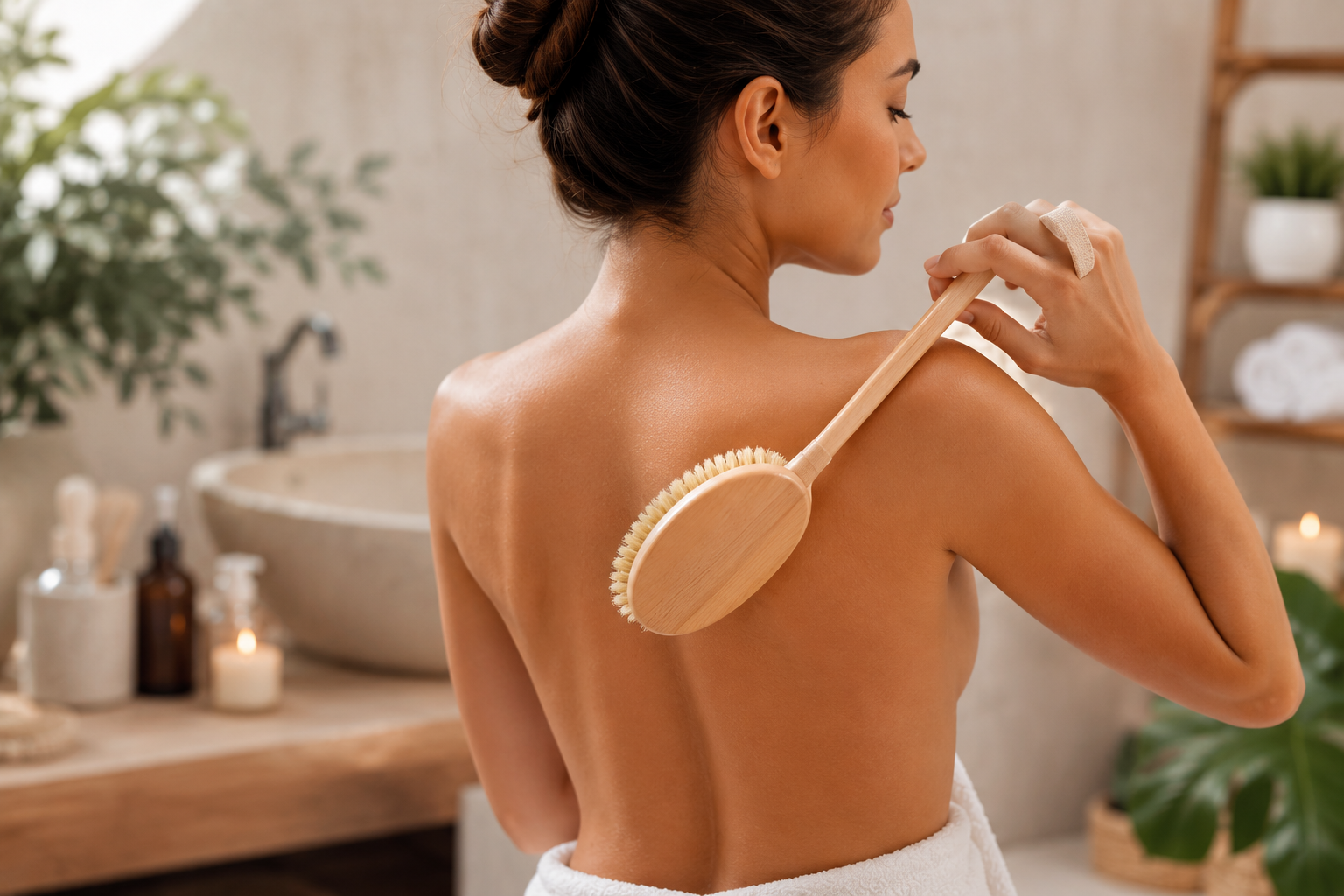
Dry brushing is a form of mechanical exfoliation performed with a dry brush, usually before bathing.
The bristles physically sweep across the skin and loosen some of the dead cells sitting on its surface.
It is often promoted as a wellness ritual with benefits ranging from smoother skin to improved circulation and lymphatic drainage.
Some of these claims are more convincing than others.
The clearest benefit is exfoliation. Dermatologists recognize brushes, sponges, and similar tools as forms of mechanical exfoliation, although they can cause irritation if used too aggressively. [3]
How Dry Brushing Affects Skin Texture
Dry, flaky skin can make the body feel rough and uneven.
Dry brushing physically removes some of the loose cells on the skin's surface. This can make the skin feel temporarily smoother and softer.
That effect does not mean the brush is speeding up deep skin renewal.
It is mainly a surface-level exfoliating effect.
For people with dry or sensitive skin, excessive mechanical exfoliation can backfire. Repeated friction may increase redness, dryness, or irritation instead of improving texture. [3]
Does Dry Brushing Improve Circulation?
There is some reason your skin may look temporarily different after brushing.
Mechanical stimulation can increase blood flow near the skin's surface. Cleveland Clinic notes that the skin may temporarily appear plumper after dry brushing because of increased circulation. [1]
But this should not be confused with improving overall circulation throughout the body.
There is also no strong evidence that dry brushing produces meaningful long-term cardiovascular or circulatory benefits.
Dry brushing may temporarily increase blood flow near the skin's surface, but its best-supported cosmetic benefit is mechanical exfoliation.
Does Dry Brushing Stimulate the Lymphatic System?
This is one of the most common claims surrounding dry brushing.
The lymphatic system helps move fluid and supports immune function. Specialized lymphatic treatments are sometimes used in medical settings, particularly for conditions such as lymphedema.
However, evidence for dry brushing itself producing meaningful lymphatic benefits in healthy people is limited.
Research on manual lymphatic drainage and medical lymphedema treatment cannot automatically be applied to dry brushing. These are different techniques with different levels of clinical evidence. [4,5]
So it is more accurate to describe dry brushing as a form of mechanical exfoliation and massage rather than a proven lymphatic detox treatment.
Can Dry Brushing Reduce Cellulite?
This claim is much stronger than the evidence.
Cellulite is a structural change involving connective tissue and fat beneath the skin. Brushing the surface cannot permanently remove those underlying structures.
Cleveland Clinic notes that there is no evidence that dry brushing permanently improves the appearance of cellulite. Any temporary change may result from increased blood flow and short-term skin swelling. [2]
So if your goal is cellulite removal, dry brushing is not a proven treatment.
How to Dry Brush Safely
Dry brushing should feel stimulating, not painful.
Use a clean body brush with bristles that are firm enough to exfoliate but comfortable against your skin.
Start at the feet or ankles and use light, long strokes over the limbs. You can use gentle circular motions on areas such as the torso and back. [1]
Do not repeatedly scrub the same patch of skin.
A few light passes are generally enough. Excessive pressure can cause irritation and, in more aggressive cases, bleeding. [1]
After brushing, shower to remove loosened skin cells and apply moisturizer.
5 Steps to Start Dry Brushing
- Choose a suitable brush. Avoid extremely stiff bristles if your skin is sensitive or easily irritated.
- Brush before showering. Dry skin makes the technique easier to perform and allows you to rinse away loosened skin cells afterward.
- Keep pressure light. Your skin should not hurt, burn, or become significantly red during the process.
- Moisturize afterward. Mechanical exfoliation can increase dryness, so apply a moisturizer after showering. [3]
- Adjust the frequency. More brushing is not necessarily better. Reduce or stop the practice if your skin becomes dry, sore, red, or irritated.
Who Should Avoid Dry Brushing?
Dry brushing is not appropriate for every skin type.
Do not brush over cuts, scrapes, open wounds, sunburn, infections, active inflammation, or irritated skin. Dermatologists also recommend avoiding moles, warts, and raised or suspicious lesions. [1]
People with very sensitive skin may find mechanical exfoliation too irritating.
If you have an inflammatory skin condition or are unsure whether brushing is appropriate, ask a dermatologist before adding it to your routine.
Dry Brushing vs Chemical Exfoliation
| Feature | Dry Brushing | Chemical Exfoliation |
|---|---|---|
| Type | Mechanical | Chemical |
| Removes surface dead cells | Yes | Yes |
| Common ingredients | None required | AHAs, BHAs |
| Best suited for | Body exfoliation | Specific skin concerns |
| Irritation risk | Higher with aggressive brushing | Higher with excessive strength or frequency |
Neither method is automatically better.
Your skin type and the reason you want to exfoliate should determine which approach makes sense.
The American Academy of Dermatology recommends choosing an exfoliation method based on skin type and avoiding excessive exfoliation, which can lead to irritation. [3]
Common Myths About Dry Brushing
Myth: Dry brushing detoxifies your body.
Fact: There is no strong clinical evidence that dry brushing removes toxins from the body. Your liver, kidneys, lungs, and gastrointestinal system handle the body's major detoxification processes.
Myth: Dry brushing permanently removes cellulite.
Fact: There is no good evidence that dry brushing permanently reduces cellulite. Any visible improvement is likely to be temporary. [2]
Myth: Harder brushing gives better results.
Fact: Aggressive brushing can damage or irritate the skin. Effective exfoliation does not require painful pressure. [1,3]
Myth: Dry brushing provides proven lymphatic detoxification.
Fact: Evidence supporting meaningful lymphatic effects from dry brushing is limited. Medical lymphatic drainage techniques should not be equated with ordinary dry brushing.
What the Science Says
The strongest evidence behind dry brushing concerns mechanical exfoliation.
Dermatologists recognize mechanical exfoliation as a way to remove dead skin cells, but they also warn that excessive exfoliation can cause irritation and damage. [3]
Dry brushing may also temporarily increase local blood flow, which can make the skin appear more plump immediately afterward. [1,2]
The evidence becomes much weaker when the claims move beyond the skin's surface.
There is currently no strong clinical evidence that dry brushing permanently reduces cellulite, detoxifies the body, or provides major health benefits through lymphatic stimulation.
Evidence Strength Summary
| Claim | Evidence Strength |
|---|---|
| Dry brushing mechanically exfoliates skin | Strong |
| Dry brushing can temporarily increase local circulation | Moderate |
| Dry brushing improves skin smoothness | Moderate |
| Dry brushing improves lymphatic function | Limited |
| Dry brushing permanently reduces cellulite | Insufficient |
| Dry brushing detoxifies the body | Insufficient |
Bottom Line
Dry brushing can be a simple way to exfoliate the body and temporarily improve how the skin looks and feels.
Its most credible benefit is mechanical exfoliation. It may also temporarily increase blood flow near the skin's surface.
But the bigger wellness claims do not hold up nearly as well.
There is no strong evidence that dry brushing permanently removes cellulite, detoxifies the body, or dramatically improves lymphatic function.
If you enjoy the ritual, use it gently. Avoid damaged or irritated skin, moisturize afterward, and stop if your skin becomes persistently red or uncomfortable.
In skincare, more friction does not mean better results. A gentle routine that your skin tolerates is usually the smarter approach.
Medical References
- Cleveland Clinic. The Truth About Dry Brushing and What It Does for You. Dermatology guidance on benefits, technique, safety, and cellulite claims.
- Cleveland Clinic. Cellulite: What It Is, Causes, Location & Treatment. Evidence review of dry brushing and temporary changes in cellulite appearance.
- American Academy of Dermatology. How to Safely Exfoliate at Home. Updated February 6, 2026. Guidance on mechanical exfoliation, irritation, skin type, and moisturizing.
- Ezzo J, et al. Manual lymphatic drainage for breast cancer-related lymphedema: a systematic review and meta-analysis of randomized controlled trials. Supportive Care in Cancer. 2022.
- Ezzo J, et al. Manual lymphatic drainage and related physical therapies for lymphedema. Evidence from randomized controlled research indicates that results vary by treatment and condition.