Reviewed by the HyaluFlow Health Editorial Team | Published: August 15, 2026 | Last Updated: August 15, 2026
Key Takeaways
- Cold exposure changes facial skin temperature and blood-vessel responses.
- Facial icing may temporarily reduce the appearance of mild puffiness.
- Cold can make skin feel tighter or look less flushed for a short time.
- There is no strong evidence that icing permanently shrinks pores or builds collagen.
- Direct or prolonged ice contact can irritate or injure the skin.
- A cool compress is a gentler alternative to rubbing bare ice on the face.
- Daily sunscreen and consistent barrier care matter more for long-term skin health.
What Is an Ice Facial?
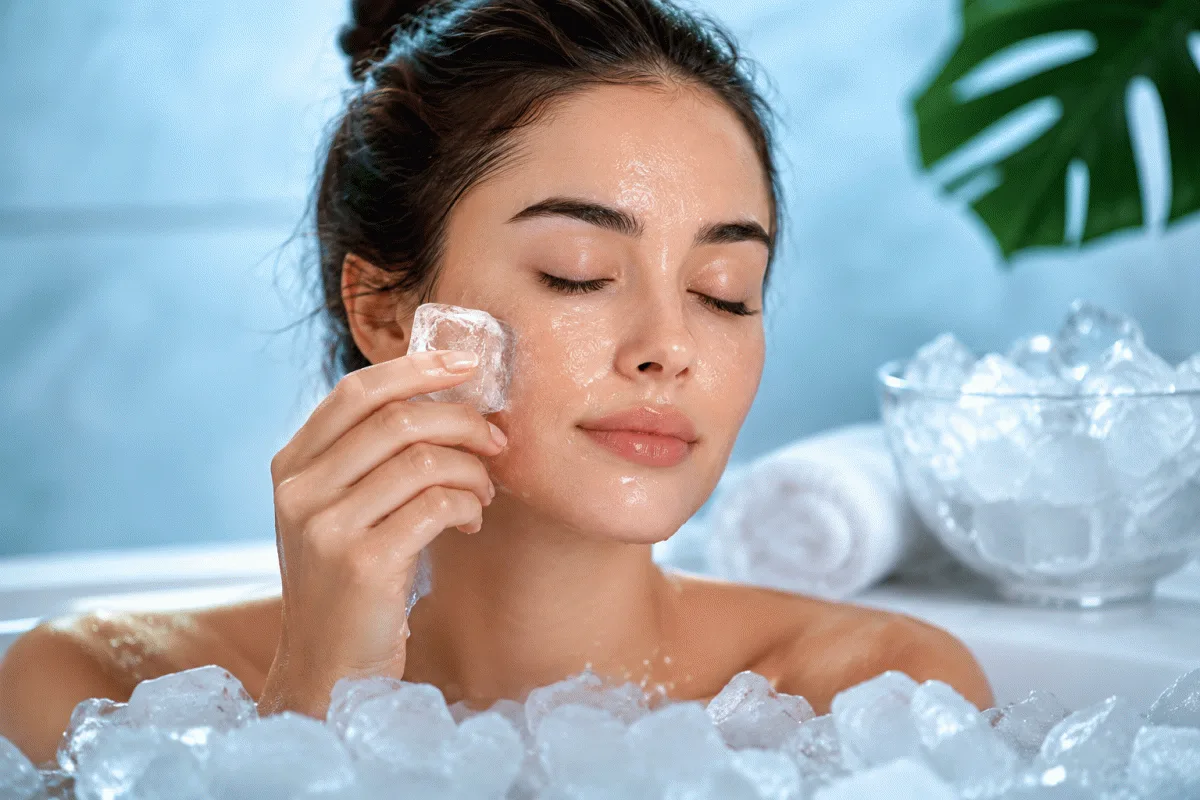
An ice facial is a cosmetic cold-treatment technique that cools the face using an ice roller, chilled facial tool, cool compress, or wrapped cold pack.
The appeal is simple: cold can temporarily change skin temperature, blood flow, and the appearance of swelling. Social media claims about permanent pore reduction or collagen production, however, go beyond what current evidence supports.
How Cold Affects Facial Skin
Cold exposure changes the behavior of blood vessels near the skin surface. Research on facial cold exposure has documented changes in skin temperature and cold-induced vascular responses, helping explain why cooled skin can temporarily look less flushed. Facial Cold-Induced Vasodilation and Skin Temperature During Exposure to Cold Wind
Cold can create a temporary cosmetic effect, but a short-term change in appearance is not the same as permanent skin remodeling.
Can Ice Facials Reduce Facial Puffiness?
They may reduce the appearance of mild puffiness temporarily. Cooling can alter local blood-vessel responses and may make swollen or flushed skin appear calmer for a short period.
This effect can be noticeable after waking, during hot weather, or when temporary fluid retention contributes to facial swelling. It does not remove facial fat or permanently change facial structure.
Do Ice Facials Tighten Skin?
Cold can make the skin feel temporarily firmer or tighter as its temperature changes. Once the skin warms again, that sensation and visual effect generally fade.
There is no strong clinical evidence that routine facial icing produces lasting skin tightening or meaningful collagen remodeling. Claims that rubbing ice on the face reverses sagging should therefore be treated cautiously.
Can Ice Permanently Shrink Pores?
No. Ice cannot permanently change pore size, which is influenced by factors including genetics, sebum production, and the structure of the hair follicle.
Cooling may make pores look temporarily less noticeable because surrounding tissue can appear tighter. That is a short-lived visual effect rather than a structural reduction in pore size.
Ice Facials for Summer Redness
Heat can leave the face feeling warm and looking flushed. A cool compress may provide short-term comfort by lowering the skin's surface temperature.
Persistent facial redness should not automatically be treated with ice. Conditions such as rosacea, dermatitis, and sunburn can have different causes and may require targeted treatment.
Can Facial Icing Damage the Skin Barrier?
Brief, gentle cooling is not the same as extreme cold exposure. However, prolonged temperature exposure can influence skin-barrier measurements, and research shows that temperature changes can affect transepidermal water loss and other skin properties. Impact of Water Exposure and Temperature Changes on Skin Barrier Function
Experimental research has also found that low temperatures can affect epidermal differentiation and barrier-related proteins. These findings do not prove that a brief cool compress damages healthy facial skin, but they support avoiding unnecessary extreme cold. Low Temperature-Mediated Skin Barrier Dysfunction
How to Use an Ice Facial Safely
1. Avoid Bare Ice on the Skin
Do not repeatedly rub a frozen ice cube directly against your face. Use a clean cloth barrier, chilled roller, or cool compress to reduce the intensity of the cold exposure.
2. Keep Cooling Brief
There is no established need for prolonged icing. Stop if the skin becomes painful, excessively numb, unusually pale, blistered, or intensely red.
3. Keep the Tool Moving
If you use a cooling roller, move it gently across the skin rather than holding it against one spot. This helps avoid excessive localized cooling.
4. Moisturize Afterwards
If your skin feels dry or tight afterward, apply a gentle moisturizer. During daytime use, broad-spectrum sunscreen remains a more important long-term step than facial icing.
Who Should Avoid Facial Icing?
People with very sensitive skin, cold-induced hives, certain circulation problems, or conditions aggravated by cold should use caution. Extreme cold exposure can produce adverse skin reactions, so stronger cooling techniques should not be treated as harmless skincare.
If cooling causes persistent numbness, pain, blistering, swelling, or unusual skin discoloration, stop immediately and seek medical advice when symptoms are significant or do not resolve.
Ice Facial vs. Cool Compress
| Feature | Ice Facial | Cool Compress |
|---|---|---|
| Cooling intensity | Higher | Gentler |
| Puffiness relief | May be temporary | May be temporary |
| Risk of irritation | Higher with direct ice | Generally lower |
| For sensitive skin | Use caution | Often the gentler option |
| Permanent anti-aging effect | Not established | Not established |
What the Science Says
The evidence supports a limited conclusion: cooling changes skin temperature and vascular responses and may produce temporary cosmetic effects. It does not establish facial icing as a treatment for wrinkles, sagging, enlarged pores, or skin aging.
Research on temperature and skin physiology also shows that environmental temperature can influence barrier function and inflammatory responses. This makes gentle, controlled cooling more sensible than extreme or prolonged exposure. The Impact of Temperature on the Skin Barrier and Atopic Dermatitis
Evidence Strength Summary
- Moderate: Cold exposure changes facial skin temperature and vascular responses.
- Limited: Temporary reduction in the appearance of facial puffiness.
- Insufficient: Permanent pore reduction, lasting skin tightening, or meaningful collagen stimulation from facial icing.
- Important: Extreme or prolonged cold exposure can cause skin injury and should be avoided.
Bottom Line
Ice facials can be a simple short-term summer skincare technique for cooling the face and temporarily reducing the appearance of puffiness. They are not a proven anti-aging treatment or a substitute for sunscreen, moisturizer, or appropriate dermatological care.
For a safer approach, choose gentle cooling rather than prolonged direct ice contact. For healthier skin over time, consistent sun protection and barrier-supportive skincare have far stronger practical value.