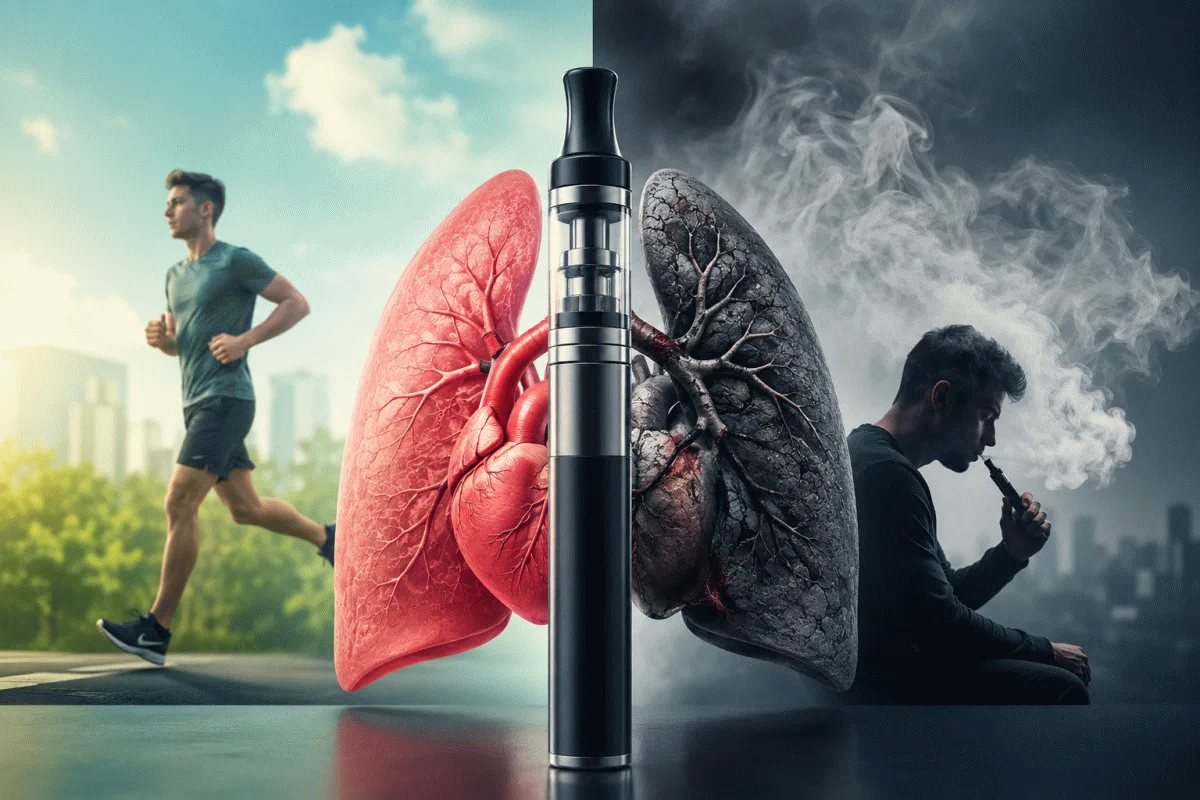
Quick Answer: Current scientific evidence shows that vaping is not safe. Research links e-cigarette use to respiratory symptoms, cardiovascular strain, nicotine addiction, and a likely increased risk of lung and oral cancers. Although completely switching from cigarettes to vaping may reduce exposure to some harmful combustion chemicals, vaping still carries significant health risks and should not be considered harmless.[1][2][3][4]
Key Takeaways
- Vaping exposes users to nicotine, ultrafine particles, heavy metals, and potentially harmful chemicals.
- Recent research links e-cigarettes to lung irritation, cardiovascular stress, and a likely increased cancer risk.
- Dual use of cigarettes and e-cigarettes provides little or no meaningful health benefit.
- Young people, pregnant individuals, and non-smokers should avoid vaping entirely.
- Adults who completely switch from smoking to vaping may reduce exposure to some toxic combustion products, but vaping is still not risk-free.
Think vaping is just harmless water vapor? That belief was common when e-cigarettes first became popular, but today's evidence tells a far more complicated story. Modern vape aerosols contain nicotine, ultrafine particles, heavy metals, volatile organic compounds, and other chemicals that can affect multiple organs—not just the lungs.[2][5]
Over the past few years, researchers have published larger systematic reviews, updated public health guidance, and stronger laboratory evidence examining the long-term effects of vaping. In 2026, several major scientific reviews strengthened concerns about respiratory disease, cardiovascular health, and cancer risk, shifting the conversation from "Is vaping safer than smoking?" to "What are the health risks of vaping itself?"[1][3][4]
Understanding this distinction is important. While vaping generally exposes users to fewer toxic combustion products than traditional cigarettes, that does not mean e-cigarettes are safe. The health effects differ, and new evidence continues to emerge as longer-term studies become available.
Why This Matters
More than a decade after e-cigarettes entered the market, millions of people worldwide now vape regularly. Some adults use vaping as a smoking cessation aid, while many teenagers and young adults begin vaping without ever smoking cigarettes. This makes understanding the true health effects increasingly important for individuals, healthcare professionals, educators, and policymakers.[5][6]
Misinformation exists on both sides of the debate. Some online content falsely claims vaping is completely harmless, while other sources incorrectly suggest it is equally dangerous as smoking under every circumstance. The current scientific evidence supports a more balanced conclusion: vaping is generally less harmful than continued cigarette smoking for adults who switch completely, but it is far from harmless and should never be viewed as a healthy habit.[2][4][6]
For non-smokers, teenagers, pregnant individuals, and people considering trying vaping recreationally, current evidence clearly indicates that avoiding e-cigarettes altogether remains the safest choice.[5][6]
Respiratory Effects: What Current Research Shows
The lungs remain the organ system with the strongest evidence of vaping-related harm. Unlike clean air, vape aerosol contains fine particles, nicotine, flavoring chemicals, aldehydes, and trace metals that can irritate airway tissues and trigger inflammation.[1][2]
A large systematic review and meta-analysis published in Tobacco Induced Diseases evaluated more than one hundred studies investigating respiratory health among e-cigarette users. Researchers found that people who vape have significantly higher rates of chronic cough, wheezing, shortness of breath, and other respiratory symptoms compared with individuals who have never used e-cigarettes.[1]
The review also reported that people who both smoke cigarettes and vape—known as dual users—generally experience respiratory risks similar to people who smoke cigarettes alone. This suggests that adding vaping while continuing to smoke provides little respiratory benefit.[1]
Laboratory studies further show that chemicals found in vape aerosol can impair the lungs' natural defense mechanisms, increase oxidative stress, and promote inflammatory responses that may contribute to chronic respiratory disease over time.[2][7]
Cardiovascular Effects
Growing evidence also links vaping to cardiovascular stress. Nicotine stimulates the sympathetic nervous system, temporarily increasing heart rate, blood pressure, and blood vessel constriction. Repeated exposure may contribute to endothelial dysfunction—the impaired function of blood vessel lining—which is considered an early step in cardiovascular disease.[3][8]
In 2026, the American Heart Association highlighted accumulating evidence that chemicals generated during normal e-cigarette use may adversely affect cardiovascular health beyond nicotine alone. Researchers believe ultrafine particles, heavy metals released from heating coils, and reactive chemical compounds may contribute to vascular inflammation and oxidative stress.[3]
Although long-term cardiovascular outcomes continue to be studied, current evidence indicates that vaping cannot be considered heart-safe, particularly among people with existing cardiovascular disease or multiple risk factors.[3][8]
Cancer Risk: What 2026 Research Reveals
One of the most important developments in vaping research is the growing evidence linking e-cigarette use to cancer-related biological changes. While scientists cannot yet measure lifetime cancer rates after decades of vaping—as they can with cigarettes—multiple studies now show that vape aerosol contains compounds capable of damaging DNA, increasing oxidative stress, and promoting chronic inflammation, all of which are recognized contributors to cancer development.[4][9]
In 2026, a comprehensive peer-reviewed review published in Carcinogenesis evaluated laboratory studies, mechanistic evidence, biomarker research, and animal data. The international research team concluded that nicotine-containing e-cigarettes are likely to increase the risk of lung and oral cancers. Researchers identified numerous harmful compounds in vape aerosol, including formaldehyde, acetaldehyde, acrolein, heavy metals such as nickel and chromium, and reactive oxygen species capable of damaging cells.[4]
Importantly, "likely carcinogenic" does not mean every person who vapes will develop cancer. Rather, it means the available scientific evidence increasingly supports a causal relationship, even though long-term population studies are still ongoing. Similar warning signs were observed decades before the full cancer burden of cigarette smoking became clear.[4][9]
Nicotine Addiction and Brain Health
Most e-cigarettes deliver nicotine, one of the most addictive substances known. Nicotine rapidly reaches the brain, stimulating dopamine release and reinforcing repeated use. Over time, dependence can develop, making it difficult for users to stop vaping even when they want to quit.[5][10]
Adolescents are particularly vulnerable because their brains continue developing into their mid-twenties. According to the U.S. Centers for Disease Control and Prevention (CDC), nicotine exposure during adolescence can interfere with brain regions involved in attention, learning, memory, emotional regulation, and impulse control.[5]
Studies also suggest nicotine dependence may worsen anxiety symptoms, sleep quality, irritability, and concentration difficulties through repeated withdrawal cycles. While some users report temporary stress relief after vaping, researchers believe this often reflects relief from nicotine withdrawal rather than a genuine reduction in psychological stress.[5][10]
Oral Health Effects
The effects of vaping extend beyond the lungs. Dental researchers increasingly report associations between e-cigarette use and poor oral health. Vape aerosol can reduce saliva production, alter the oral microbiome, increase gum inflammation, and delay wound healing inside the mouth.[7][11]
Several reviews have linked regular vaping with increased risks of gingivitis, periodontal disease, mouth irritation, bad breath, and tissue inflammation. Some studies also suggest that heating chemicals and flavoring agents may damage oral epithelial cells, potentially contributing to the increased oral cancer risk identified in recent research.[4][7][11]
Youth Vaping Remains a Public Health Concern
Although smoking rates among adolescents have declined over the past decade, vaping continues to affect millions of young people worldwide. According to recent CDC surveillance, flavored disposable e-cigarettes remain especially popular among middle and high school students despite increasing regulatory efforts.[5]
Public health experts remain concerned because adolescents who begin using nicotine early are more likely to develop long-term dependence. Early nicotine exposure has also been associated with increased likelihood of later tobacco use, although individual outcomes vary and many contributing social factors exist.[5][6]
For these reasons, nearly all major public health organizations—including the CDC, American Heart Association, and World Health Organization—recommend that children, teenagers, and young adults avoid vaping entirely.[3][5][6]
Can Vaping Help People Quit Smoking?
The answer depends on who is using vaping and how it is used. For adults who already smoke cigarettes, completely switching to regulated nicotine e-cigarettes may reduce exposure to many toxic combustion products such as tar and carbon monoxide.[2][12]
Several randomized clinical trials have found that nicotine e-cigarettes may help some smokers quit when combined with structured behavioral support. However, researchers consistently emphasize that the potential benefit applies only to complete substitution. Continuing to smoke while vaping—known as dual use—appears to provide little overall health advantage and may maintain exposure to harmful chemicals from both products.[1][12]
Importantly, no major health organization recommends vaping for people who have never smoked. For non-smokers, starting e-cigarette use introduces health risks without providing any medical benefit.[5][6]
What the Science Says
The evidence surrounding vaping has become considerably stronger over the past several years. Earlier research focused mainly on short-term exposure and laboratory experiments, but newer systematic reviews, consensus statements, and mechanistic studies now provide a clearer picture of the health risks associated with long-term e-cigarette use.[1][3][4]
Researchers generally agree on several important points. First, vaping exposes users to fewer toxic combustion products than traditional cigarettes because there is no burning tobacco. Second, this reduction in exposure does not eliminate health risks. Instead, vaping introduces its own mixture of chemicals capable of affecting the lungs, cardiovascular system, oral tissues, and cellular DNA.[2][4][8]
The strongest human evidence currently supports associations with respiratory symptoms and nicotine dependence. Cardiovascular and cancer evidence continues to strengthen through mechanistic research, biomarker studies, and animal models, although researchers acknowledge that decades-long human follow-up studies are still underway because e-cigarettes are relatively new products.[1][3][4]
Evidence Strength
- Respiratory effects: Strong evidence (systematic reviews and meta-analyses)
- Nicotine addiction: Strong evidence (government and public health agencies)
- Cardiovascular effects: Moderate to strong evidence (professional society statements and clinical studies)
- Cancer risk: Moderate but rapidly strengthening evidence based on mechanistic studies, biomarkers, and comprehensive reviews.
- Smoking cessation benefit: Moderate evidence for adults who completely replace cigarettes with regulated nicotine e-cigarettes under appropriate support.
Who Should Be Especially Careful?
- Teenagers and young adults, because nicotine can interfere with normal brain development and increase the risk of long-term addiction.[5]
- Pregnant individuals, since nicotine exposure during pregnancy may negatively affect fetal growth and brain development.[5][6]
- People with asthma or chronic lung disease, because vaping may worsen airway irritation and respiratory symptoms.[1]
- Individuals with heart disease or high blood pressure, as nicotine and vape aerosol may increase cardiovascular strain.[3][8]
- Never-smokers, because initiating vaping introduces avoidable health risks without any evidence-based health benefit.[5][6]
- Dual users who both smoke cigarettes and vape, since research shows they may not receive the potential harm-reduction benefits seen with complete smoking cessation.[1][12]
Practical Ways to Reduce Harm
If you currently vape or smoke, reducing overall nicotine exposure remains one of the most effective ways to lower health risks.
- If you smoke cigarettes, aim to quit completely rather than becoming a long-term dual user.
- If you use vaping as a smoking cessation tool, work with your healthcare provider to develop a plan for eventually reducing nicotine dependence.
- Avoid purchasing unregulated or counterfeit vaping products, which may contain unpredictable chemicals or contaminants.
- Keep all nicotine products away from children and pets, as nicotine poisoning can occur even with small amounts.
- If you have persistent cough, chest pain, wheezing, shortness of breath, or coughing up blood, seek prompt medical evaluation.
Common Myths About Vaping
Myth 1: Vape aerosol is just harmless water vapor.
Fact: Vape aerosol contains nicotine, ultrafine particles, volatile organic compounds, heavy metals, aldehydes, and other potentially harmful chemicals—not simply water vapor.[2][5]
Myth 2: Vaping is completely safe because there is no tobacco smoke.
Fact: Although vaping avoids many combustion products found in cigarettes, research consistently shows measurable health risks affecting multiple organ systems.[1][3][4]
Myth 3: If I both smoke and vape, I'm protecting my health.
Fact: Current evidence suggests dual use provides little respiratory benefit compared with smoking alone and may prolong nicotine dependence.[1]
Benefits of Quitting Vaping
Although research on long-term recovery after vaping is still developing, studies and clinical experience suggest that many health improvements begin soon after nicotine exposure stops. The body starts repairing itself, inflammation gradually declines, and respiratory symptoms often improve over time.[5][6][12]
- Reduced exposure to nicotine and harmful aerosol chemicals.
- Improved lung function and fewer respiratory symptoms for many users.
- Lower heart rate and blood pressure after nicotine withdrawal resolves.
- Improved taste and smell.
- Better exercise tolerance and endurance.
- Reduced risk of long-term nicotine dependence.
- Improved oral health and reduced gum inflammation.
Recovery varies between individuals and depends on factors such as duration of vaping, nicotine concentration, previous smoking history, and overall health.
How to Quit Vaping Successfully
Quitting vaping can be challenging because nicotine dependence affects both the brain and behavior. Fortunately, evidence-based treatments significantly improve the chances of long-term success.[5][12]
1. Set a Quit Date
Choose a realistic date within the next few weeks and prepare by removing vape devices, chargers, and refill products from your home, workplace, and vehicle.
2. Identify Your Triggers
Many people vape during stress, boredom, driving, studying, or social situations. Recognizing these triggers allows you to plan healthier alternatives before cravings occur.
3. Consider Nicotine Replacement Therapy
Nicotine patches, gum, lozenges, or other approved smoking-cessation medications may help reduce withdrawal symptoms. These treatments should be used according to medical advice or product instructions.[12]
4. Seek Behavioral Support
Counseling, quitlines, digital cessation programs, and healthcare professionals can provide practical strategies that improve quit success compared with trying to quit alone.
5. Expect Temporary Withdrawal Symptoms
Common symptoms include irritability, cravings, restlessness, difficulty concentrating, anxiety, headaches, and sleep disturbances. These usually improve over several weeks as nicotine dependence decreases.
Limitations of Current Research
Although vaping research has expanded rapidly, several important limitations remain. E-cigarettes have only been widely available for approximately two decades, meaning researchers cannot yet measure lifetime disease risks with the same certainty as conventional cigarette smoking.
Many studies also involve rapidly changing products. Device designs, heating temperatures, nicotine concentrations, and flavoring ingredients continue to evolve, making it difficult to compare results across different generations of e-cigarettes.[2][4]
Much of the current cancer evidence comes from laboratory experiments, biomarkers, mechanistic studies, and animal research rather than decades-long human cohort studies. Nevertheless, many scientists argue these findings provide sufficient early warning to justify precaution rather than waiting several more decades for definitive long-term outcomes.[4]
Research Highlights
- A systematic review of more than 100 studies linked vaping with significantly higher rates of respiratory symptoms among current users.[1]
- The American Heart Association reports growing evidence that chemicals produced during normal e-cigarette use may adversely affect cardiovascular health.[3]
- A comprehensive 2026 review published in Carcinogenesis concluded that nicotine-containing e-cigarettes are likely to increase the risk of lung and oral cancers.[4]
- CDC surveillance continues to show millions of adolescents use e-cigarettes, with flavored products remaining the most common choice among youth.[5]
- Evidence supports vaping as a possible harm-reduction tool only for adults who completely replace combustible cigarettes—not for dual users or people who have never smoked.[12]
Key Takeaways
- Vaping is not harmless and should not be considered a safe alternative to clean air.
- Current evidence links e-cigarettes to respiratory symptoms, cardiovascular stress, nicotine addiction, and a likely increased risk of lung and oral cancers.
- Complete replacement of cigarettes with regulated e-cigarettes may reduce exposure to certain harmful combustion chemicals, but it does not eliminate health risks.
- Teenagers, pregnant individuals, non-smokers, and people with chronic heart or lung disease should avoid vaping entirely.
- The safest option for overall health remains avoiding both combustible tobacco products and e-cigarettes whenever possible.
Bottom Line
Current evidence shows that vaping is not a safe habit. While e-cigarettes generally expose users to fewer combustion toxins than conventional cigarettes, they still deliver nicotine and numerous chemicals that can affect the lungs, heart, blood vessels, mouth, and other tissues.
For adults who already smoke cigarettes, switching completely to regulated e-cigarettes may reduce exposure to certain harmful combustion products and may support smoking cessation under professional guidance. However, this potential harm reduction applies only to complete substitution—not dual use—and should not be interpreted as proof that vaping is harmless.
For non-smokers, teenagers, pregnant individuals, and anyone considering vaping recreationally, current scientific evidence strongly supports avoiding e-cigarettes altogether. As research continues to evolve, one message remains consistent across major public health organizations: the healthiest choice is not to inhale nicotine or aerosolized chemicals in the first place.[1][3][5][6]
References
- Kundu A, et al. Evidence Update on the Respiratory Health Effects of Vaping E-Cigarettes: A Systematic Review and Meta-analysis. Tobacco Induced Diseases. 2025–2026.
- National Academies of Sciences, Engineering, and Medicine. Public Health Consequences of E-Cigarettes. National Academies Press.
- American Heart Association. Scientific Statement on E-Cigarette Aerosol Chemicals and Cardiovascular Health. June 2026.
- Stewart BW, et al. Carcinogenicity Assessment of Nicotine E-Cigarettes. Carcinogenesis. 2026.
- Centers for Disease Control and Prevention (CDC). Electronic Cigarettes (E-Cigarettes): Health Effects, Youth Use, and Nicotine Information. Updated 2026.
- World Health Organization (WHO). Tobacco: Electronic Nicotine Delivery Systems (ENDS).
- Kouzoukas E, et al. The Health Effects of Vaping and E-Cigarettes: Consensus Recommendations. International Journal of Drug Policy. 2026.
- Benowitz NL, Fraiman JB. Cardiovascular Effects of Electronic Cigarettes. Nature Reviews Cardiology.
- International Agency for Research on Cancer (IARC). Mechanisms of Carcinogenesis and Cancer Risk Assessment.
- Yale Tobacco Center of Regulatory Science. Nicotine Dependence and Brain Development.
- Scoping Review on Electronic Cigarettes and Periodontal Health. Journal of Periodontology.
- Hartmann-Boyce J, et al. Electronic Cigarettes for Smoking Cessation. Cochrane Database of Systematic Reviews.