Reviewed by the HyaluFlow Health Editorial Team | Published: June 29, 2026 | Last Updated: August 29, 2026
Quick Answer: Earlobes wrinkle mainly because aging reduces skin elasticity and soft-tissue volume. UV exposure and mechanical stress can speed the process. Daily sunscreen, moisturizer, lighter earrings, and evidence-based anti-aging care may help, while fillers or earlobe repair can address advanced changes.
Key Takeaways
- Earlobes lack cartilage and depend on skin and connective tissue for shape.
- Sun exposure can accelerate collagen breakdown and visible aging.
- Heavy earrings can stretch and elongate the earlobe.
- Moisturizers improve hydration; retinoids have stronger evidence for photoaging.
- Significant laxity or torn piercings may need professional treatment.
Why Do Earlobes Wrinkle?
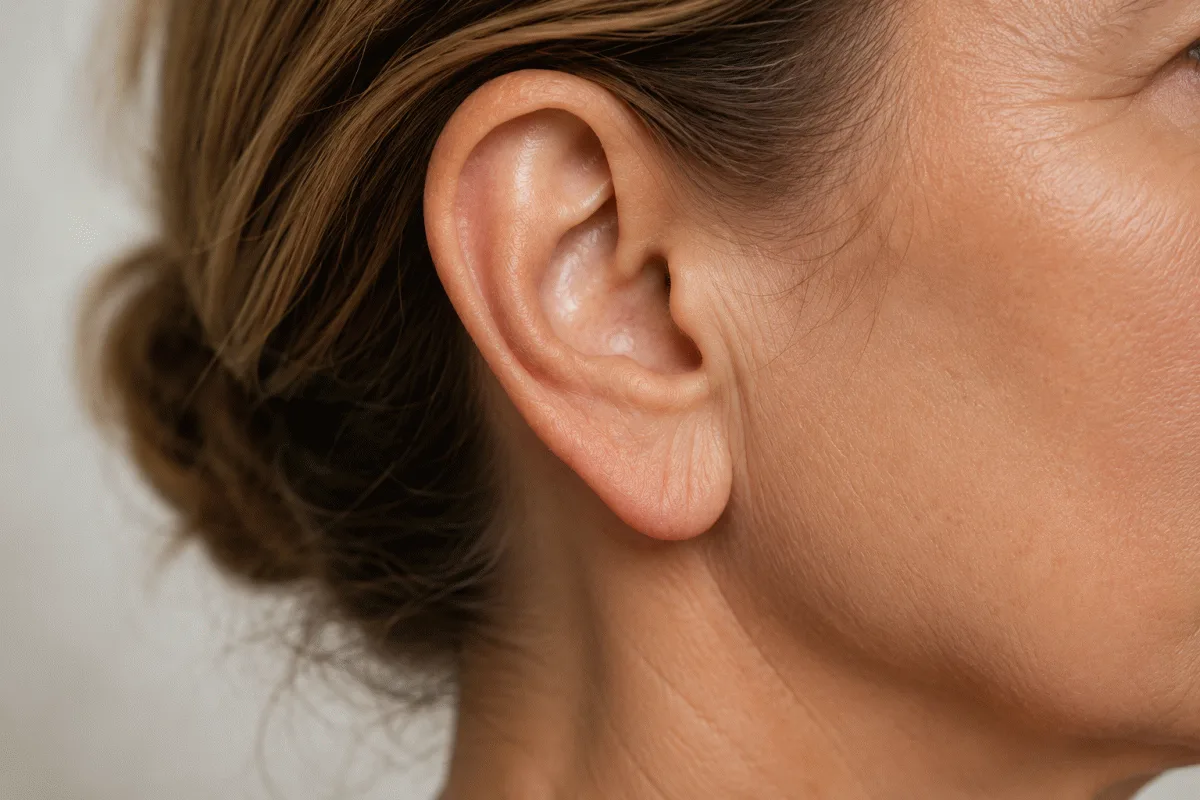
The earlobe is made mainly of skin, connective tissue, blood vessels, nerves, and subcutaneous fat rather than cartilage. With age, collagen and tissue support decline while volume can decrease, making the lobe thinner, flatter, or more wrinkled. A 2025 review describes aging-related elongation, soft-tissue atrophy, ptosis, and wrinkles as common earlobe changes.
Esthetic and reconstructive options for earlobe deformities
What Causes Earlobe Wrinkles?
Age-related collagen loss
Intrinsic aging changes dermal collagen, elastin, and hydration. These changes reduce the skin's ability to resist stretching and return to its original shape.
Sun exposure
UV radiation accelerates photoaging by damaging skin structures and promoting collagen-degrading pathways. The American Academy of Dermatology recommends sunscreen on exposed ears and reapplication every two hours outdoors.
American Academy of Dermatology: How to Prevent Skin Cancer
Heavy earrings
Large or heavy earrings place repeated downward tension on soft earlobe tissue. Long-term stretching can enlarge piercing holes and contribute to elongation or acquired tears.
Reconstruction of the Middle-Aged Torn Earlobe
Smoking
Smoking is linked with premature skin aging and impaired collagen metabolism. Human research found lower type I and III collagen synthesis in smokers.
Smoking affects collagen synthesis and extracellular matrix turnover in human skin
How to Prevent Earlobe Wrinkles
Protect your ears from UV exposure. Apply broad-spectrum SPF 30 or higher to the front, back, and lobes. A hat adds protection during prolonged outdoor activity.
Moisturize consistently. Humectants and barrier-supporting ingredients can reduce dryness and make fine lines less noticeable. Ceramide-containing moisturizers have clinical evidence for improving hydration and barrier measures, but they cannot reverse structural sagging.
Ceramide-containing moisturizer randomized controlled trial
Extend your routine to your ears. Applying your suitable facial moisturizer or sunscreen to the earlobes adds little effort.
Reduce mechanical stress. Choose lightweight earrings and avoid jewelry that pulls on the piercing.
Can Skincare Reverse Earlobe Wrinkles?
Skincare can improve hydration and some signs of photoaging, but it cannot fully restore severely stretched tissue or lost volume. Topical tretinoin has strong evidence for photoaging, although studies have mainly examined facial or other exposed skin rather than earlobes.
Topical tretinoin for treating photoaging: A systematic review
Retinoids can irritate sensitive skin, so introduce them cautiously.
Medical Treatments for Aging Earlobes
| Option | Best suited for | Evidence |
|---|---|---|
| Hyaluronic acid filler | Volume loss, mild-to-moderate ptosis and wrinkles | Moderate |
| Laser or resurfacing | Selected texture and photoaging concerns | Moderate |
| Earlobe repair | Tears or severe stretching | Strong clinical use |
Studies support hyaluronic acid fillers for restoring earlobe volume, but evidence remains limited. A 2023 review describes fillers, lasers, peels, and other approaches depending on the problem.
Nonsurgical treatment of earlobe aging with hyaluronic acid fillers · Earlobe Rejuvenation: A Review of Current Treatment Modalities
What the Science Says
The strongest evidence concerns general skin aging rather than earlobe-specific wrinkles. UV exposure and smoking contribute to collagen damage, while randomized trials support topical retinoids for photoaging. Earlobe procedure evidence is more limited.
Common Myths
Myth: Moisturizer can tighten a sagging earlobe.
Fact: Moisturizers improve hydration and skin feel, but cannot replace substantially lost volume or repair stretched tissue.
Myth: Every earlobe crease means heart disease.
Fact: Diagonal earlobe creases have been studied in relation to coronary artery disease, but they are not a standalone diagnostic test. Proper cardiovascular assessment is still required.
Diagonal Earlobe Crease (Frank's Sign): A Systematic Review
Who Should Pay Attention?
- People with substantial sun exposure.
- Frequent wearers of heavy earrings or smokers.
- Anyone noticing rapid changes, tears, or persistent skin lesions.
- People with significant volume loss or sagging.
Evidence Strength Summary
| Approach | Evidence |
|---|---|
| Daily sunscreen | Strong |
| Topical retinoids for photoaging | Strong |
| Ceramide moisturizers | Moderate |
| Reducing heavy-earring stress | Moderate; earlobe evidence limited |
| Earlobe fillers or repair | Moderate to limited |
When to See a Dermatologist
Seek evaluation for a sore that does not heal, bleeding, crusting, a changing mole or spot, persistent scaling, pain, swelling, infection, or a rapidly changing earlobe. The AAD advises evaluation of new or suspicious, changing, itching, or bleeding skin lesions.
Bottom Line
Earlobe wrinkles usually reflect normal aging combined with UV exposure, smoking, volume loss, and mechanical stretching. Daily sunscreen, moisturization, sensible jewelry choices, and evidence-based anti-aging care can help limit visible changes, while significant sagging, volume loss, or torn piercings may benefit from professional treatment.