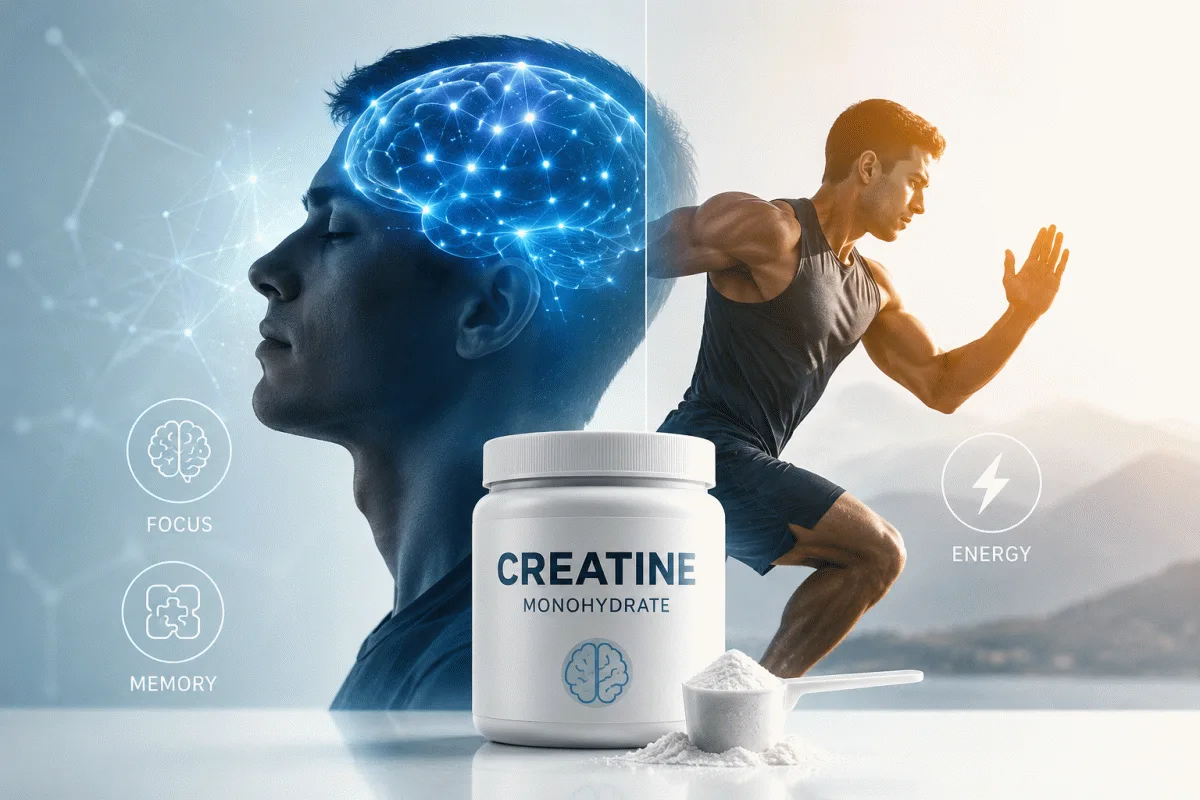
Creatine has earned its reputation as one of the world's most researched sports supplements, with decades of evidence supporting its ability to improve strength, power, and exercise performance. More recently, however, scientists have begun investigating whether its benefits extend beyond muscles and into the brain.
Social media often claims that creatine can boost memory, sharpen focus, eliminate brain fog, and even protect against neurological diseases. While some of these claims are supported by emerging scientific evidence, others are exaggerated or lack sufficient research.
So, can creatine really improve brain function, or is it simply another wellness trend?
Here's what the latest scientific evidence actually shows.
Quick Answer
Yes—but only in certain situations. Research suggests creatine may improve memory, attention, and mental processing speed, particularly in people whose brains are under increased energy demands, such as older adults, vegetarians, or individuals experiencing sleep deprivation. However, current evidence does not support creatine as a universal cognitive enhancer for healthy, well-rested adults.
Key Takeaways
- Creatine helps produce rapid energy for both muscles and brain cells.
- Recent systematic reviews suggest it may improve memory, attention, and processing speed under certain conditions.
- Benefits appear strongest in vegetarians, older adults, and people experiencing sleep deprivation.
- Evidence remains inconsistent for healthy young adults with normal creatine stores.
- Creatine monohydrate is the most researched and scientifically supported form.
- Healthy lifestyle habits remain the foundation of long-term brain health.

Creatine at a Glance
| Claim | Current Evidence |
|---|---|
| Improves exercise performance | ✔ Strong |
| May improve memory | ✔ Moderate |
| May improve attention | ✔ Moderate |
| May reduce mental fatigue | ✔ Moderate |
| Improves intelligence | ✘ No convincing evidence |
| Replaces healthy sleep | ✘ No |
What Is Creatine?
Creatine is a naturally occurring compound produced from the amino acids glycine, arginine, and methionine. Your liver, kidneys, and pancreas produce approximately one gram daily, while additional creatine comes from foods such as beef, fish, poultry, and other animal products.
About 95% of the body's creatine is stored inside skeletal muscles, where it provides rapid energy during short bursts of intense physical activity. The remaining 5% is found in organs with high energy demands, including the brain, heart, and nervous system.
Inside cells, creatine combines with phosphate to form phosphocreatine, an energy reserve that helps regenerate adenosine triphosphate (ATP). ATP is often described as the body's primary energy currency because nearly every cellular process depends on it.
Although creatine is widely associated with muscle performance, brain cells also require large amounts of ATP to support memory, learning, attention, and communication between neurons.
Why Scientists Think Creatine Could Benefit the Brain
Your brain accounts for only about 2% of your body weight, yet it consumes roughly 20% of your body's daily energy.
Every thought, memory, and decision depends on a continuous supply of ATP. During periods of increased mental demand—such as sleep deprivation, prolonged concentration, illness, or aging—the brain's energy requirements increase significantly.
Researchers believe that increasing brain phosphocreatine stores may help maintain ATP production during these demanding situations, allowing brain cells to function more efficiently. This biological mechanism forms the foundation of current research into creatine and cognitive performance.
Can Creatine Improve Memory?
Memory is currently the strongest area of research linking creatine to brain health.
A 2024 systematic review and meta-analysis of 16 randomized controlled trials involving 492 participants found that creatine supplementation significantly improved memory performance, attention time, and information-processing speed. However, researchers found no significant improvement in executive function or overall cognitive performance.
These findings suggest creatine may enhance specific aspects of cognition rather than acting as a general brain booster.
Benefits also appear to vary between individuals. Vegetarians and vegans often experience greater improvements than people who regularly consume meat because they generally have lower baseline creatine stores.
| Population | Potential Memory Benefit | Strength of Evidence |
|---|---|---|
| Vegetarians and vegans | Most likely to benefit | Moderate |
| Older adults | Possible improvement | Moderate |
| Healthy young adults | Small or inconsistent benefit | Limited |
Can Creatine Improve Focus and Attention?
Attention and concentration require continuous energy production inside brain cells. Because creatine helps regenerate ATP, researchers have investigated whether supplementation could help maintain focus during mentally demanding activities.
Current evidence suggests creatine may improve attention and information-processing speed, particularly when the brain is under increased stress. However, studies have not consistently demonstrated improvements in higher-order thinking skills such as planning, reasoning, or decision-making.
In other words, creatine appears more likely to support basic cognitive performance than dramatically increase intelligence or productivity.
Creatine and Mental Fatigue
Mental fatigue often develops after prolonged studying, demanding work, or extended periods of concentration.
Several clinical studies suggest creatine may help preserve cognitive performance when the brain is under sustained stress by supporting ATP production. Rather than making someone "smarter," creatine appears to help the brain maintain performance when energy availability becomes a limiting factor.
What the Science Says: Current evidence suggests creatine may reduce mental fatigue and support cognitive performance during periods of increased mental demand, although larger clinical trials are still needed to confirm these findings.
Does Creatine Help After Sleep Deprivation?
Sleep deprivation places enormous stress on the brain and commonly leads to slower reaction times, reduced attention, impaired memory, and poorer decision-making.
Several controlled studies suggest creatine supplementation may improve reaction time, reasoning, and memory following short-term sleep deprivation. Researchers believe this occurs because additional phosphocreatine helps maintain ATP production when the brain's normal energy metabolism is disrupted.
However, creatine should never be viewed as a replacement for adequate sleep. While supplementation may lessen some of the temporary effects of sleep loss, it cannot restore the broad physical and cognitive benefits of proper rest.
Could Creatine Support Healthy Brain Aging?
As people age, changes in brain energy metabolism may contribute to gradual declines in memory, reasoning, and overall cognitive performance. Because creatine plays an important role in cellular energy production, researchers are investigating whether supplementation may help support healthy brain aging.
Several clinical studies have reported modest improvements in memory and reasoning among older adults, particularly when creatine supplementation was combined with regular resistance exercise. However, findings remain inconsistent, and larger long-term studies are needed before creatine can be recommended specifically for preserving cognitive health during aging.
Can Creatine Help People With Depression?
Researchers are also exploring whether creatine may play a supportive role in treating depression. Early clinical studies suggest that adding creatine to standard antidepressant therapy may improve treatment response in some individuals, particularly women with major depressive disorder.
Scientists believe this effect may be related to improved brain energy metabolism rather than a direct effect on mood itself. Although these findings are encouraging, the evidence remains preliminary, and creatine should never replace professional mental health treatment.
Who May Benefit Most?
| Group | Potential Benefit | Current Evidence |
|---|---|---|
| Vegetarians and vegans | Improved memory and cognitive performance | Moderate |
| Older adults | Possible improvements in memory and reasoning | Moderate |
| Sleep-deprived individuals | Reduced mental fatigue and better cognitive performance | Moderate |
| Healthy young adults | Small or inconsistent benefits | Limited |
| Athletes | Well-established physical performance benefits | Strong |
Typical Dose Used in Research
Most research investigating creatine's effects on physical and cognitive performance has used creatine monohydrate, which remains the most studied and cost-effective form.
- Maintenance dose: 3–5 grams daily.
- Optional loading phase: Approximately 20 grams daily, divided into four doses, for 5–7 days.
- After loading: Continue with 3–5 grams daily to maintain creatine stores.
Although a loading phase increases muscle creatine stores more quickly, it is not essential. Taking 3–5 grams daily will gradually achieve similar levels over several weeks.
Who Should Avoid Creatine?
Creatine is considered safe for most healthy adults, but some people should consult a healthcare professional before taking it.
You should seek medical advice before using creatine if you:
- Have kidney disease or impaired kidney function.
- Have significant liver disease.
- Are pregnant or breastfeeding, as research remains limited.
- Take medications that may affect kidney function.
- Have another medical condition requiring professional supervision.
Is Creatine Safe?
Creatine monohydrate is one of the most extensively researched dietary supplements available. Decades of clinical research indicate that recommended doses are generally safe for healthy adults.
The most commonly reported side effects are mild and may include:
- Temporary water retention.
- Bloating.
- Mild stomach discomfort.
- Digestive upset.
These effects are usually temporary and often improve by taking creatine with food, drinking adequate water, and avoiding unnecessarily high doses.
Common Myths About Creatine
Myth: Creatine is a steroid.
Fact: Creatine is not an anabolic steroid. It is a naturally occurring compound produced by the body and found in foods such as meat and fish.
Myth: Creatine only benefits bodybuilders.
Fact: Although its strongest evidence remains in sports performance, researchers continue investigating its potential role in brain health, healthy aging, and neurological disorders.
Myth: Creatine damages healthy kidneys.
Fact: Current evidence does not show kidney damage in healthy individuals taking recommended doses. People with pre-existing kidney disease should seek medical advice before supplementation.
Myth: Creatine makes you smarter.
Fact: Creatine may improve certain aspects of cognition under specific circumstances, but it has not been shown to increase intelligence.
What the Science Says
Overall, the scientific evidence supporting creatine for brain health is promising but not definitive.
A 2024 systematic review and meta-analysis of 16 randomized controlled trials involving 492 participants found significant improvements in memory, attention time, and information-processing speed following creatine supplementation. However, researchers found no significant improvements in executive function or overall cognitive performance.
Current evidence suggests the greatest benefits are seen in people with lower creatine stores or increased brain energy demands, including vegetarians, older adults, and individuals experiencing sleep deprivation. Healthy young adults often experience only small or inconsistent cognitive improvements.
Scientists agree that larger, longer-term clinical trials are still needed before creatine can be recommended as a general cognitive enhancement supplement.
Final Verdict
Creatine remains one of the most effective and well-researched supplements for improving physical performance. Emerging evidence also suggests it may support certain aspects of brain function, particularly memory, attention, and mental performance when the brain is under increased energy demands.
However, it is not a miracle supplement, nor should it replace healthy habits that consistently support cognitive health.
If you're considering creatine primarily for brain health, the current evidence is encouraging but not conclusive. For most people, adequate sleep, regular exercise, a balanced diet, stress management, and lifelong learning remain the most reliable strategies for maintaining long-term cognitive function. Creatine may provide additional support for some individuals, but it works best as part of a healthy lifestyle rather than as a standalone solution.
References
- Xu Y, et al. Effects of Creatine Supplementation on Cognitive Function in Adults: A Systematic Review and Meta-Analysis. Frontiers in Nutrition. 2024.
- Kreider RB, et al. International Society of Sports Nutrition Position Stand: Safety and Efficacy of Creatine Supplementation in Exercise, Sport, and Medicine. Journal of the International Society of Sports Nutrition. 2025.
- Forbes SC, et al. Creatine Supplementation in Health and Disease. Nutrients.
- Rawson ES, Venezia AC. Use of Creatine in the Brain. Amino Acids.
Editorial Note: This article is based on peer-reviewed systematic reviews, randomized controlled trials, meta-analyses, and established sports nutrition research. It is intended for educational purposes only and should not replace professional medical advice. Consult a qualified healthcare professional before starting any dietary supplement, particularly if you have an underlying medical condition or take prescription medications.