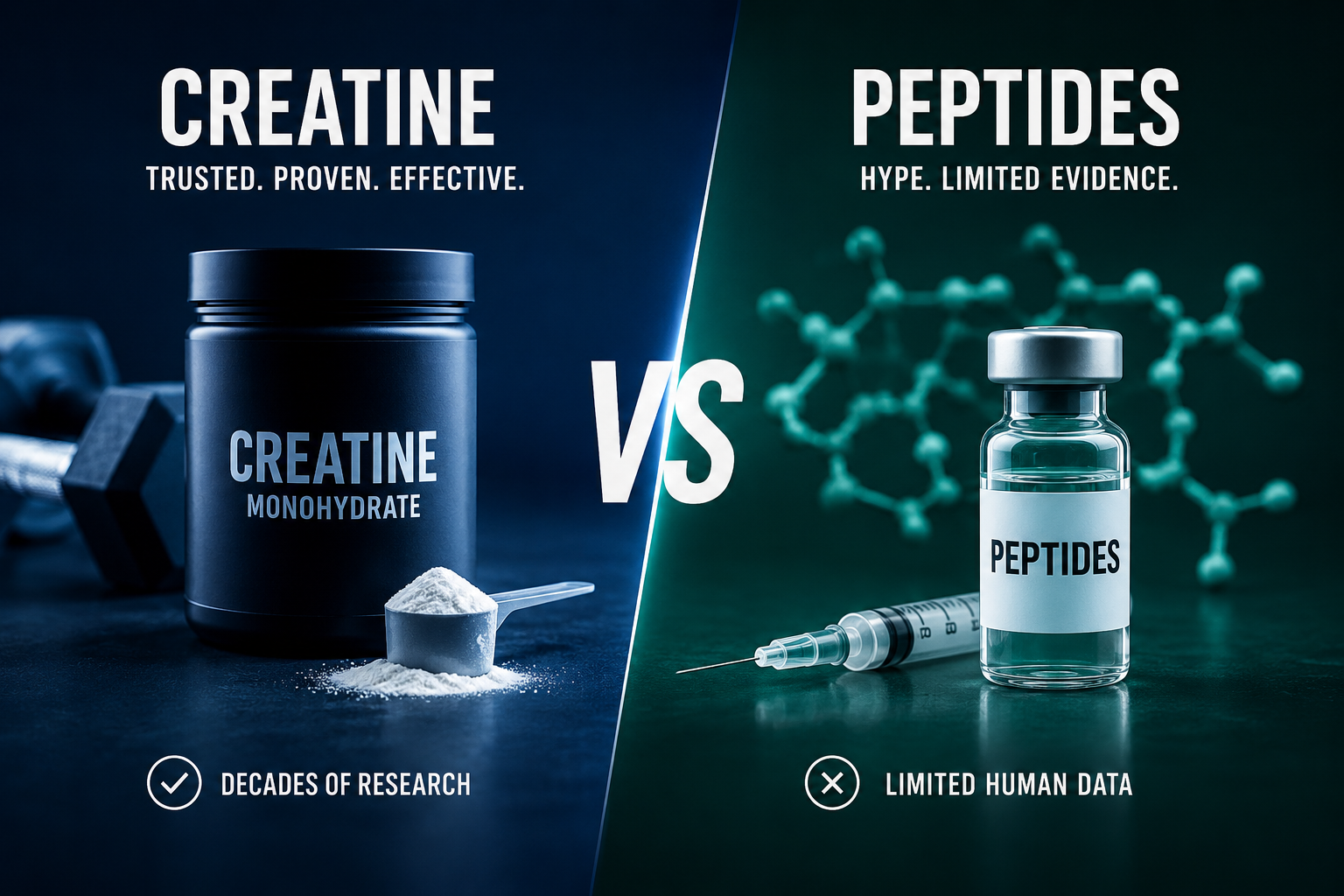
Quick Answer: Despite growing popularity on social media, there is currently insufficient high-quality clinical evidence showing that peptide "loading" improves muscle growth or athletic performance in healthy adults. In contrast, creatine monohydrate has decades of research demonstrating consistent improvements in strength, power, lean muscle mass, and exercise performance when combined with resistance training.
Key Takeaways
- Creatine monohydrate is supported by hundreds of clinical studies for strength and muscle performance.
- Most muscle-building peptides lack large, well-controlled human trials in healthy athletes.
- BPC-157 research remains largely limited to animal studies and laboratory research.
- CJC-1295 and ipamorelin can increase growth hormone levels, but evidence for meaningful muscle gains is limited.
- Many popular peptides are not FDA-approved for bodybuilding or athletic performance.
- Growth hormone secretagogues are prohibited by the World Anti-Doping Agency (WADA).
Fitness trends evolve rapidly, and peptides have become one of the latest topics dominating social media. Influencers frequently promote injectable compounds such as BPC-157, CJC-1295, ipamorelin, and GHK-Cu as powerful alternatives to traditional supplements like creatine. These products are often marketed as faster routes to muscle growth, improved recovery, and enhanced performance.
While the marketing sounds convincing, scientific evidence tells a much more cautious story. Most peptide claims are supported by limited or early-stage research, whereas creatine has accumulated decades of high-quality clinical evidence demonstrating both effectiveness and safety.
What Are Muscle-Building Peptides?
Peptides are short chains of amino acids that can act as signaling molecules within the body. Different peptides serve different purposes, and they should not all be grouped together.
- CJC-1295 is a growth hormone-releasing hormone (GHRH) analog designed to stimulate growth hormone release.
- Ipamorelin is a growth hormone secretagogue that stimulates the pituitary gland through ghrelin receptors.
- BPC-157 is marketed primarily for tissue healing and recovery, although it has not been approved for these uses.
- GHK-Cu is a naturally occurring copper peptide that has been investigated mainly for wound healing and skin repair.
Because growth hormone contributes to tissue growth and metabolism, many assume these peptides automatically produce greater muscle gains. However, increasing a hormone level does not necessarily translate into measurable improvements in muscle size or strength.
What Does the Research Actually Show?
Current evidence supporting peptide use for healthy athletes is surprisingly limited.
Growth hormone secretagogues such as CJC-1295 and ipamorelin have demonstrated the ability to increase circulating growth hormone and IGF-1 levels in some studies. However, there is little high-quality evidence showing that these hormonal changes consistently improve muscle mass, strength, or athletic performance in resistance-trained adults.
BPC-157 receives significant attention online, yet most published research has been conducted in animal models. Human clinical trials evaluating muscle growth, recovery, or sports performance remain scarce, making it impossible to draw strong conclusions about its effectiveness.
Many claims circulating online are based on anecdotal reports rather than randomized controlled clinical trials, which remain the gold standard for evaluating treatment effectiveness.
Creatine Has Decades of Scientific Evidence
Unlike experimental peptides, creatine monohydrate has been extensively studied for more than 30 years.
Creatine increases phosphocreatine stores inside skeletal muscle, allowing faster regeneration of ATP—the body's primary energy source during high-intensity exercise. This leads to improved training capacity, increased strength, greater lean muscle gains, and better recovery from repeated bouts of intense exercise.
Large systematic reviews and position statements from the International Society of Sports Nutrition consistently conclude that creatine monohydrate is one of the safest and most effective sports supplements currently available when consumed at recommended doses.
Safety and Regulatory Concerns
The safety profiles of peptides differ considerably from creatine.
Creatine has been evaluated across hundreds of clinical studies involving athletes, older adults, women, and various patient populations. Serious adverse effects remain uncommon when used appropriately.
Many peptide products, however, are sold through online vendors or gray-market suppliers where product quality, purity, and dosage cannot be independently verified. Laboratory analyses have identified mislabeled and contaminated peptide products in unregulated markets.
Additionally, most popular performance peptides—including BPC-157, CJC-1295, and ipamorelin—are not approved by the U.S. Food and Drug Administration (FDA) for bodybuilding or sports performance.
What About Competitive Athletes?
Athletes competing under anti-doping rules should be especially cautious.
The World Anti-Doping Agency (WADA) prohibits growth hormone secretagogues and several peptide hormones under its Prohibited List. Testing positive can result in suspension regardless of whether the substance was purchased legally or recommended outside approved medical care.
Common Myths About Peptide Loading
Myth: Peptides are simply stronger versions of creatine.
Fact: Creatine and peptides work through entirely different biological mechanisms and cannot be directly compared.
Myth: Raising growth hormone automatically builds muscle.
Fact: Higher hormone levels alone do not guarantee meaningful improvements in muscle size or strength.
Myth: BPC-157 is scientifically proven to speed muscle recovery.
Fact: Most supporting evidence comes from animal studies rather than robust human clinical trials.
Who Should Pay Attention?
- Resistance-training beginners considering performance supplements.
- Competitive athletes subject to anti-doping regulations.
- Individuals considering purchasing peptides online.
- People seeking evidence-based methods to improve muscle growth safely.
Bottom Line
Although peptide therapy has generated enormous interest across the fitness industry, current scientific evidence does not support replacing creatine with peptide "loading" for muscle growth or athletic performance. Most peptides remain experimental for these purposes and lack the extensive human research available for creatine.
If your goal is improving strength, lean muscle mass, and exercise performance, creatine monohydrate continues to offer the strongest combination of effectiveness, safety, affordability, and scientific support.
What the Science Says
- Creatine monohydrate consistently improves strength, power, and lean mass in resistance-trained individuals.
- Growth hormone secretagogues can increase GH levels, but evidence for improved muscle performance remains limited.
- BPC-157 currently lacks sufficient human clinical evidence for muscle recovery or hypertrophy.
- Major sports organizations prohibit several peptide hormones used for performance enhancement.
Medical References
- Kreider RB, et al. International Society of Sports Nutrition Position Stand: Creatine Supplementation. Journal of the International Society of Sports Nutrition. 2022.
- Antonio J, et al. Common questions and misconceptions about creatine supplementation. Journal of the International Society of Sports Nutrition.
- U.S. Food and Drug Administration (FDA). Human Growth Hormone, Peptides and Related Products Safety Communications.
- World Anti-Doping Agency (WADA). 2026 Prohibited List.
- NIH Office of Dietary Supplements. Creatine Fact Sheet for Health Professionals.
- Gentile P, et al. Current evidence surrounding BPC-157: review of preclinical and clinical literature.
- Drug Enforcement Administration and FDA guidance regarding compounded peptide products.