Reviewed by the HyaluFlow Health Editorial Team | Published: July 12, 2026 | Last Updated: August 26, 2026
Quick Answer
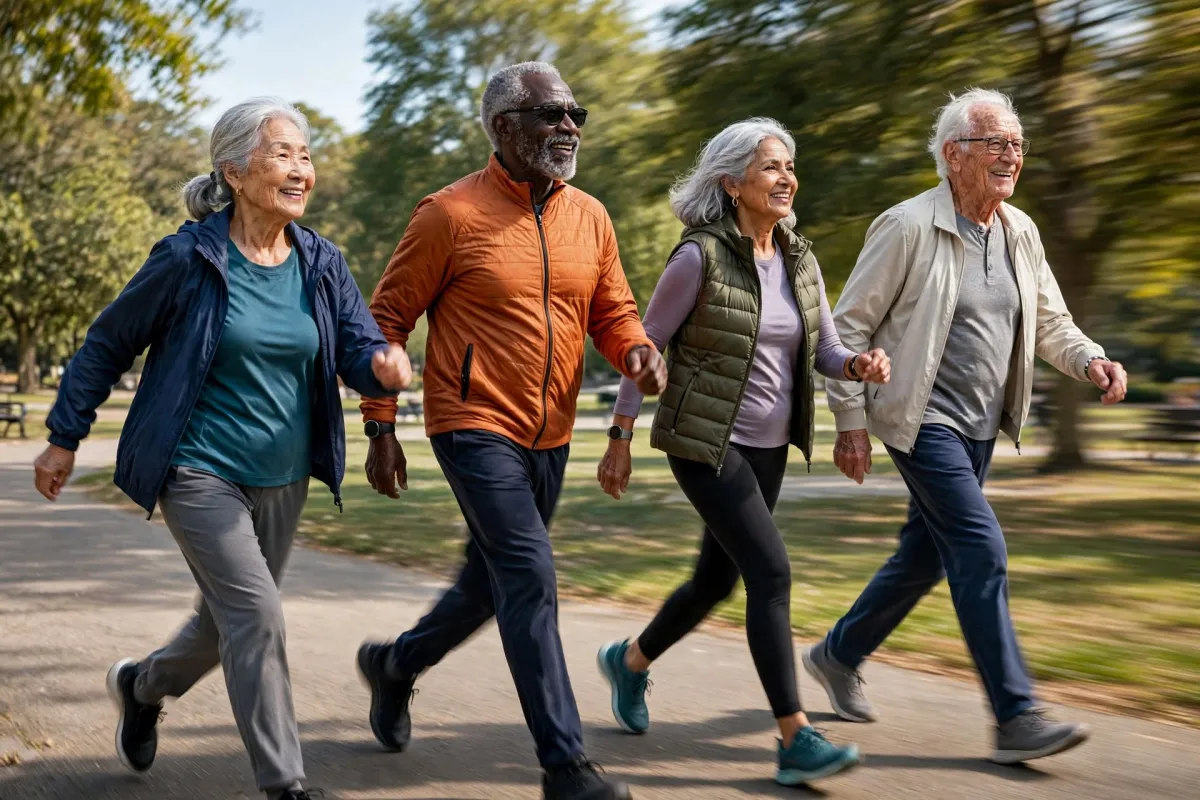
A 2026 study published in Neurology found that adults aged 80 and older with exceptionally fast walking speeds, called "super movers", had about a 50% lower risk of developing cognitive impairment than slower walkers. The study shows an association, not proof that walking faster prevents dementia.
Key Takeaways
- Super movers were adults aged 80+ with exceptionally fast walking speeds for their age and sex.
- They had about half the risk of cognitive impairment in the main analysis.
- Some participants showed slower cognitive decline and better hippocampal preservation.
- The study was observational and cannot prove that faster walking prevents dementia.
- Regular, safe physical activity matters more than trying to achieve an unusually fast walking speed.
Why Walking Speed Matters
Walking requires coordination between the brain, nervous system, muscles, joints, vision, balance, and cardiovascular system. Because of this, gait speed can provide a useful snapshot of physical function in older adults.
A systematic review in Age and Ageing, "How gait influences frailty models and health-related outcomes", supports the importance of gait speed as a functional health measure in aging.
What Are "Super Movers"?
Researchers defined super movers as adults aged 80 or older whose walking speed was at least 1.5 standard deviations faster than the average for their age and sex. About 9% of participants met this definition.
The term does not describe a particular exercise program. Instead, it identifies older adults who naturally maintain unusually strong mobility despite advanced age.
What the 2026 Study Found
The study, "Cognitive Aging and Brain Health: A Comparison of Super Movers vs Nonsuper Movers" in Neurology, analyzed data from three long-running aging cohorts.
Among 3,989 adults without cognitive impairment at baseline, super movers had a 51% lower risk of developing cognitive impairment during follow-up than nonsuper movers.
Researchers also examined 197 participants from the LonGenity study. Super movers showed slower declines in memory and thinking abilities, along with better preservation of certain hippocampal structures.
In the Rush Memory and Aging Project, involving 692 participants, super movers had better cognitive performance before death. However, brain autopsy findings did not show that they necessarily had less Alzheimer's-related pathology.
Does Fast Walking Prevent Dementia?
No. This was an observational study, meaning researchers found a relationship between walking speed and cognitive outcomes but could not prove that faster walking caused the lower risk.
Fast walking may instead be a marker of overall resilience. People who maintain excellent mobility may also have differences in cardiovascular health, fitness, education, chronic disease, lifestyle, or other factors that affect cognition.
How to Measure Walking Speed
You can estimate gait speed by measuring a short, flat walking distance and timing how long it takes to cross it at your usual pace. Divide the distance in meters by the time in seconds to calculate meters per second.
Do not turn the test into a race. For older adults, safety matters more than achieving a particular speed, and repeated measurements are more useful than one isolated result.
What the Science Says
The new Neurology findings add to research linking physical function with cognitive aging. The important message is not that everyone should walk faster, but that maintaining mobility may be an important part of healthy aging.
The 2026 WHO Guidelines on Risk Reduction of Cognitive Decline and Dementia emphasize healthy lifestyle behaviors and management of modifiable risk factors rather than relying on a single physical measurement.
Common Myths
- Myth: Fast walking prevents dementia.
Fact: The study found an association, not proof of cause and effect. - Myth: Slow walking means dementia is inevitable.
Fact: Gait speed is only one indicator and cannot predict an individual's future. - Myth: Older adults should force themselves to walk faster.
Fact: Safe, regular physical activity is more important than chasing an extreme walking speed.
Who Should Pay Attention?
Older adults should take a noticeable decline in walking ability seriously, particularly when it occurs alongside falls, weakness, balance problems, or changes in memory and thinking.
A sudden or progressive change in gait should be discussed with a healthcare professional. People with mobility limitations or medical conditions should choose physical activity appropriate for their abilities.
Evidence Strength Summary
- Fast gait and lower cognitive-impairment risk: Moderate observational evidence.
- Fast walking causes better cognitive aging: Not established.
- Gait speed as a health and function marker: Supported by research.
- Walking faster as a dementia treatment: Insufficient evidence.
Bottom Line
Adults aged 80 and older who naturally walked exceptionally fast had about a 50% lower risk of cognitive impairment in this 2026 study. But the research does not prove that increasing walking speed itself prevents dementia.
The practical takeaway is straightforward: protect mobility, stay physically active, and pay attention to meaningful changes in walking ability. Gait speed may offer a useful window into how the body and brain are aging together.