Medically reviewed by the HyaluFlow Health Editorial Team | Published: July 04, 2026 | Last Updated: July 30, 2026
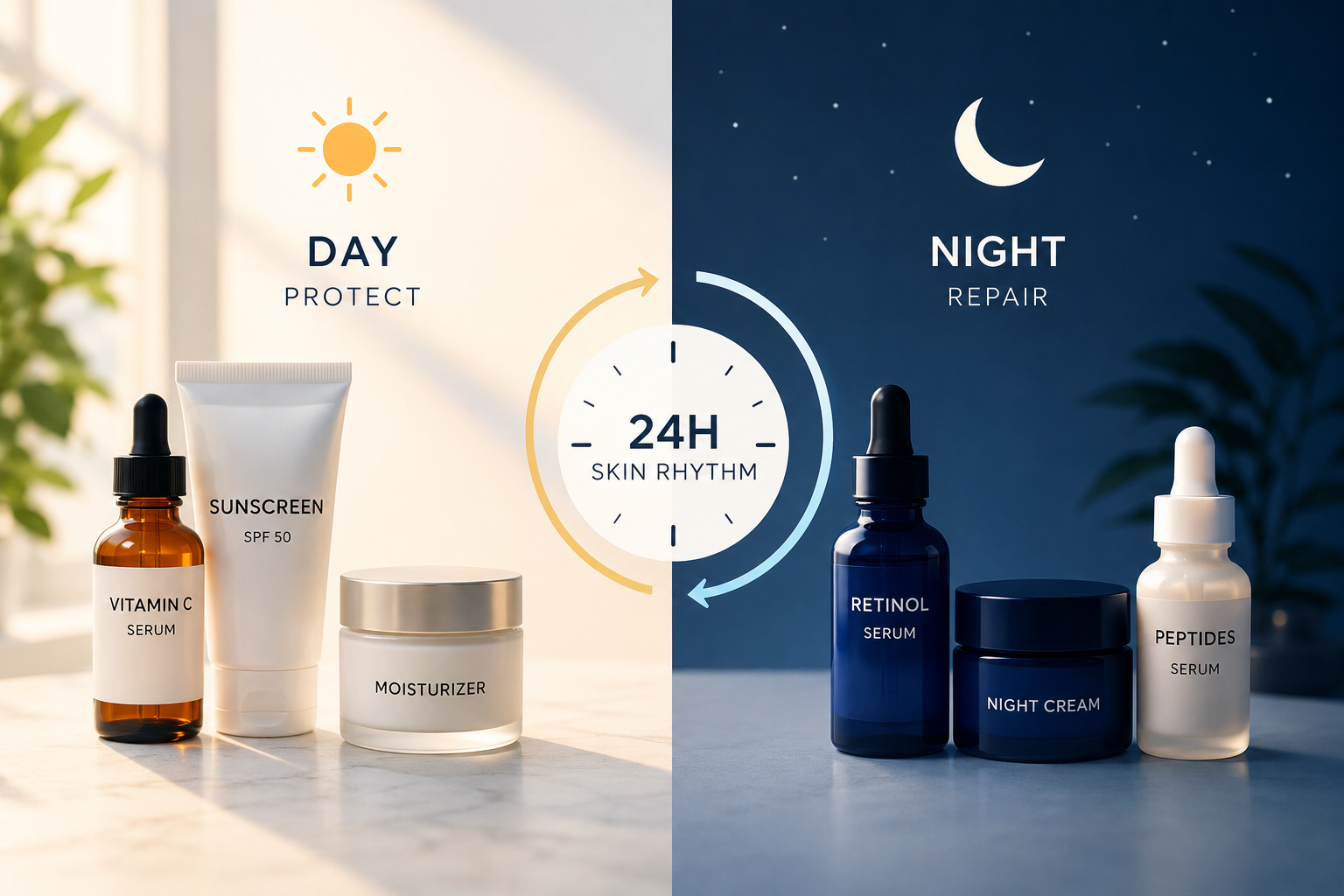
You don't need more skincare products—you need better timing. Your skin doesn't behave the same way at 8 a.m. as it does at 10 p.m. Throughout the day, it switches between protecting itself from environmental damage and repairing that damage while you sleep.
This daily cycle is controlled by your skin's circadian rhythm, an internal biological clock found in nearly every skin cell. Research suggests that using certain ingredients when your skin is naturally prepared to benefit from them may improve their effectiveness while supporting healthier, younger-looking skin.
Quick Answer
Yes—timing your skincare routine can matter. During the day, your skin focuses on defending itself against UV rays, pollution, and oxidative stress, making sunscreen and antioxidants your top priorities. At night, skin repair, cell renewal, and collagen production increase, making retinoids, peptides, ceramides, and moisturizers better suited for evening use.
Key Takeaways
- Your skin follows a natural circadian rhythm every 24 hours.
- Morning skincare should prioritize protection with antioxidants and sunscreen.
- Nighttime is the best time for repair-focused ingredients such as retinoids.
- Skin loses more water overnight, making hydration especially important before bed.
- Consistent sleep and daily sunscreen remain essential for healthy skin.
- Chrono-skincare improves product timing without requiring a complicated routine.
Why Your Skin Changes Throughout the Day
Your skin is your body's largest organ, and it constantly adapts to its environment. During daylight hours, it prepares for ultraviolet (UV) radiation, pollution, temperature changes, and other external stressors.
After sunset, priorities shift. Instead of defending itself, the skin increases repair activities such as cell renewal, DNA repair, and collagen production. This daily rhythm is regulated by clock genes including BMAL1, CLOCK, PER, and CRY, which coordinate skin barrier function, hydration, inflammation, and tissue repair.
These natural changes explain why dermatologists often recommend different skincare ingredients for morning and evening use.
Science Snapshot: Healthy skin protects itself during the day and repairs itself at night. Matching your skincare routine to this natural cycle may improve product performance without adding extra steps.
Morning Skincare: Focus on Protection
Every morning, your skin faces UV radiation, pollution, cigarette smoke, and free radicals. These environmental stressors generate oxidative damage that contributes to wrinkles, uneven skin tone, and collagen breakdown.
This is why antioxidant ingredients work best before daytime exposure. Vitamin C is among the most studied antioxidants and helps neutralize free radicals while supporting collagen synthesis. Research also shows that combining vitamin C with vitamin E and ferulic acid improves antioxidant stability and photoprotection.
However, antioxidants are only part of the equation. Daily use of a broad-spectrum sunscreen with SPF 30 or higher remains the most effective way to prevent premature skin aging and skin cancer.
Best Morning Ingredients
- Vitamin C
- Vitamin E
- Ferulic acid
- Niacinamide
- Broad-spectrum sunscreen (SPF 30 or higher)
These ingredients work together to reduce oxidative stress while helping maintain a healthier skin barrier throughout the day.
Night Skincare: Focus on Repair
While you sleep, your skin becomes more active internally. Cell turnover increases, collagen production rises, and damaged skin cells begin repairing DNA affected by sunlight and pollution.
At the same time, the skin barrier becomes slightly more permeable. This allows some active ingredients to penetrate more effectively, but it also increases transepidermal water loss (TEWL). Without enough hydration, skin may wake up feeling dry or irritated.
For this reason, evening routines should combine treatment ingredients with barrier-supporting moisturizers to reduce overnight moisture loss.
Why Certain Ingredients Work Better at Specific Times
Most skincare ingredients work regardless of when you apply them. However, some align better with your skin's natural circadian rhythm, making them more effective or better tolerated at certain times of the day.
Vitamin C: Morning Is Best
Vitamin C is a powerful antioxidant that helps protect skin from free radicals produced by UV radiation and pollution. It also supports collagen production and may improve skin brightness over time.
Using vitamin C in the morning allows it to work alongside sunscreen, providing an extra layer of defense against environmental damage. It should never replace sunscreen, but the combination offers better protection than either alone.
Retinoids: Better at Night
Retinol, retinal, and prescription retinoids increase skin cell turnover and stimulate collagen production. These effects naturally complement the skin's overnight repair cycle.
Applying retinoids at night also reduces exposure to sunlight, which may degrade some formulations and increase skin sensitivity. Beginners should start two to three nights per week before increasing frequency as tolerated.
Ceramides and Hydrating Ingredients
Because water loss naturally increases overnight, barrier-supporting ingredients become especially valuable before bed.
Look for moisturizers containing:
- Ceramides
- Hyaluronic acid
- Glycerin
- Squalane
- Cholesterol
These ingredients strengthen the skin barrier, improve hydration, and support overnight recovery.
Peptides
Peptides are small chains of amino acids that act as signaling molecules within the skin. Some peptide formulations may support collagen production and skin firmness, making them a good addition to many evening routines.
Morning vs. Night Skincare Comparison
| Ingredient | Morning | Night | Main Benefit |
|---|---|---|---|
| Vitamin C | ★★★★★ | ★★★☆☆ | Antioxidant protection |
| Vitamin E + Ferulic Acid | ★★★★★ | ★★★☆☆ | Reduces oxidative stress |
| Broad-Spectrum Sunscreen | ★★★★★ | ☆☆☆☆☆ | UV protection |
| Retinol / Retinal | ★☆☆☆☆ | ★★★★★ | Cell renewal and collagen support |
| Peptides | ★★★☆☆ | ★★★★★ | Supports skin repair |
| Ceramides | ★★★★☆ | ★★★★★ | Barrier repair |
| Hyaluronic Acid | ★★★★☆ | ★★★★★ | Hydration |
Clinical Pearl: Chrono-skincare doesn't require buying separate product lines. Simply use protective ingredients during the day and repair-focused ingredients at night.
A Simple Science-Based Routine
Morning
- Cleanse gently.
- Apply a vitamin C serum.
- Use a lightweight moisturizer if needed.
- Finish with broad-spectrum SPF 30 or higher.
Night
- Remove sunscreen and cleanse.
- Apply a retinoid if tolerated.
- Add peptides if desired.
- Seal everything with a ceramide-rich moisturizer.
This simple routine follows your skin's natural biology without adding unnecessary products or complicated steps.
What the Science Says
Research over the past two decades confirms that human skin follows a circadian rhythm controlled by clock genes such as BMAL1, CLOCK, PER, and CRY. These genes regulate skin cell division, DNA repair, collagen production, sebum secretion, and barrier function throughout the day.[1][2]
Studies also show that oxidative stress is greatest during daylight because of UV radiation and pollution. This supports using antioxidants and sunscreen in the morning to help reduce free radical damage before it occurs.[3][4]
At night, skin repair mechanisms become more active. Cell turnover increases, collagen synthesis accelerates, and damaged DNA begins to recover. Researchers have also found that transepidermal water loss (TEWL) rises overnight, making moisturizers especially important before bed.[1][5]
While product timing can improve skincare efficiency, experts agree that consistency, daily sunscreen, and evidence-based ingredients remain far more important than following a perfect schedule.
Common Myths About Day vs. Night Skincare
Myth: You need completely different skincare products for day and night.
Fact: Many moisturizers and hydrating products work well at any time. The main difference is when certain active ingredients provide the greatest benefit.
Myth: Vitamin C only works in the morning.
Fact: Vitamin C remains effective whenever it is used, but morning application offers better protection against daily environmental stress.
Myth: Retinol cannot be used during the day.
Fact: Retinoids still work if applied during daytime, but nighttime use is generally preferred because sunlight may increase irritation and degrade some formulations.
Myth: Expensive day and night creams are essential.
Fact: Most people achieve excellent results with a simple routine built around sunscreen, antioxidants, retinoids, and moisturizers.
Who Should Pay Attention?
Chrono-skincare may be particularly helpful for people concerned about premature aging, uneven skin tone, dryness, or a weakened skin barrier.
It may also benefit individuals who regularly use retinoids, vitamin C serums, or other active ingredients and want to maximize their effectiveness.
If you have eczema, rosacea, psoriasis, or persistent skin irritation, consult a dermatologist before introducing multiple active ingredients into your routine.
Bottom Line
Your skin doesn't perform the same job all day. During daylight hours, it focuses on protecting itself from UV radiation and environmental damage. At night, it shifts toward repair, hydration, and collagen production.
The most effective routine is also the simplest: use antioxidants and sunscreen every morning, then switch to repair-focused ingredients such as retinoids and ceramide-rich moisturizers at night. Following your skin's natural biological rhythm can improve your routine without making it more complicated.
References
- [1] Hardman JA, Haslam IS, Farjo N, et al. Circadian control of human skin physiology. Experimental Dermatology.
- [2] Geyfman M, Andersen B. Circadian clock genes and skin biology. Journal of Investigative Dermatology.
- [3] Lin FH, Lin JY, Gupta RD, et al. Ferulic acid stabilizes vitamins C and E and improves photoprotection. Journal of Investigative Dermatology.
- [4] Pullar JM, Carr AC, Vissers MCM. The roles of vitamin C in skin health. Nutrients.
- [5] American Academy of Dermatology. Daily skincare and sunscreen recommendations.
- [6] Griffiths CEM, et al. Restoration of collagen formation with topical tretinoin. New England Journal of Medicine.
- [7] Kafi R, et al. Improvement of naturally aged skin with topical retinol. Archives of Dermatology.
- [8] National Institute of Arthritis and Musculoskeletal and Skin Diseases (NIAMS). Skin health resources.