Quick Answer
Retinol remains the most evidence-based topical ingredient for reducing signs of neck aging by increasing collagen production and accelerating skin renewal. However, because neck skin is thinner and produces less natural oil than facial skin, it is more prone to irritation. Peptides offer a gentler alternative that supports collagen synthesis, improves skin barrier function, and enhances skin firmness with a lower risk of redness and peeling. For many people, combining peptides with a carefully introduced retinol routine provides the best long-term results.
Key Takeaways
- Retinol has the strongest clinical evidence for improving wrinkles and photoaging.
- Peptides are generally better tolerated by sensitive neck skin.
- The neck has fewer sebaceous glands, making it more susceptible to dryness and irritation.
- Barrier-supporting moisturizers containing ceramides improve tolerance to active ingredients.
- Daily sunscreen is essential because UV exposure is the primary driver of neck aging.
- Many dermatologists recommend combining peptides and retinol rather than choosing only one.
Why Neck Skin Ages Faster Than Facial Skin
The neck and décolletage often show signs of aging earlier than the face. This region has thinner skin, fewer sebaceous glands, reduced structural support, and experiences constant movement throughout the day. Years of ultraviolet (UV) exposure, repetitive bending while looking at digital devices, and gradual collagen loss contribute to horizontal neck lines, laxity, uneven pigmentation, and crepey skin.
Unlike facial skin, the neck has a weaker protective barrier, making it more vulnerable to irritation from potent skincare ingredients. Selecting products that balance effectiveness with skin barrier protection is therefore essential.
Quick Fact: Neck skin is thinner and naturally produces less oil than facial skin, making it more prone to dryness, irritation, and accelerated visible aging.
Peptides vs Retinol: Side-by-Side Comparison
| Feature | Peptides | Retinol |
|---|---|---|
| Primary action | Cell signaling and collagen support | Accelerates cell turnover and collagen production |
| Scientific evidence | Moderate | Strong |
| Best for | Sensitive skin and prevention | Wrinkles, sun damage, texture improvement |
| Irritation risk | Very low | Moderate to high |
| Barrier friendly | Excellent | Requires gradual introduction |
| Suitable for beginners | Yes | Yes, with slow introduction |
How Peptides Help Aging Neck Skin
Peptides are short chains of amino acids that function as signaling molecules within the skin. Certain peptides communicate with skin cells, encouraging natural repair mechanisms and supporting extracellular matrix proteins such as collagen and elastin.
Popular peptide ingredients include Copper Tripeptide-1 (GHK-Cu), Palmitoyl Tripeptide-1, and Palmitoyl Tetrapeptide-7. Clinical studies suggest these ingredients may improve skin elasticity, hydration, firmness, and the appearance of fine lines over time while causing minimal irritation.
Because peptides do not accelerate skin cell turnover like retinoids, they are generally well tolerated by people with sensitive skin, rosacea-prone skin, or compromised skin barriers.
Peptides support healthier-looking skin through cellular signaling rather than controlled irritation, making them an excellent option for delicate neck skin.
How Retinol Improves Neck Aging
Retinol is a vitamin A derivative and one of the most extensively researched anti-aging ingredients in dermatology. After conversion into retinoic acid within the skin, it stimulates collagen synthesis, normalizes keratinization, improves epidermal turnover, and reduces the appearance of fine lines, wrinkles, uneven pigmentation, and rough texture.
While highly effective, retinol commonly causes dryness, peeling, redness, and irritation during the adjustment period. These effects can be even more noticeable on the neck because the skin barrier is naturally weaker than on the face.
Starting with a low-strength encapsulated retinol or retinaldehyde product and gradually increasing frequency can significantly improve tolerance.
What the Science Says
Large clinical studies consistently identify topical retinoids as the gold standard for treating photoaged skin because they increase collagen production, reduce matrix metalloproteinases (MMPs), and improve epidermal structure.
Research on cosmetic peptides continues to grow. Studies suggest signal peptides and copper peptides can improve skin elasticity, hydration, collagen remodeling, and overall skin quality, although the evidence remains less extensive than that supporting retinoids.
Current dermatology experts generally view peptides as complementary ingredients rather than direct replacements for retinoids.
How to Build an Effective Neck Care Routine
1. Apply Peptides Every Morning
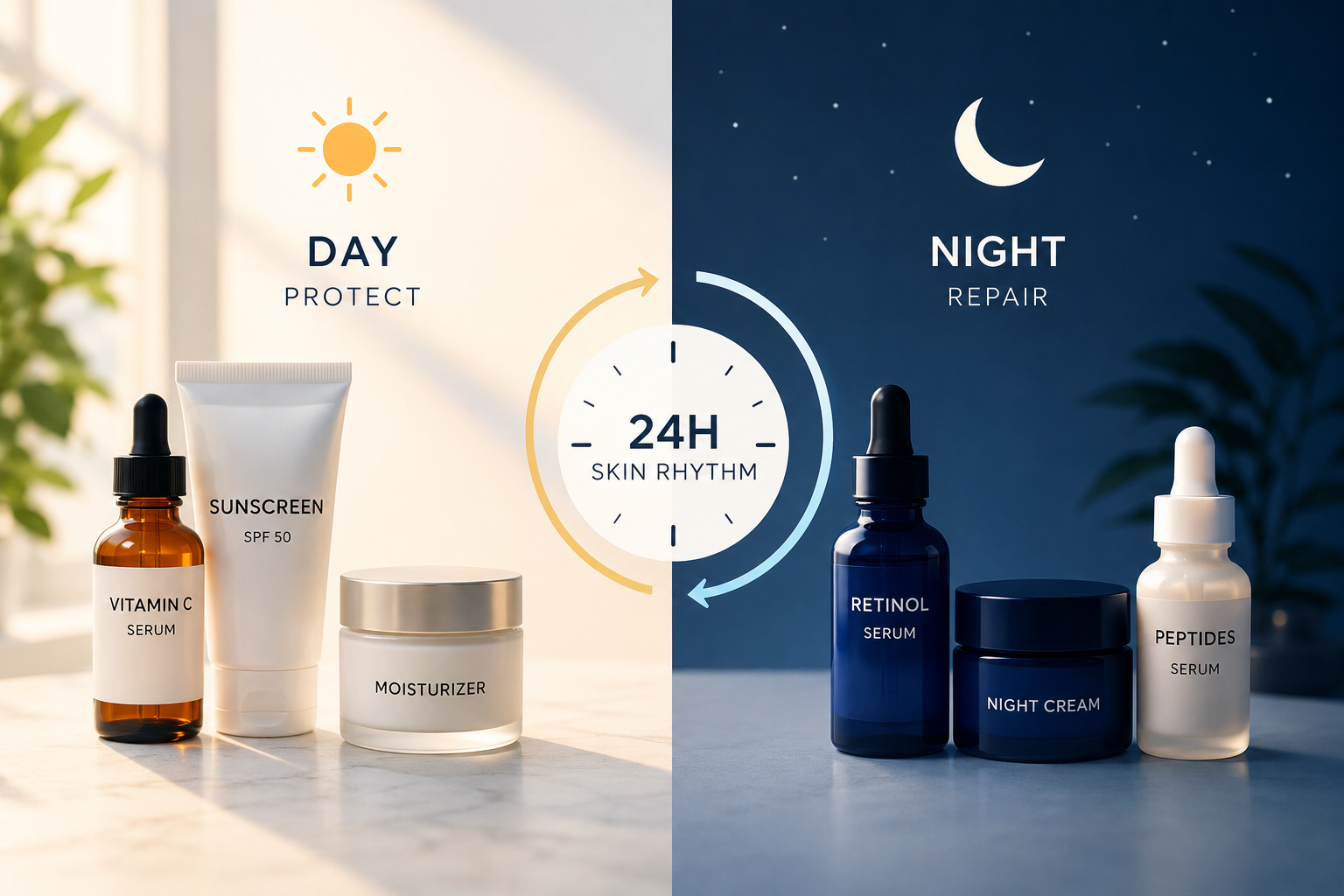
Use a peptide serum on the neck and décolletage after cleansing. Follow with a moisturizer containing ceramides and broad-spectrum SPF 30 or higher sunscreen to protect newly formed collagen from UV damage.
2. Introduce Retinol Slowly at Night
Choose a low-strength encapsulated retinol or retinaldehyde formulated for sensitive skin. Begin two nights per week before increasing frequency based on tolerance.
3. Prioritize Barrier Repair
After active ingredients, apply a moisturizer containing ceramides, cholesterol, and fatty acids to reduce transepidermal water loss and improve skin barrier recovery.
4. Use Gentle Application Techniques
Apply skincare using light upward strokes from the collarbone toward the jawline. Avoid aggressive rubbing or pulling that may increase mechanical stress on delicate neck skin.
5. Never Skip Sunscreen
Daily UV protection remains the single most important strategy for preventing collagen degradation and slowing visible neck aging.
Common Myths
- Myth: Retinol is too harsh for every neck.
Fact: Most people can tolerate properly formulated low-strength retinol when introduced gradually. - Myth: Peptides work instantly.
Fact: Improvements usually require consistent use over several weeks or months. - Myth: More retinol produces faster results.
Fact: Excessive use increases irritation without necessarily improving long-term outcomes. - Myth: Neck creams are completely different from face creams.
Fact: Many quality facial products are suitable for the neck if they are well tolerated and appropriately formulated.
Who Should Pay Attention?
- Adults noticing horizontal neck lines.
- People with early signs of photoaging.
- Individuals with sensitive or dry neck skin.
- People experiencing crepey skin on the neck or chest.
- Anyone using retinol who develops persistent irritation.
Bottom Line
Retinol remains the most scientifically supported ingredient for improving visible signs of neck aging, including wrinkles, uneven texture, and collagen loss. Peptides provide a valuable complementary approach by supporting collagen production, strengthening the skin barrier, and minimizing irritation. Rather than viewing them as competitors, most people achieve the best results by combining peptide-based daytime care with carefully introduced nighttime retinol, alongside daily sunscreen and barrier-supportive moisturizers.
Medical References
1. American Academy of Dermatology. Retinoids for aging skin.
2. Fisher GJ, et al. Mechanisms of Photoaging and Chronological Skin Aging. Archives of Dermatology.
3. Kafi R, et al. Improvement of Naturally Aged Skin With Vitamin A (Retinol). Archives of Dermatology.
4. Choi CM, Berson DS. Cosmeceuticals. Seminars in Cutaneous Medicine and Surgery.
5. Robinson LR, et al. Topical Palmitoyl Pentapeptide Improves Photoaged Human Facial Skin. International Journal of Cosmetic Science.
6. Pickart L, Margolina A. Regenerative and Protective Actions of GHK-Cu in the Skin. Clinical, Cosmetic and Investigational Dermatology.
7. Griffiths CEM. Retinoids and Photoaging. Journal of Dermatological Treatment.