Quick Answer: Hyaluronic acid can provide both surface and deeper hydration, but it does not add moisture by itself. Instead, it attracts and holds water. Products containing multiple molecular weights of hyaluronic acid, applied to damp skin and sealed with a moisturizer, provide the best hydration while reducing the risk of moisture loss.
Key Takeaways
- Hyaluronic acid is a humectant that attracts and binds water.
- High molecular weight HA mainly hydrates the skin's surface.
- Low molecular weight HA penetrates the upper layers of the skin more effectively.
- Applying HA to damp skin followed by moisturizer improves hydration.
- Using HA incorrectly in very dry environments may contribute to increased water loss from the skin.
Hyaluronic acid (HA) has become one of the most popular skincare ingredients, appearing in serums, moisturizers, sheet masks, and even makeup. Marketing often suggests it delivers instant, deep hydration, but the science is more nuanced.
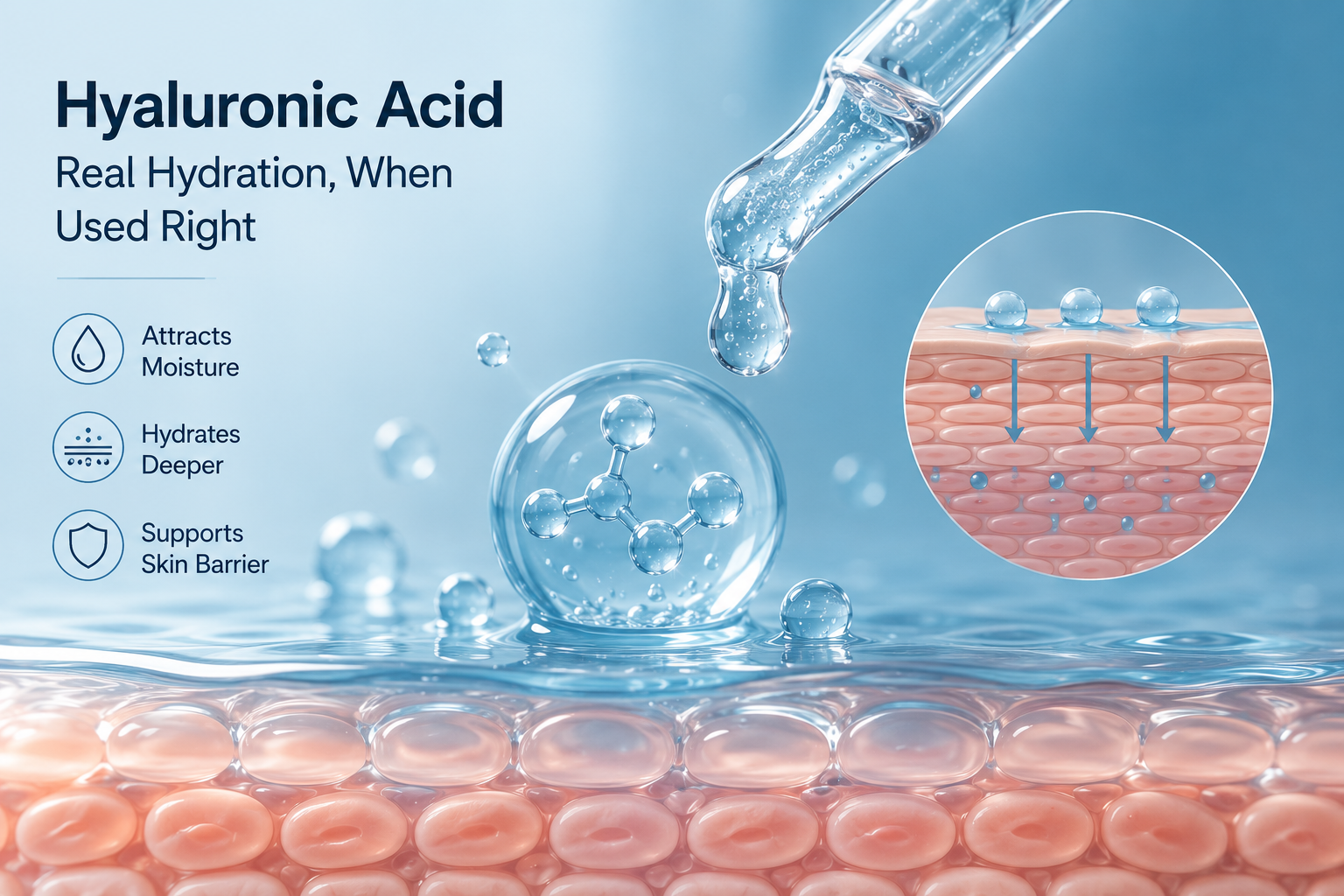
Hyaluronic acid does not produce moisture. Instead, it functions as a humectant, attracting water from its surroundings and holding it within the skin. Whether that results in healthier, hydrated skin depends on several factors, including the type of hyaluronic acid used, the surrounding humidity, and your skincare routine.
What Is Hyaluronic Acid?
Hyaluronic acid is a naturally occurring sugar molecule found throughout the body, especially in the skin, joints, and connective tissues. Nearly half of the body's hyaluronic acid is located in the skin, where it helps maintain hydration, elasticity, and resilience.
Its remarkable ability to bind water makes it an important component of healthy skin. Research shows that one gram of hyaluronic acid can bind several liters of water, helping maintain skin moisture and reducing the appearance of dryness.
Does Hyaluronic Acid Penetrate the Skin?
The answer depends largely on its molecular weight.
High Molecular Weight Hyaluronic Acid
Large HA molecules remain primarily on the skin's surface because they cannot easily penetrate the outer skin barrier. They form a lightweight film that temporarily smooths roughness, reduces transepidermal water loss (TEWL), and leaves skin feeling softer.
Low Molecular Weight Hyaluronic Acid
Smaller HA molecules penetrate more effectively into the upper layers of the epidermis, where they attract water and provide longer-lasting hydration. Some studies suggest they may also support skin barrier repair and improve skin elasticity over time.
Many dermatologists recommend products containing multiple molecular weights because they hydrate both the skin's surface and the upper epidermal layers simultaneously.
Can Hyaluronic Acid Dry Out Your Skin?
Surprisingly, yes—under certain conditions.
Because hyaluronic acid attracts water, it needs a nearby moisture source. In environments with very low humidity, such as air-conditioned rooms, heated homes during winter, or extremely dry climates, HA may pull water from deeper layers of the skin instead of from the surrounding air.
If that moisture is not sealed in with a moisturizer, it can evaporate, increasing transepidermal water loss. This may leave the skin feeling tighter or drier after the serum dries.
While this effect is often discussed in skincare communities, evidence suggests the overall formulation of the product, supporting ingredients, and proper application play a much larger role than hyaluronic acid alone.
How to Use Hyaluronic Acid Correctly
1. Apply to Damp Skin
After cleansing, leave your skin slightly damp or lightly mist it with water before applying hyaluronic acid. This provides immediate moisture for HA to bind.
2. Follow With a Moisturizer
Apply a moisturizer within one to two minutes. Moisturizers containing ceramides, glycerin, squalane, or fatty acids help lock hydration into the skin and strengthen the moisture barrier.
3. Choose Multi-Weight Formulas
Products containing sodium hyaluronate, hydrolyzed hyaluronic acid, and multiple HA sizes generally provide more comprehensive hydration than formulas using a single form alone.
4. Adjust for Your Environment
If you live in a dry climate or spend long hours in air-conditioned spaces, consider using a humidifier indoors. Maintaining indoor humidity helps optimize the performance of humectants like hyaluronic acid.
What the Science Says
Clinical studies consistently show that topical hyaluronic acid improves skin hydration, reduces roughness, and enhances skin elasticity. Research also indicates that molecular weight significantly influences how HA interacts with the skin, with combination formulations often providing the greatest cosmetic benefits.
Modern formulations frequently combine multiple HA sizes with barrier-supporting ingredients such as ceramides and glycerin to maximize hydration while minimizing moisture loss.
Common Myths About Hyaluronic Acid
Myth: Hyaluronic acid always penetrates deep into the skin.
Fact: Only lower molecular weight forms penetrate the upper epidermis effectively. Larger molecules remain on the surface.
Myth: Hyaluronic acid hydrates the skin by itself.
Fact: It binds existing water rather than creating moisture.
Myth: More hyaluronic acid always means better hydration.
Fact: Product formulation, molecular weight, supporting ingredients, and proper application matter more than concentration alone.
Who Should Use Hyaluronic Acid?
- People with dry or dehydrated skin.
- Individuals experiencing seasonal dryness.
- Those using retinoids or exfoliating acids who need additional hydration.
- People with oily or acne-prone skin looking for lightweight hydration.
- Mature skin seeking improved plumpness and skin barrier support.
Bottom Line
Hyaluronic acid is supported by strong scientific evidence as an effective hydrating ingredient, but it works by attracting water rather than generating it. Products that combine multiple molecular weights and are applied to damp skin before moisturizer offer the best chance of improving hydration, supporting the skin barrier, and maintaining a healthy, plump complexion.