Medically reviewed by the HyaluFlow Health Editorial Team | Published: June 29, 2026 | Last Updated: August 7, 2026
Quick Answer
Side sleeping can create facial compression, stretching, and temporary sleep lines. However, there is not enough evidence to prove that consistently sleeping on one side permanently accelerates aging on that side of the face.
Research does show that mechanical pressure during sleep can contribute to facial lines. Other major factors, including age, UV exposure, genetics, smoking, and natural collagen loss, have much stronger evidence as causes of long-term skin aging.
Key Takeaways
- Side sleeping places repeated pressure on the face.
- Sleep position can contribute to temporary facial lines and creases.
- Evidence linking one-sided sleeping with permanent facial asymmetry is limited.
- Sun exposure remains a much stronger driver of premature skin aging.
- Back sleeping can reduce direct facial pressure during sleep.
- A smooth pillowcase may reduce friction, but it cannot prevent skin aging.
- Daily sunscreen and evidence-based skincare remain more important for long-term skin health.
Table of Contents
- Can Side Sleeping Cause Facial Wrinkles?
- How Pillow Pressure Affects the Skin
- Does Side Sleeping Age One Side Faster?
- How to Reduce Sleep Lines
- What About Silk Pillowcases?
- Can Skincare Prevent Sleep Wrinkles?
- What the Science Says
- Common Myths
- Who Should Pay Attention?
- Bottom Line
Can Side Sleeping Cause Facial Wrinkles?
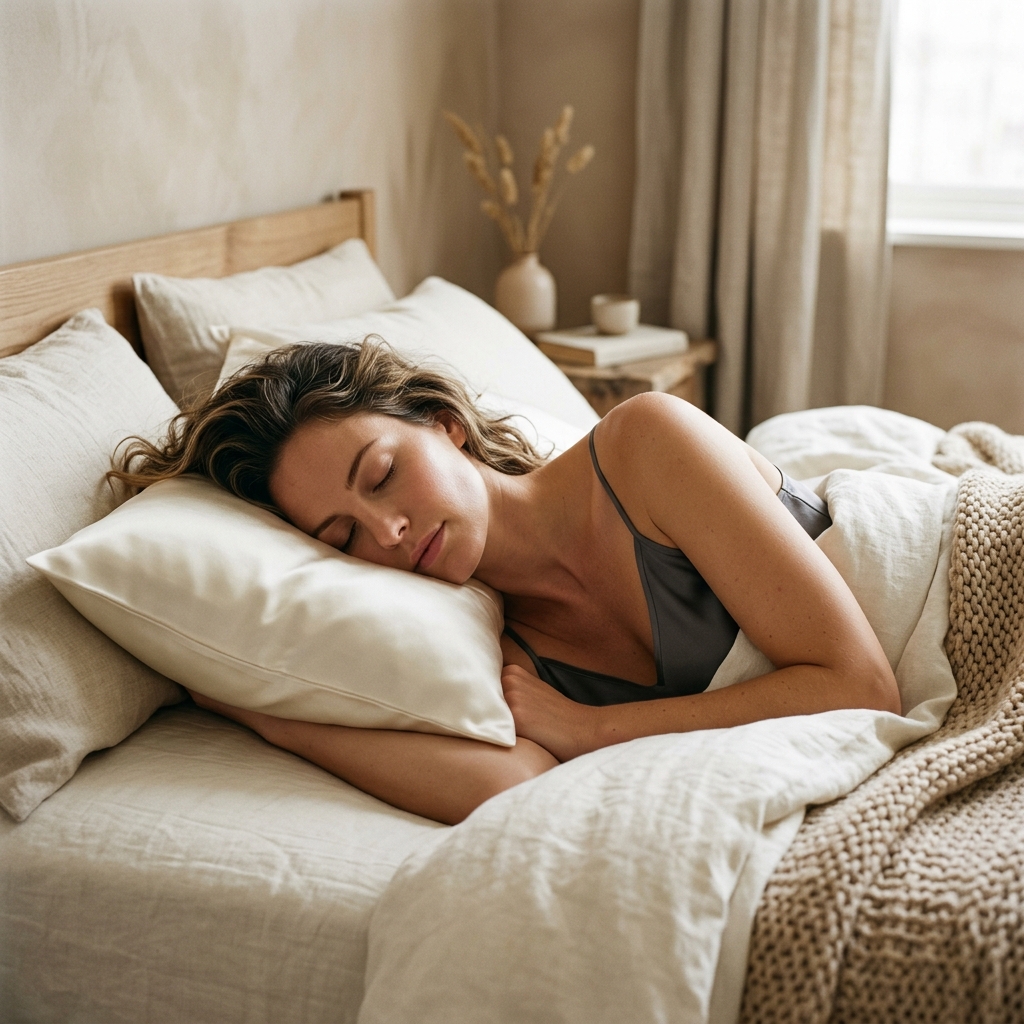
Yes, side sleeping can create what researchers call sleep wrinkles or sleep lines.
When your face rests against a pillow, the skin can be compressed and folded.
Repeated mechanical stress may produce creases in areas such as the cheeks, around the eyes, and near the mouth.
A review of sleep-related facial distortion found that compression, shear, and other mechanical forces can affect facial skin during lateral or stomach sleeping. [1]
These lines are different from expression wrinkles.
Expression wrinkles develop mainly from repeated facial muscle movement.
Sleep lines are associated with repeated mechanical distortion during sleep.
How Pillow Pressure Affects the Skin
Your face experiences pressure whenever it rests against a pillow.
That pressure can temporarily deform the skin.
Over many years, repeated mechanical stress may contribute to persistent lines in some people.
However, the process is more complicated than simply saying that pillow pressure destroys collagen.
There is currently no strong clinical evidence showing that ordinary side sleeping directly causes localized collagen loss by restricting blood flow.
The original claim that nightly pillow pressure chronically reduces oxygen delivery and therefore causes one-sided collagen breakdown is not well established in humans.
Side sleeping can create repeated mechanical stress on facial skin, but research has not established that it permanently ages the sleeping side faster than the other side.
Does Side Sleeping Age One Side Faster?
This is where the evidence becomes less clear.
It is reasonable to suspect that repeatedly compressing one side could contribute to more visible sleep lines on that side.
But that does not prove that the entire side of the face is biologically aging faster.
A study of 100 women found no significant relationship between preferred sleep side and the side of the face with more wrinkles or facial descent. [2]
This is important because facial asymmetry has many possible causes.
Genetics, sun exposure, facial expressions, bone structure, fat distribution, muscle activity, and normal aging can all contribute.
Therefore, a deeper wrinkle on one side should not automatically be blamed on sleeping position.
How to Reduce Sleep Lines
You do not need to completely change your sleeping position to protect your skin.
Small adjustments may reduce repeated facial compression.
1. Try Back Sleeping
Sleeping on your back minimizes direct contact between your face and the pillow.
The American Academy of Dermatology notes that side or stomach sleeping may contribute to sleep lines and that back sleeping can help reduce this type of facial pressure. [3]
However, comfort matters.
If back sleeping makes it difficult to sleep well, forcing the position may not be worthwhile.
2. Reduce Pillow Friction
A smoother pillowcase may reduce friction between your skin and the fabric.
Silk and satin pillowcases are often marketed for this reason.
However, strong clinical evidence that ordinary silk or satin pillowcases prevent facial aging is limited.
Think of them as a comfort or friction-reduction option, not an anti-aging treatment.
3. Keep Your Skin Well Moisturized
Dry skin can make fine lines look more noticeable.
A moisturizer containing ingredients such as ceramides, glycerin, or hyaluronic acid can help support hydration and the skin barrier.
This will not eliminate sleep lines, but it can improve the appearance and comfort of dry skin.
4. Protect Your Skin From UV Damage
If your goal is long-term wrinkle prevention, sunscreen matters far more than your pillowcase.
Use a broad-spectrum sunscreen with SPF 30 or higher during the day.
UV exposure is one of the strongest modifiable contributors to premature skin aging.
Can Skincare Prevent Sleep Wrinkles?
Skincare cannot completely prevent mechanical creasing during sleep.
It can, however, improve the skin's overall resilience and reduce other causes of premature aging.
Retinoids
Topical retinoids have strong evidence for improving photoaged skin.
They can help reduce the appearance of fine wrinkles and improve skin texture over time.
Moisturizers
Regular moisturization helps reduce dryness and supports the skin barrier.
Hydrated skin can also make fine lines appear less noticeable.
Antioxidants
Ingredients such as vitamin C can provide antioxidant protection and support collagen-related processes in the skin.
They should complement, not replace, daily sunscreen.
What the Science Says
Research supports the existence of sleep-related facial lines.
A study using facial pressure observations found that sleeping against a pillow produced visible facial deformation and wrinkles during sleep. [4]
Another study identified sleep lines in middle-aged women and found that their presence was associated with age and other signs of skin aging. [5]
However, evidence that sleep position causes one side of the face to age faster is inconsistent.
The study of 100 women found no significant relationship between preferred sleeping side and the side showing greater wrinkles or facial descent. [2]
This means the most accurate conclusion is simple: side sleeping may contribute to mechanical sleep lines, but it has not been proven to cause faster biological aging on one side of the face.
Common Myths
Myth: Sleeping on one side destroys collagen on that side.
Fact: There is not enough human evidence to make this claim. Side sleeping creates mechanical pressure, but localized collagen loss from pillow pressure has not been clearly demonstrated.
Myth: Sleeping on your back stops facial aging.
Fact: Back sleeping reduces direct facial compression, but it cannot stop intrinsic aging, UV damage, or collagen decline.
Myth: Silk pillowcases prevent wrinkles.
Fact: Smooth fabrics may reduce friction, but strong evidence that standard silk pillowcases prevent long-term facial wrinkles is lacking.
Myth: Uneven wrinkles prove you sleep on that side.
Fact: Facial asymmetry has many possible causes. Sleep position is only one potential contributor.
Who Should Pay Attention?
This topic may be useful if you regularly notice sleep lines after waking.
You may also want to consider your sleeping position if one side of your face repeatedly develops deep pillow creases.
However, do not assume that every difference between the two sides of your face is caused by sleeping position.
If you notice a new or rapidly changing facial asymmetry, swelling, weakness, or another unusual change, speak with a healthcare professional rather than treating it as normal skin aging.
Evidence Strength Summary
| Claim | Evidence Strength |
|---|---|
| Sleep position can create temporary facial lines | Moderate |
| Mechanical compression contributes to sleep wrinkles | Moderate |
| Side sleeping permanently ages one side faster | Limited |
| Back sleeping reduces direct facial pressure | Moderate |
| Silk pillowcases prevent facial aging | Limited |
| Daily sunscreen helps prevent premature skin aging | Strong |
| Topical retinoids improve photoaging | Strong |
Bottom Line
Side sleeping can contribute to sleep lines because your face repeatedly experiences pressure and mechanical distortion against the pillow.
But the claim that sleeping on one side makes that entire side of your face age faster is not supported by strong evidence.
If you want to minimize sleep-related facial creases, back sleeping can reduce facial pressure.
A smooth pillowcase may also reduce friction.
For long-term skin aging, however, focus on the fundamentals.
Use sunscreen daily, moisturize consistently, avoid smoking, and consider evidence-based ingredients such as retinoids when appropriate.
Medical References
- Anson G, Kane MA, Lambros V. Sleep Wrinkles: Facial Aging and Facial Distortion During Sleep. Aesthetic Surgery Journal. 2016;36(8):931-940. PMID: 27329660. DOI: 10.1093/asj/sjw074. [1]
- Kotlus BS. Effect of sleep position on perceived facial aging. Dermatologic Surgery. 2013;39(9):1360-1362. PMID: 23865987. DOI: 10.1111/dsu.12266. [2]
- American Academy of Dermatology Association. Dermatologists' guidance on healthy skin care and sleep-related skin aging. [3]
- Poljsak B, Godic A, Lampe T, Dahmane R. The influence of sleeping on the formation of facial wrinkles. Journal of Cosmetic and Laser Therapy. 2012;14(3):133-138. PMID: 22506801. DOI: 10.3109/14764172.2012.685563. [4]
- Xerfan EMS, Facina AS, Tomimori J, Tufik S, Andersen ML. Sleep lines on the skin: an overview of possible causes beyond a purely mechanical etiology. International Journal of Dermatology. 2022;61(6):760-762. PMID: 35141884. DOI: 10.1111/ijd.16072. [5]