Medically reviewed by the HyaluFlow Health Editorial Team | Published: June 29, 2026 | Last Updated: August 9, 2026
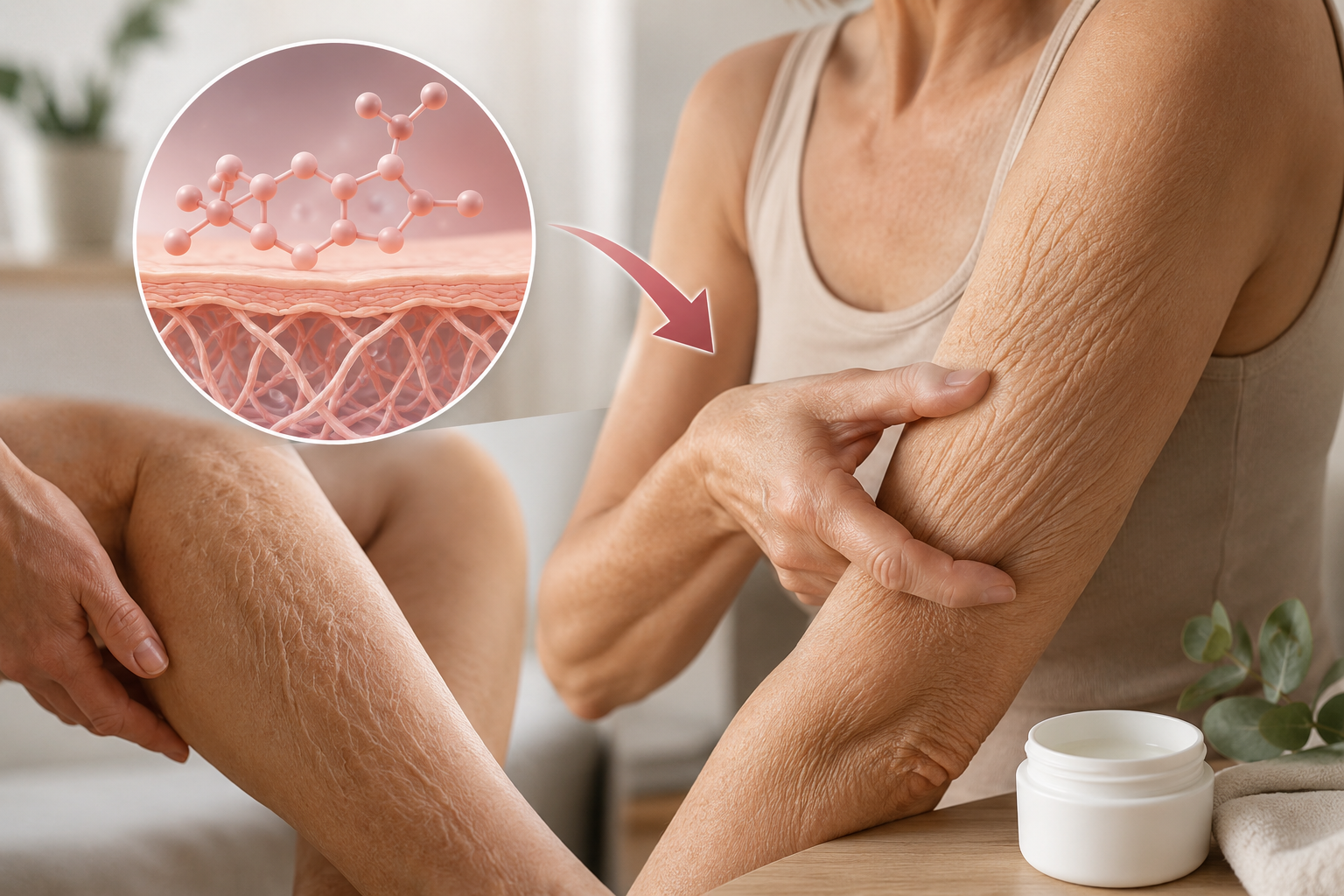
Menopause can change the skin in ways that are easy to overlook. While facial aging often gets the most attention, the arms and legs can also become noticeably drier, thinner, rougher, and more crepey.
The main driver is the decline in estrogen during the menopausal transition. Estrogen affects collagen production, skin thickness, hydration, elasticity, and the function of the skin barrier.
Quick Answer: Menopause can change the skin on the arms and legs by reducing estrogen-related support for collagen, hydration, elasticity, and barrier function. The result may be drier, thinner, rougher, or crepey-looking skin. A consistent routine using gentle cleansing, rich moisturizers, controlled exfoliation, retinoids when appropriate, and daily sun protection can improve its appearance and comfort.
Key Takeaways
- Estrogen decline is linked to changes in collagen, skin thickness, hydration, and elasticity.
- Collagen loss can make the skin on the arms and legs look thinner and less firm.
- Menopause can also alter ceramides and other skin-barrier lipids.
- A weakened barrier can increase dryness and water loss from the skin.
- Ceramide-rich moisturizers can help support the skin barrier.
- Lactic acid and other alpha-hydroxy acids may improve rough texture when used carefully.
- Retinoids can support collagen remodeling but may cause irritation if introduced too aggressively.
- Phytoestrogens are promising but are not proven replacements for estrogen therapy.
Why Menopause Changes Skin on the Arms and Legs
Estrogen does more than regulate reproductive function. It also influences several biological processes involved in maintaining healthy skin.
When estrogen levels fall during menopause, collagen production and other aspects of skin structure can change. Studies and reviews have linked menopause with reduced skin thickness, elasticity, hydration, and collagen content. [1][2]
Collagen provides much of the skin's structural framework. When collagen becomes less abundant, the skin has less support and may gradually look thinner and less firm.
Research suggests that collagen loss can be particularly rapid around the menopausal transition. Some reviews estimate that skin collagen may decrease by as much as 30% during the first five years after menopause. [1][2]
That figure is an estimate, not a prediction for every woman. Age, genetics, cumulative sun exposure, smoking, nutrition, and other factors also influence collagen loss.
The arms and legs may therefore develop a more noticeable crepey appearance, especially around the upper arms, thighs, knees, and lower legs.
How Estrogen Decline Affects Skin Hydration
Menopausal skin can also become noticeably drier. Estrogen influences substances involved in maintaining the skin's water content, including hyaluronic acid and other components of the extracellular matrix. [1][3]
When the skin holds less water, it can feel tight and rough. Fine lines may also become more visible because dehydrated skin reflects light differently and has less surface smoothness.
This does not mean drinking excessive amounts of water will reverse menopausal skin aging. Internal hydration matters for overall health, but it cannot replace the structural changes associated with collagen and estrogen loss.
Topical moisturization is therefore an important part of managing menopausal dry skin.
The Role of Ceramides and the Skin Barrier
Ceramides are lipids found naturally in the outermost layer of the skin. Along with cholesterol and fatty acids, they help create a barrier that limits water loss and protects the skin from external irritants.
Research has found measurable changes in the ceramide profile of postmenopausal skin. One study found lower ceramide levels and changes in ceramide structure in postmenopausal women compared with premenopausal women. These changes were not observed in the same way among women using hormone replacement therapy. [4]
This provides biological support for the idea that estrogen decline can influence skin-barrier lipids.
When barrier function is impaired, transepidermal water loss, or TEWL, can increase. The skin may then become rougher, drier, flaky, or itchy.
Menopause can affect both sides of skin aging: reduced structural support from collagen loss and reduced moisture retention from changes in the skin barrier.
What Crepey Skin on the Arms and Legs Really Means
Crepey skin is not simply dry skin. It usually reflects a combination of reduced elasticity, collagen loss, thinning of the skin, dehydration, and cumulative environmental damage.
Sun exposure is particularly important. Ultraviolet radiation breaks down collagen and contributes to premature skin aging, which can compound the effects of hormonal aging.
This is why the appearance of crepey skin can vary dramatically between people of the same age.
| Skin Change | What May Contribute | What Can Help |
|---|---|---|
| Dryness | Barrier changes and reduced hydration | Rich moisturizers and gentle cleansing |
| Crepey texture | Collagen and elasticity loss | Sun protection, retinoids, moisturization |
| Roughness | Dryness and accumulated dead cells | Careful chemical exfoliation |
| Thinner-looking skin | Age and estrogen-related structural changes | Sun protection and consistent skin care |
How to Improve Dry, Crepey Skin During Menopause
There is no topical product that can completely restore youthful skin structure. The realistic goal is to improve hydration, support the barrier, reduce roughness, and protect remaining collagen.
1. Use a Ceramide-Rich Body Cream
For dry menopausal skin, a rich cream or ointment is generally more useful than an extremely lightweight lotion.
Look for ingredients such as ceramides, glycerin, petrolatum, hyaluronic acid, and other humectants or occlusives.
Apply moisturizer soon after bathing while the skin is still slightly damp. This helps reduce moisture loss from the surface.
2. Exfoliate Gently With Alpha-Hydroxy Acids
Lactic acid and glycolic acid can help loosen dead skin cells and improve rough or uneven texture.
Lactic acid may be particularly useful when dryness and roughness occur together because it also has humectant properties.
Start slowly rather than exfoliating aggressively. Excessive use can damage the barrier and make menopausal dryness worse.
3. Consider a Retinoid for Texture and Collagen Support
Retinoids are among the better-studied topical ingredients for photoaging. They can increase collagen-related activity and improve skin texture over time.
Body skin may tolerate retinoids differently from facial skin. Introduce them gradually and use moisturizer to reduce irritation.
Prescription retinoids should be discussed with a qualified healthcare professional, particularly if you have sensitive or damaged skin.
4. Do Not Overlook Sunscreen
Hormonal aging and photoaging can occur at the same time. UV radiation continues to damage collagen after menopause.
Apply broad-spectrum sunscreen to exposed arms and legs when spending time outdoors. Clothing and shade provide additional protection.
Consistent UV protection is one of the most important long-term steps for slowing further collagen damage.
5. Replace Harsh Body Cleansers
Very hot showers, aggressive scrubbing, and harsh cleansers can worsen dryness.
Use a gentle, fragrance-free cleanser and avoid unnecessary scrubbing of already-dry skin.
After bathing, pat the skin dry rather than rubbing it vigorously, then apply moisturizer.
6. Be Careful With Phytoestrogens
Phytoestrogens such as genistein have attracted interest because they can interact with estrogen receptors.
A small randomized trial involving postmenopausal women found that topical genistein increased type I and type III collagen in facial skin. However, topical estrogen produced a stronger effect, and the study involved only 30 women. [5]
These findings are interesting but do not prove that phytoestrogen products can reverse crepey skin on the arms and legs.
They should not be marketed as natural replacements for medically prescribed estrogen therapy.
What the Science Says About Estrogen and Skin
The relationship between estrogen and skin structure is supported by laboratory research, clinical trials, and systematic reviews.
Clinical research has found that topical estradiol can increase collagen-related measures in postmenopausal skin. [7][8]
A systematic review and meta-analysis also found improvements in some measures of skin elasticity, thickness, and collagen with menopausal hormone therapy. However, this does not mean hormone therapy should be used solely for cosmetic skin aging. [2]
Hormone therapy has potential benefits and risks that depend on factors such as age, symptoms, medical history, treatment type, and timing. Decisions about treatment should therefore be individualized with a healthcare professional.
Common Myths About Menopause Skin Changes
Myth 1: Crepey skin is caused only by dryness.
Reality: Dryness can make crepey texture more obvious, but collagen loss, reduced elasticity, skin thinning, and cumulative UV exposure also contribute.
Myth 2: Drinking more water rebuilds lost collagen.
Reality: Adequate hydration is important, but drinking excessive water cannot replace collagen lost through aging and hormonal changes.
Myth 3: Phytoestrogens work exactly like estrogen.
Reality: Phytoestrogens can interact with estrogen receptors, but their biological effects are different and generally weaker. Evidence for treating menopausal body skin remains limited.
Myth 4: Scrubbing removes crepey skin.
Reality: Aggressive scrubbing can damage the skin barrier. Gentle exfoliation is a better option when rough texture is the main concern.
Who Should Pay Attention?
Women going through perimenopause or menopause may notice new dryness, roughness, itching, thinning, or crepey texture on the arms and legs.
These changes are often manageable with consistent skin care, but persistent symptoms should not automatically be blamed on menopause.
See a dermatologist or healthcare professional if severe itching, persistent scaling, a new rash, open sores, unusual pigmentation, or rapidly changing skin develops.
Bottom Line
Menopause can change the skin on the arms and legs because falling estrogen affects collagen, elasticity, hydration, and skin-barrier function.
The result can be skin that feels drier and looks thinner, rougher, or more crepey.
You cannot completely stop hormonal skin aging, but you can improve the appearance and comfort of your skin. Focus on a rich moisturizer, gentle cleansing, controlled exfoliation, appropriate retinoid use, and consistent UV protection.
Evidence Strength Summary: Strong evidence supports a relationship between estrogen decline and changes in skin collagen, thickness, hydration, and elasticity. Evidence for ceramide changes is moderate, while evidence for topical phytoestrogens remains limited.
Medical Research References:
- Thornton MJ. Estrogens and aging skin. Dermato-Endocrinology. 2013. PMID: 24194966.
- Pivazyan L, et al. Skin Rejuvenation in Women using Menopausal Hormone Therapy: A Systematic Review and Meta-Analysis. Journal of Menopausal Medicine. 2023;29(3):97-111. PMID: 38230593.
- Hall G, et al. Menopause induces changes to the stratum corneum ceramide profile, which are prevented by hormone replacement therapy. Skin Health and Disease. 2022. PMID: 36522440.
- Aragão Silva L, et al. Collagen concentration on the facial skin of postmenopausal women after topical treatment with estradiol and genistein. Climacteric. 2017;20(6):555-560. PMID: 28508697.
- Varila E, et al. The effect of topical oestradiol on skin collagen of postmenopausal women. British Journal of Obstetrics and Gynaecology. 1995;102(12):985-989. PMID: 8652490.
- Thornton MJ, et al. Induction of collagen by estradiol: difference between sun-protected and photodamaged human skin in vivo. Archives of Dermatology. 2008;144(9):1129-1140. PMID: 18794456.