Your hands are constantly exposed to sunlight, water, soaps, cleaning products, and environmental pollutants, making them one of the first areas of the body to show visible signs of aging. Unlike facial skin, the skin on the back of the hands is thinner, contains fewer sebaceous (oil) glands, and has very little underlying fat. Over time, collagen and elastin naturally decline, while repeated ultraviolet (UV) exposure accelerates this process, leading to wrinkles, dryness, prominent veins, and age spots.
Although aging is inevitable, premature aging of the hands can often be slowed with consistent, evidence-based skincare habits. Daily sun protection, proper moisturization, topical retinoids, and healthy lifestyle choices can help preserve skin structure, maintain hydration, and reduce visible signs of aging.
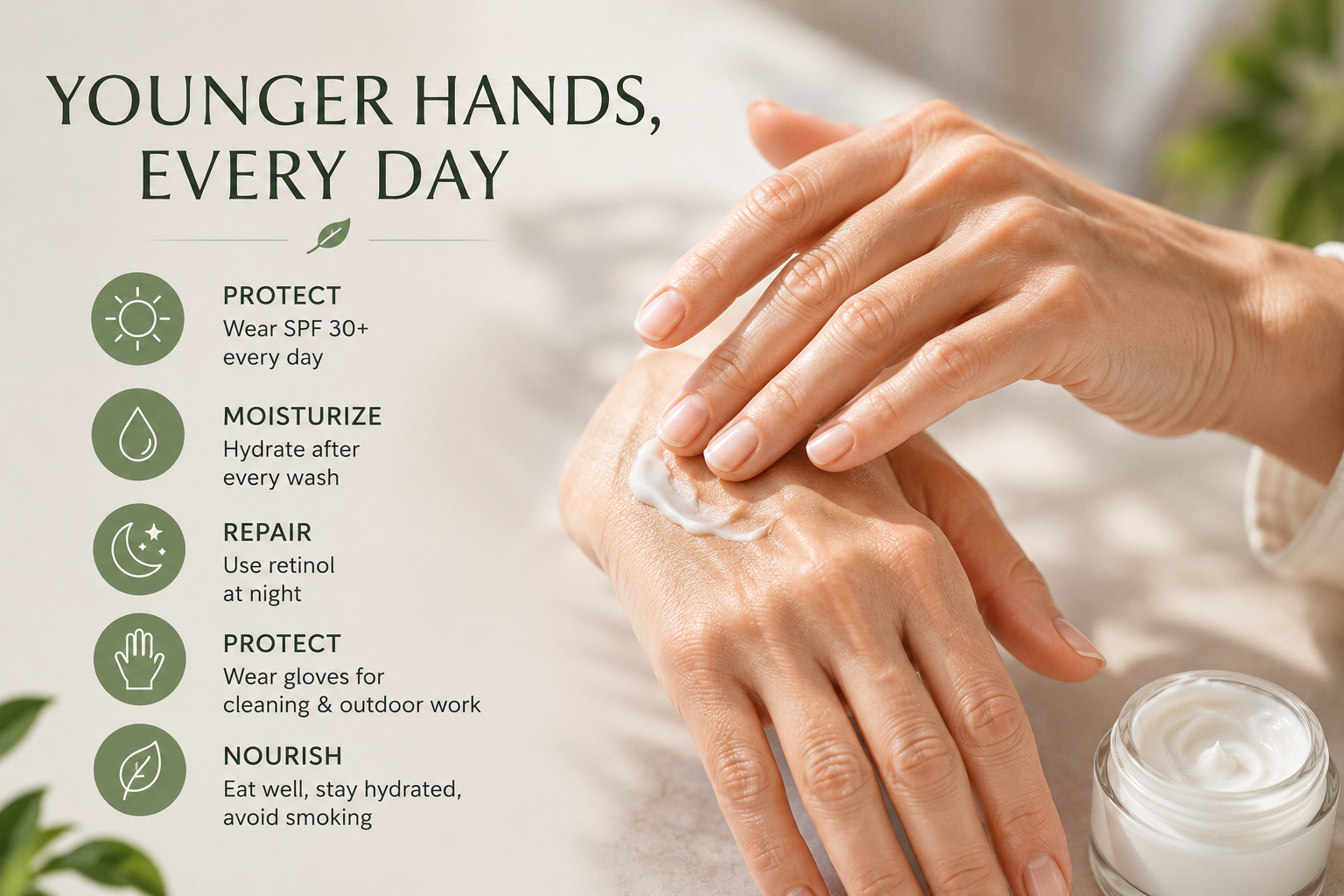
The most effective natural ways to prevent aging hands include applying broad-spectrum SPF 30 or higher every day, moisturizing after each hand wash, using retinoids at night, protecting your hands from harsh chemicals, eating a nutrient-rich diet, and avoiding smoking. Together, these habits help preserve collagen, maintain the skin barrier, and reduce wrinkles, dryness, and age spots.[1][2]
- Daily sunscreen is the most effective way to prevent premature hand aging.
- Frequent moisturizing helps restore the skin barrier and reduce dryness.
- Retinoids can stimulate collagen production and improve skin texture.
- Protective gloves reduce damage from water, detergents, and harsh chemicals.
- A healthy lifestyle supports long-term skin health and collagen maintenance.
- Consistency is more important than expensive skincare products.
Why Do Hands Age Faster Than the Face?
Many people invest heavily in facial skincare while overlooking their hands. As a result, the hands often reveal a person's age sooner than the face. This occurs because the skin on the back of the hands is naturally thinner and contains significantly less subcutaneous fat than facial skin. As collagen, elastin, and fat gradually decrease with age, veins, tendons, and bones become increasingly visible beneath the skin.[3]
The hands also contain relatively few sebaceous glands, which produce the natural oils that keep skin soft and hydrated. Without sufficient oil production, the skin becomes more susceptible to dryness, irritation, and a crepey texture. Everyday activities such as frequent handwashing, alcohol-based sanitizers, exposure to detergents, and changing weather conditions further weaken the skin barrier, increasing moisture loss and accelerating visible aging.[1][4]
Intrinsic aging—the natural biological aging process—is unavoidable. However, extrinsic aging caused by environmental factors, particularly chronic UV exposure and smoking, accounts for a substantial portion of premature skin aging and is largely preventable.[3][5]
Did you know? Dermatologists consider the backs of the hands one of the most common areas where photoaging becomes noticeable because they receive frequent sun exposure but are often forgotten during sunscreen application.
How Sun Exposure Accelerates Hand Aging
Ultraviolet radiation is the single most important external factor responsible for premature aging of the hands. Every day, your hands are exposed while driving, walking outdoors, gardening, or performing routine tasks. Unlike facial skincare, sunscreen is rarely applied to the hands consistently, allowing cumulative UV damage to build over decades.[2][6]
UVA rays penetrate deeply into the dermis, generating reactive oxygen species (free radicals) that damage collagen and elastin fibers. This process weakens the skin's supportive framework, causing wrinkles, reduced elasticity, thinning skin, and a crepey appearance. UV exposure also stimulates excess melanin production, leading to solar lentigines, commonly known as age spots or liver spots.[3][6]
Research shows that daily use of broad-spectrum sunscreen significantly reduces the development of photoaging and pigment changes compared with inconsistent sunscreen use.[2]
UVA vs. UVB: What's the Difference?
- UVA rays: Penetrate deep into the skin and are primarily responsible for premature aging and collagen breakdown.
- UVB rays: Affect the outer layers of the skin, causing sunburn and contributing to skin cancer risk.
- Broad-spectrum sunscreen: Protects against both UVA and UVB radiation and is recommended by dermatologists for daily use.[2]
Daily Routine to Prevent Aging Hands Naturally
The most effective anti-aging routine is simple, affordable, and consistent. While no product can completely stop aging, combining several evidence-based habits offers the greatest long-term protection.
1. Moisturize After Every Hand Wash
Handwashing is essential for hygiene, but it also removes the skin's protective lipids. Apply a fragrance-free moisturizer immediately after washing while your skin is still slightly damp. This helps seal in moisture and reduces transepidermal water loss.
Look for products containing:
- Ceramides
- Glycerin
- Hyaluronic acid
- Shea butter
- Petrolatum
- Squalane
These ingredients strengthen the skin barrier, improve hydration, and reduce dryness and roughness.[1][4]
2. Apply Broad-Spectrum SPF 30 or Higher Every Day
Sunscreen is arguably the most important anti-aging product for your hands. Apply SPF 30 or higher every morning to the backs of your hands, even on cloudy days. Reapply after handwashing or every two hours during prolonged outdoor activities.
If you drive frequently, remember that UVA rays can penetrate standard vehicle windows, making consistent sunscreen use especially important for preventing uneven aging.[2][6]
3. Use Retinol or Prescription Retinoids at Night
Topical retinoids are among the most extensively studied anti-aging ingredients in dermatology. They stimulate collagen synthesis, increase healthy skin cell turnover, and gradually improve fine lines, uneven pigmentation, and skin texture.[7]
Begin by applying a small amount two to three nights per week before increasing frequency as tolerated. Follow with a moisturizer to reduce irritation, and always use sunscreen during the day because retinoids can increase sun sensitivity.
4. Protect Your Hands from Chemicals and Cold Weather
Household cleaning products, detergents, solvents, and prolonged water exposure can weaken the skin barrier. Wear waterproof gloves when cleaning or washing dishes, and insulated gloves during cold weather to prevent excessive dryness and cracking.
Barrier protection is particularly important for healthcare workers, cleaners, hairdressers, and anyone whose occupation requires frequent handwashing.[1]
5. Avoid Smoking
Smoking accelerates skin aging by reducing blood flow, increasing oxidative stress, and breaking down collagen and elastin. Numerous studies associate smoking with earlier wrinkle formation and poorer skin quality throughout the body, including the hands.[5]
Comparison: Daily Habits That Help Prevent Aging Hands
| Habit | Primary Benefit | Evidence Strength |
|---|---|---|
| Daily SPF 30+ | Prevents photoaging, wrinkles, and age spots | Strong |
| Barrier-repair moisturizer | Improves hydration and repairs the skin barrier | Strong |
| Retinoids | Stimulate collagen and improve skin texture | Strong |
| Protective gloves | Reduce irritation and chemical damage | Moderate |
| Healthy diet | Supports collagen production and skin repair | Moderate |
| Avoid smoking | Reduces collagen breakdown and oxidative stress | Strong |
Continue with Part 2: Nutrition, What the Science Says, Common Myths, Who Should Pay Attention, Evidence Strength Summary, Bottom Line, Internal Linking, and Medical References.
Nutrition and Lifestyle Habits That Support Younger-Looking Hands
Healthy skin depends not only on topical skincare but also on good nutrition and lifestyle habits. Your body requires adequate protein, vitamins, minerals, and healthy fats to produce collagen, repair damaged tissue, and maintain a strong skin barrier.
A balanced diet rich in colorful fruits, vegetables, whole grains, legumes, nuts, seeds, and fatty fish provides antioxidants that help reduce oxidative stress caused by UV radiation and environmental pollutants. Vitamin C plays an essential role in collagen synthesis, while vitamin E helps protect skin cells from free radical damage. Omega-3 fatty acids support skin hydration and barrier function.[8][9]
Staying well hydrated also supports normal skin function. While drinking more water alone will not erase wrinkles, adequate hydration contributes to overall skin health.
Lifestyle choices matter just as much. Getting sufficient sleep, managing chronic stress, exercising regularly, limiting alcohol consumption, and avoiding smoking all contribute to healthier skin over time.[5][8]
What the Science Says
Scientific evidence consistently shows that premature skin aging is driven largely by chronic ultraviolet (UV) exposure rather than aging alone. UVA rays penetrate deep into the dermis where they generate reactive oxygen species that damage collagen, elastin, and other structural proteins. Over time, this leads to wrinkles, loss of elasticity, thinning skin, and uneven pigmentation.[3][6]
Barrier-repair moisturizers improve skin hydration by reducing transepidermal water loss and restoring the skin's protective lipid layer. Ingredients such as ceramides, glycerin, hyaluronic acid, and petrolatum have strong evidence supporting their ability to improve dry, damaged skin.[1][4]
Topical retinoids remain one of the most extensively researched anti-aging treatments. They promote healthy skin cell turnover, stimulate collagen production, and improve fine lines, rough texture, and pigmentation when used consistently over several months.[7]
Although no skincare product can completely stop the natural aging process, combining daily sunscreen, regular moisturization, topical retinoids, and protective habits provides the strongest evidence-based strategy for maintaining healthier, younger-looking hands.
Common Myths About Aging Hands
- Myth: Moisturizer alone can remove wrinkles.
Fact: Moisturizers improve hydration and temporarily soften fine lines but cannot replace lost collagen. - Myth: Sunscreen is only necessary at the beach.
Fact: Daily UV exposure while driving, walking, or running errands contributes significantly to premature hand aging. - Myth: Age spots are simply part of getting older.
Fact: Most age spots are primarily caused by cumulative sun exposure rather than age alone. - Myth: Expensive creams work better than sunscreen.
Fact: Consistent daily sunscreen offers greater protection against premature aging than most anti-aging creams used without sun protection. - Myth: It's too late to start caring for aging hands.
Fact: Healthy skincare habits can improve skin texture and help slow further damage at almost any age.
Who Should Pay Extra Attention?
Anyone can benefit from protecting their hands, but some individuals have a higher risk of premature hand aging.
- Adults over 40 years of age
- People with significant lifetime sun exposure
- Healthcare workers and anyone who washes their hands frequently
- Hairdressers, cleaners, mechanics, and others exposed to chemicals
- Outdoor workers and gardeners
- People with eczema or chronically dry skin
- Current and former smokers
When to See a Dermatologist
While wrinkles and age spots are common signs of aging, certain skin changes should be evaluated by a dermatologist. Seek medical advice if you notice:
- A dark spot that changes in size, shape, or color
- A sore that does not heal
- Persistent redness, pain, or swelling
- Severe cracking or dryness that does not improve with moisturizers
- Rapidly growing bumps or unusual skin lesions
Early evaluation can help identify skin cancers, precancerous lesions, eczema, or other treatable skin conditions.
Evidence Strength Summary
| Recommendation | Evidence Strength |
|---|---|
| Daily broad-spectrum sunscreen | Strong |
| Barrier-repair moisturizers | Strong |
| Topical retinoids | Strong |
| Smoking cessation | Strong |
| Protective gloves | Moderate |
| Healthy diet and hydration | Moderate |
Related Reading
For more evidence-based skincare advice, you may also find these HyaluFlow articles helpful:
- Peptides vs. Retinol: Which Is Better for Your Skin?
- Does Hyaluronic Acid Actually Hydrate Skin?
- Best Foods for Skin Barrier Repair
- Does Sunscreen Prevent Wrinkles?
Bottom Line
Your hands are exposed to more environmental stress than almost any other part of your body, making them especially vulnerable to premature aging. Fortunately, protecting them does not require an expensive skincare routine. Daily sunscreen, regular moisturization, nighttime retinoids, protective gloves, good nutrition, and healthy lifestyle habits are supported by scientific evidence and can significantly reduce wrinkles, dryness, and age spots over time.
Consistency is the key. Small daily habits practiced for years are far more effective than occasional use of expensive anti-aging products.
Medical References
- American Academy of Dermatology Association (AAD). Skin Care Basics and Hand Care Recommendations.
- American Academy of Dermatology Association. Sunscreen FAQs and Sun Protection Guidelines.
- Fisher GJ, Kang S, Varani J, et al. Mechanisms of Photoaging and Chronological Skin Aging. Archives of Dermatology.
- Elias PM. Skin Barrier Function. Journal of Investigative Dermatology.
- Morita A. Tobacco Smoke Causes Premature Skin Aging. Journal of Dermatological Science.
- British Association of Dermatologists. Sun Protection and Skin Ageing.
- Griffiths CEM, et al. Topical Tretinoin (Retinoic Acid) Improves Photoaged Skin. New England Journal of Medicine.
- National Institute on Aging (NIA). Skin Care and Aging.
- National Institutes of Health (NIH). Nutrition and Skin Health.