Reviewed by the HyaluFlow Health Editorial Team | Published: August 21, 2026 | Last Updated: August 21, 2026
K-beauty has moved far beyond the famous 10-step routine. In 2026, Korean skincare trends gaining traction in the U.S. are increasingly focused on barrier health, hydration, PDRN, peptides, overnight masks, scalp care, and treatment-inspired formulas.
The shift is also becoming easier to see in mainstream retail. On August 20, 2026, Sephora launched an Olive Young-curated selection of 19 Korean beauty brands across more than 500 U.S. stores and Sephora.com, giving American shoppers easier access to Korean beauty products. Sephora Newsroom, 2026.
Quick Answer: The biggest K-beauty trends in 2026 include PDRN skincare, barrier repair, peptides, overnight masks, scalp care, advanced hydration, and a more natural version of glass skin. The smartest strategy is to build around proven skincare basics before chasing viral ingredients.
Key Takeaways
- K-beauty is becoming more accessible to U.S. consumers.
- PDRN is one of the most talked-about Korean skincare ingredients.
- Barrier-focused skincare has a stronger scientific foundation than many viral trends.
- Peptides show potential, but evidence varies by peptide and formulation.
- Scalp care is becoming an important part of Korean beauty routines.
- Emerging ingredients should be judged by clinical evidence rather than marketing claims.
Why K-Beauty Is Growing in the U.S.
Korean skincare has influenced Western beauty for years, but wider retail access is accelerating its reach. The Sephora and Olive Young partnership brings 19 Korean beauty brands into more than 500 U.S. stores, making Korean skincare easier to discover and purchase.
Beauty industry coverage also shows that K-beauty has become an established force in Western markets rather than a short-lived fad. Industry reports highlight the continued expansion and evolution of Korean skincare across U.S. retailers.
PDRN Is a Major K-Beauty Trend
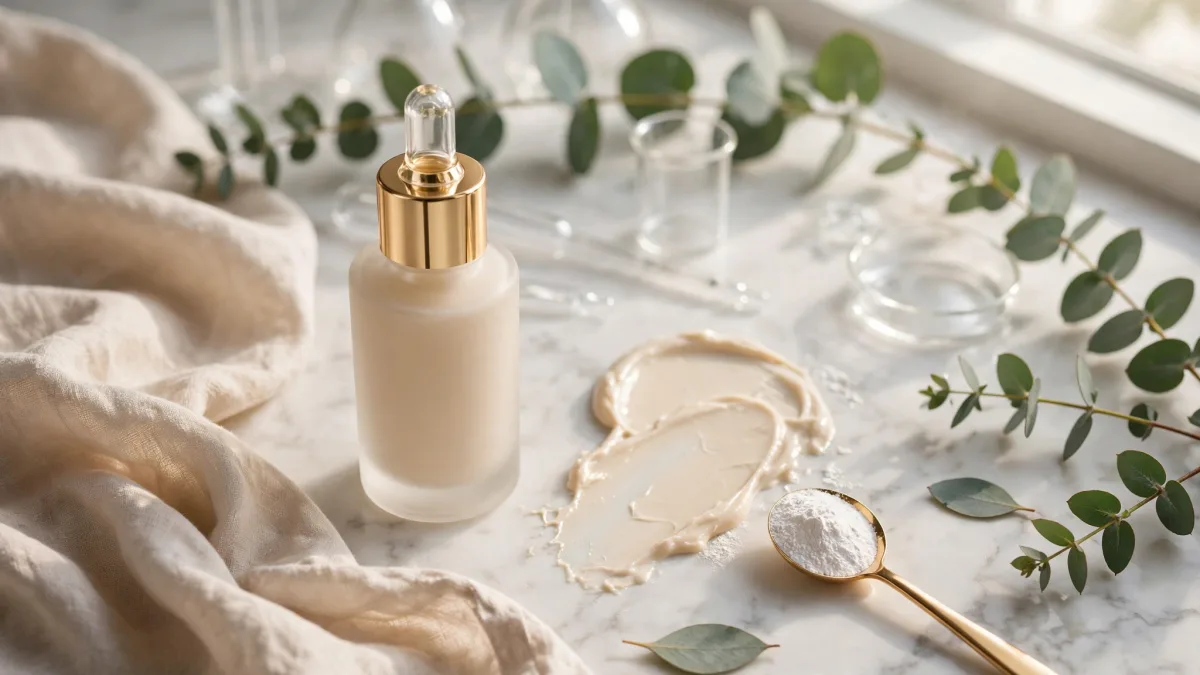
PDRN, or polydeoxyribonucleotide, has become one of the biggest ingredient trends in Korean skincare because of its connection to tissue-repair and regenerative research.
A 2026 systematic review found growing dermatological interest in PDRN and related polynucleotides while emphasizing differences between formulations and the need for stronger clinical evidence. Kream et al., Dermatologic Surgery, 2026.
A separate randomized split-face study evaluated a specific topical PDRN preparation for photodamaged skin and reported improvements in several skin outcomes. Ye et al., PLOS ONE, 2026.
That does not mean every PDRN serum will deliver the same results. Concentration, molecular characteristics, formulation, delivery system, and study design can all influence outcomes.
Glass Skin Is Becoming More Natural
The original glass-skin trend focused on an intensely smooth, reflective, hydrated complexion. The newer version is shifting toward skin that looks plump, supple, and healthy rather than simply glossy.
That is a useful change because healthy-looking skin does not require endless product layers. A consistent routine can be more valuable than repeatedly adding new active ingredients.
Barrier Care Remains a K-Beauty Essential
Barrier-focused skincare may be less exciting than a viral ingredient, but it has a stronger scientific foundation. The skin barrier helps limit water loss and protects against external substances.
Ceramides are particularly important because they are major components of the stratum corneum and contribute to barrier function. Schild et al., International Journal of Cosmetic Science, 2024.
Research also supports the importance of maintaining the skin barrier in inflammatory skin conditions. Feingold and Elias, Journal of Lipid Research, 2024.
Overnight Masks Are Trending
Overnight masks are gaining attention because they remain on the skin much longer than conventional rinse-off masks. Many use occlusive or film-forming textures that can help reduce water loss.
However, leaving a product on overnight does not automatically make its active ingredients more effective. The complete formulation still determines what a product can realistically accomplish.
Peptides Are Moving Deeper Into K-Beauty
Peptides are increasingly common in Korean anti-aging products, particularly formulas marketed for firmness, smoothing, and visible signs of aging.
Evidence is promising but not uniform. A 2026 systematic review and meta-analysis of randomized controlled trials found potential benefits from peptide interventions but also noted limitations in the available evidence, particularly when applying findings to topical skincare. Nukaly et al., Frontiers in Medicine, 2026.
So a peptide product may be worth considering, but the word "peptide" alone does not guarantee a visible anti-aging effect.
Scalp Care Is Becoming Part of K-Beauty
Korean beauty is increasingly treating the scalp as an important part of hair care. Products now target scalp cleansing, hydration, buildup, and overall scalp condition rather than focusing only on the hair shaft.
That approach can be useful for scalp maintenance, but scalp care should not be confused with proven hair-loss treatment. Persistent or significant shedding may have an underlying cause requiring professional assessment.
What the Science Says
The strongest K-beauty principles are surprisingly simple: support the skin barrier, maintain hydration, minimize unnecessary irritation, and protect skin from ultraviolet exposure.
Emerging ingredients such as PDRN and peptides are more complicated. A 2025 review described PDRN and related polynucleotides as promising areas of regenerative dermatology while emphasizing differences in terminology, products, and clinical evidence. Marques et al., Biomolecules, 2025.
The practical lesson is important: evidence for one specific formulation should not automatically be transferred to every product using the same marketing ingredient.
Common K-Beauty Myths
Myth: You need 10 steps for Korean skin.
No. More products do not automatically produce better skin and may increase irritation when multiple active ingredients are combined.
Myth: Korean skincare is automatically better.
No. Country of origin does not determine effectiveness. Ingredients, formulation, concentration, stability, and evidence matter more.
Myth: PDRN is a miracle ingredient.
No. PDRN is promising, but evidence varies by formulation and delivery method. Medical research cannot automatically be applied to every cosmetic serum.
Who Should Pay Attention?
K-beauty may appeal to people who prefer lightweight textures, hydration-focused formulas, barrier-supportive routines, and gradual skincare.
People experiencing persistent acne, severe irritation, unexplained rashes, or significant hair loss should not rely solely on viral beauty trends. These problems may require appropriate medical evaluation.
Evidence Strength Summary
Stronger evidence: hydration, moisturization, barrier support, and daily sun protection.
Promising but variable: peptides and specific topical PDRN formulations.
More research needed: broad claims surrounding many regenerative or treatment-inspired cosmetic ingredients.
Bottom Line
K-beauty is becoming a major force in U.S. skincare, and the Sephora-Olive Young expansion shows how quickly Korean beauty is moving into mainstream American retail. Sephora Newsroom, 2026.
The most useful trends are not necessarily the most viral ones. Build around barrier health and hydration first, then evaluate ingredients such as PDRN and peptides according to the evidence behind the specific product.
K-beauty's biggest lesson for 2026 is simple: innovation can be valuable, but novelty is not proof that something works.