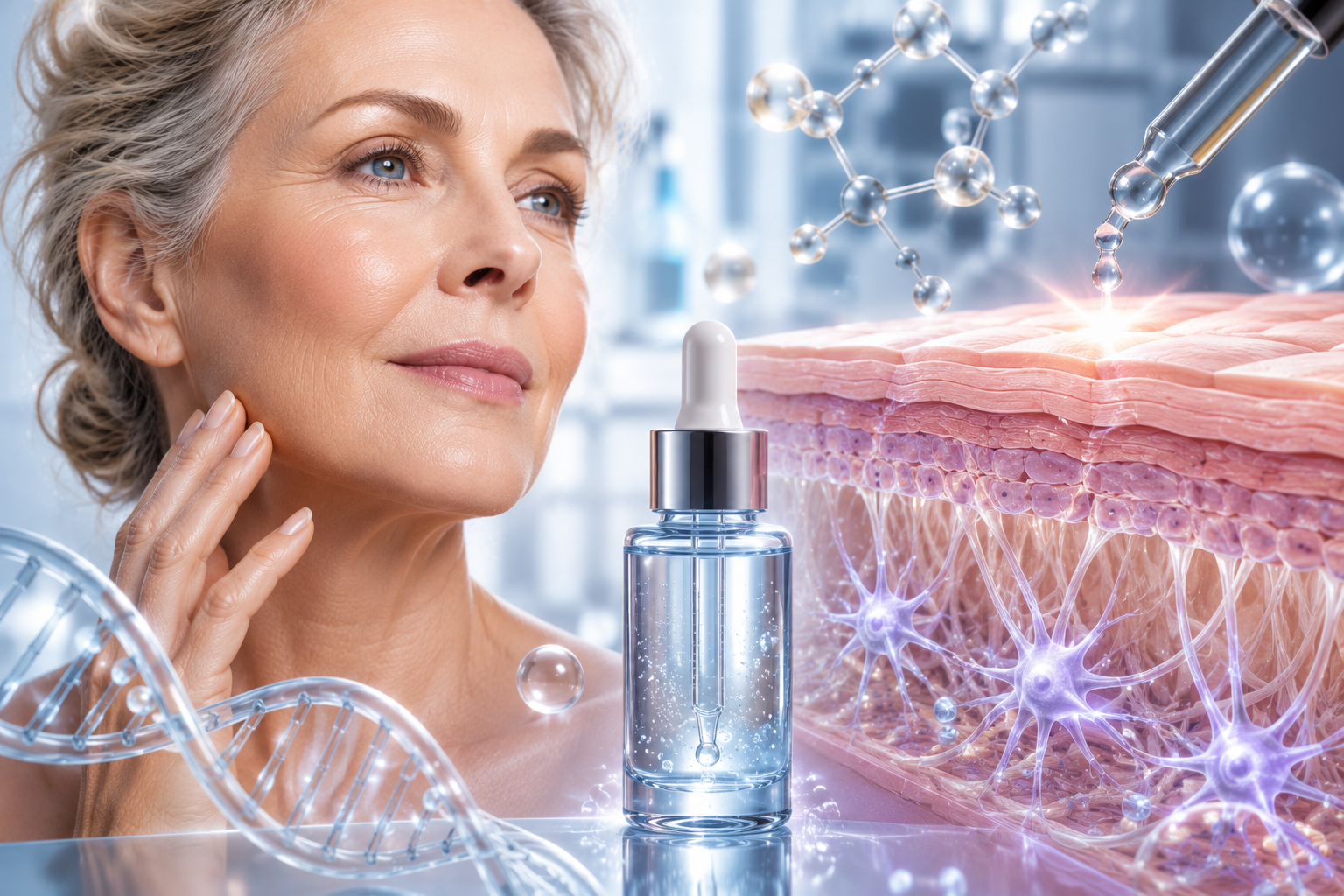
Mature skin naturally loses collagen, elastin, and moisture over time. As cell renewal slows, wrinkles become more noticeable, skin becomes thinner, and healing after irritation or cosmetic treatments takes longer. This has increased interest in regenerative skincare ingredients that support the skin's natural repair processes rather than simply moisturizing the surface.
PDRN (Polydeoxyribonucleotide) is a regenerative skincare ingredient derived from purified salmon DNA fragments. Research suggests it may help support tissue repair, improve skin hydration, reduce inflammation, and stimulate collagen production. While clinical evidence for injectable PDRN is stronger than for topical products, high-quality topical formulations may benefit mature skin, particularly when combined with sunscreen, retinoids, peptides, and a consistent skincare routine.
- PDRN supports skin repair by activating adenosine A2A receptors.
- It may improve collagen production, hydration, and skin elasticity.
- Clinical evidence is strongest for injectable PDRN, while topical evidence is still emerging.
- PDRN may help reduce redness and support recovery after cosmetic procedures.
- Best results come from combining PDRN with proven anti-aging ingredients and daily sunscreen.
What Is PDRN and Why Is It Trending in Skincare?
Polydeoxyribonucleotide (PDRN) is a purified mixture of DNA fragments extracted from salmon species such as Oncorhynchus mykiss and Oncorhynchus keta. It has been used in regenerative medicine for many years to support wound healing, tissue repair, and recovery after injury.
More recently, PDRN has entered premium skincare products because of its potential to support skin regeneration. Unlike ingredients that only hydrate the outer skin layer, PDRN aims to promote the skin's natural repair mechanisms, making it particularly appealing for mature skin affected by age-related collagen loss and slower healing.
How Does PDRN Work?
PDRN primarily activates adenosine A2A receptors, which regulate inflammation, tissue repair, and blood vessel formation. Activation of these receptors helps create an environment that supports healthier skin regeneration.
Laboratory and clinical studies suggest PDRN may:
- Stimulate fibroblasts to produce collagen and extracellular matrix proteins.
- Support hyaluronic acid production for improved hydration.
- Reduce inflammatory signals associated with skin aging.
- Promote angiogenesis, improving oxygen and nutrient delivery to healing tissues.
- Accelerate recovery after skin injury or cosmetic procedures.
What the Science Says: Current evidence suggests PDRN supports tissue regeneration through adenosine A2A receptor activation, promoting collagen synthesis, reducing inflammation, and improving wound healing. Most high-quality studies involve injectable PDRN rather than cosmetic topical products.
Is PDRN Worth It for Mature Skin?
For many people with mature skin, PDRN is a promising addition to an evidence-based skincare routine. It may be especially useful for individuals experiencing:
- Fine lines and wrinkles
- Reduced skin elasticity
- Thinner, fragile skin
- Dryness and impaired skin barrier
- Slow recovery after aesthetic procedures
However, expectations should remain realistic. Topical PDRN products cannot completely reverse skin aging or replace treatments with stronger clinical evidence, such as prescription retinoids, sunscreen, or certain dermatological procedures. Instead, PDRN appears most effective as a complementary ingredient.
PDRN vs Traditional Anti-Aging Ingredients
| Ingredient | Main Benefit | Best For | Evidence Strength |
|---|---|---|---|
| PDRN | Skin repair and regeneration | Mature and recovering skin | Moderate (stronger for injections) |
| Retinoids | Collagen stimulation | Wrinkles and photoaging | Very Strong |
| Peptides | Support collagen signaling | Firmness | Moderate |
| Hyaluronic Acid | Hydration | Dry skin | Strong |
| Vitamin C | Brightening and antioxidant protection | Uneven tone | Strong |
How to Add PDRN to Your Skincare Routine
1. Apply a PDRN Serum
Use a well-formulated PDRN serum after cleansing and before moisturizer. Morning and evening application is generally recommended according to manufacturer instructions.
2. Combine with Hyaluronic Acid and Peptides
These ingredients complement PDRN by improving hydration while supporting collagen production and skin barrier function.
3. Use After Professional Treatments
PDRN may help calm the skin after procedures such as microneedling, laser treatments, or chemical peels when recommended by your dermatologist.
4. Lock in Moisture
Finish with a moisturizer containing ceramides, cholesterol, and fatty acids to strengthen the skin barrier.
5. Wear Sunscreen Every Day
Daily broad-spectrum SPF 30 or higher remains the most effective strategy for preventing further collagen breakdown and protecting treatment results.
Who May Benefit Most?
- Adults with mature or photoaged skin.
- People experiencing slower skin healing.
- Individuals recovering from cosmetic procedures.
- Those seeking additional skin repair alongside established anti-aging ingredients.
Common Myths About PDRN
Myth: PDRN completely reverses aging.
Fact: No skincare ingredient can completely reverse aging. PDRN may support healthier skin repair but works best as part of a comprehensive skincare routine.
Myth: Salmon DNA changes human DNA.
Fact: There is no evidence that cosmetic PDRN alters human DNA. Its effects are related to tissue repair pathways rather than genetic modification.
Myth: Topical PDRN works exactly like injections.
Fact: Injectable PDRN has substantially more clinical research. Topical products may provide benefits, but evidence remains more limited.
What the Science Says
Research in regenerative medicine consistently demonstrates that PDRN promotes tissue repair, reduces inflammation, and improves wound healing through activation of adenosine A2A receptors. Clinical studies have also reported improvements in skin elasticity, hydration, and recovery after cosmetic procedures. However, experts note that additional high-quality studies are still needed to establish the long-term effectiveness of topical PDRN formulations compared with injectable therapies.
Bottom Line
PDRN is one of the most promising regenerative skincare ingredients for mature skin. While it should not be viewed as a miracle anti-aging solution, current evidence suggests it may help support collagen production, skin repair, hydration, and recovery—particularly when combined with proven skincare essentials such as sunscreen, retinoids, moisturizers, and peptides. If you're looking to strengthen your skin's natural repair processes, PDRN may be a worthwhile addition to a science-backed skincare routine.
Medical References
- Bitto A, et al. Polydeoxyribonucleotide (PDRN) restores blood flow in an experimental model of ischemic skin flaps. Journal of Vascular Surgery.
- Galeano M, et al. Polydeoxyribonucleotide stimulates angiogenesis and wound healing via adenosine A2A receptor activation. Wound Repair and Regeneration.
- Kim JY, et al. Clinical applications of polydeoxyribonucleotide in regenerative medicine: A review. International Journal of Molecular Sciences.
- American Academy of Dermatology. Skin care recommendations for healthy aging.
- International Dermal Institute. Skin aging and extracellular matrix biology.