Japanese walking has seen one of the sharpest search spikes in fitness this year, but most people trying it don't realize it's not just "walking faster." It's a structured interval protocol with over a decade of research behind it.
What Japanese Walking Actually Is
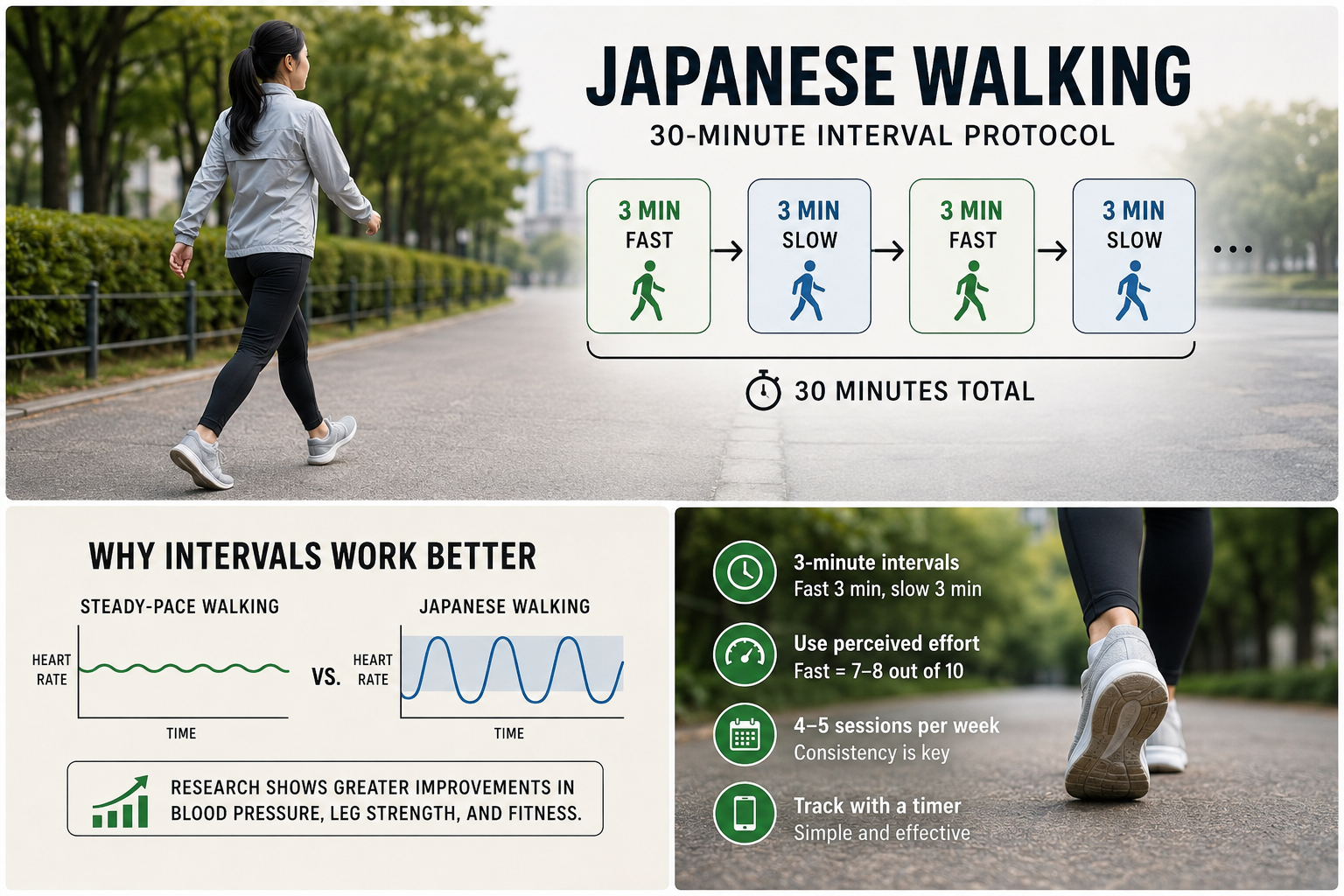
The method comes from a 2007 study by researchers at Shinshu University in Japan, who tested it against standard continuous walking. It involves alternating 3 minutes of fast-paced walking with 3 minutes of slow-paced walking, repeated for a total of 30 minutes.
The fast intervals are meant to push your heart rate to a moderately vigorous level — noticeably breathless but not exhausted. The slow intervals allow partial recovery before the next push. This on-off pattern is what separates it from simply walking briskly the whole time.
Why Intervals Beat Steady-Pace Walking
Continuous moderate walking keeps your heart rate in a narrow, steady range. Interval walking repeatedly pushes your cardiovascular system above and below that range, which creates a bigger training stimulus for your heart and leg muscles in the same amount of time.
The original research found that participants doing interval walking saw greater improvements in blood pressure, leg strength, and peak oxygen uptake than those walking continuously at a moderate pace — despite spending the same total time exercising.
Why It's Resurging Now
Interval walking fits into 2026's broader shift toward "training for life" rather than aesthetics — it requires no equipment, no gym, and is accessible to people who find running or HIIT too demanding on joints.
## 4 Ways to Try Japanese Walking- Start with 3-minute intervals. Alternate 3 minutes of fast walking (a pace where talking feels effortful) with 3 minutes of slow, easy walking. Repeat for 30 minutes total.
- Use perceived effort, not exact speed. "Fast" should feel like a 7 or 8 out of 10 in effort — not a sprint, but noticeably harder than a stroll.
- Aim for 4–5 sessions a week. The original study protocol used 4 days per week over several months to see measurable fitness improvements.
- Track progress with a simple timer. A phone timer or basic interval app is enough — no fitness tracker is required, though one can help you monitor heart rate if you have it.
Bottom Line
Japanese walking isn't a gimmick — it's a well-studied interval protocol that gets more cardiovascular benefit out of walking by alternating intensity instead of keeping a constant pace. It's a low-barrier way to train harder without needing a gym.