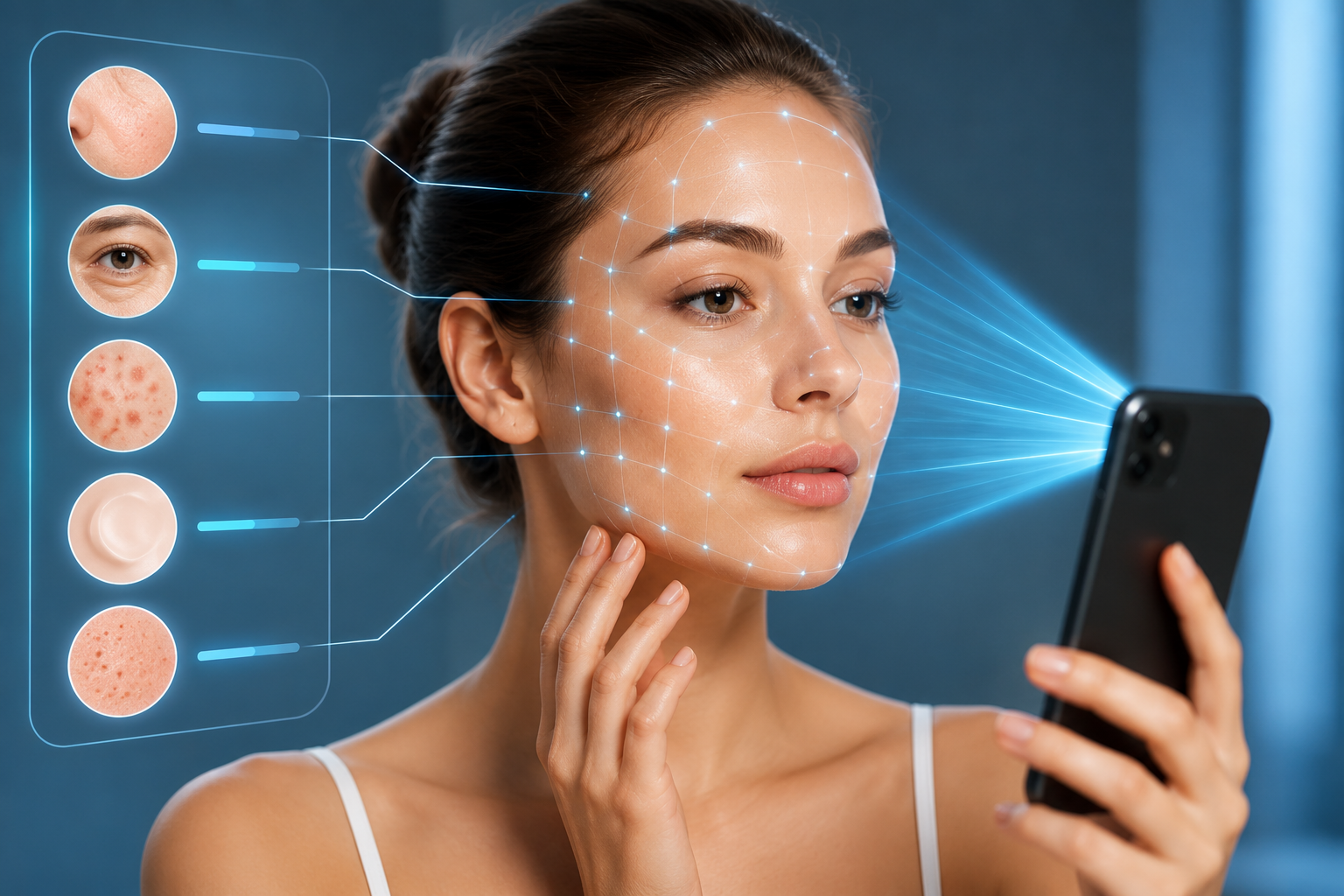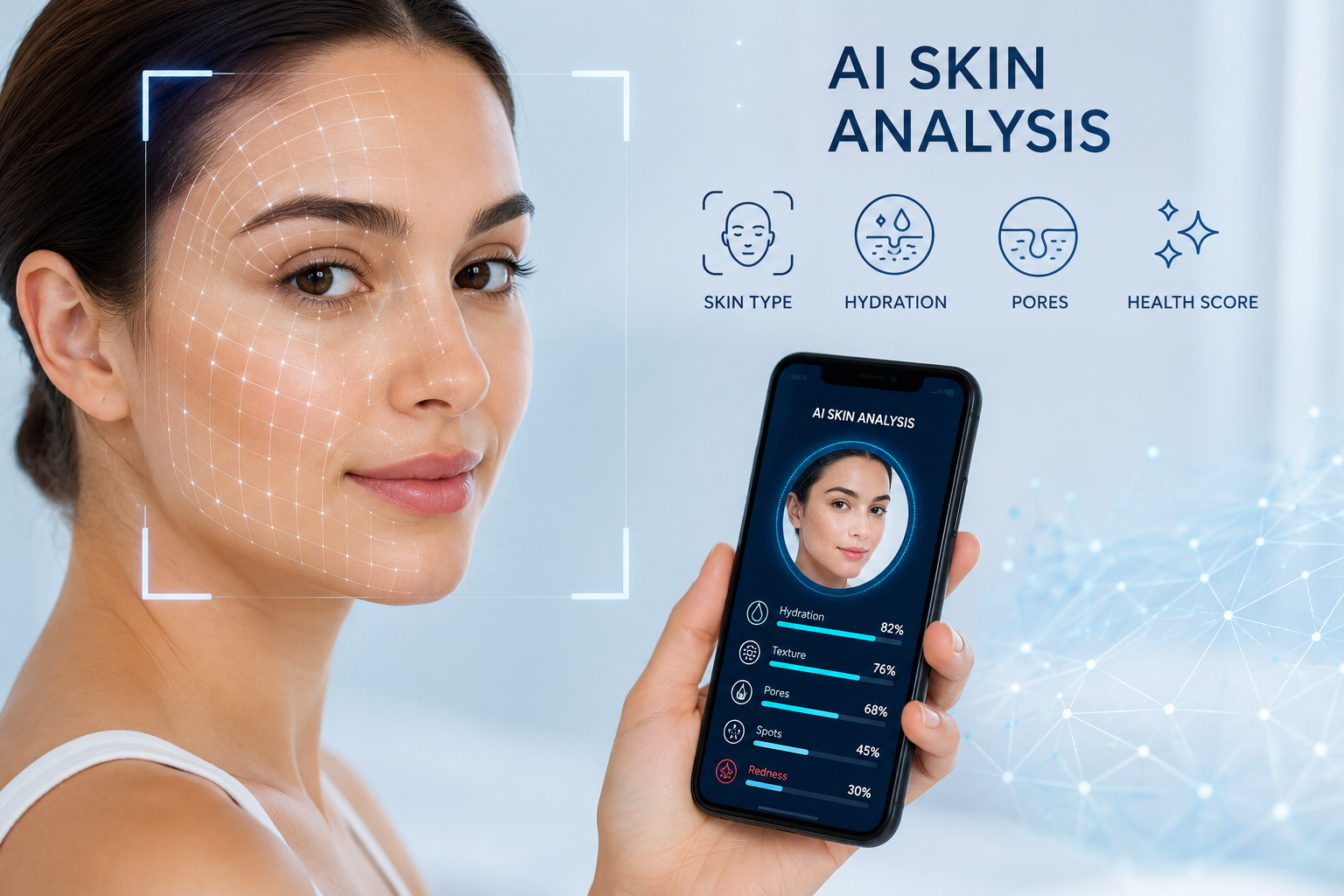
AI-powered skin analysis apps have become one of the fastest-growing trends in skincare. With nothing more than a smartphone selfie, these apps claim to identify your skin type, detect wrinkles, pigmentation, acne, enlarged pores, redness, hydration levels, and even recommend personalized skincare products within seconds.
It sounds impressive—but can artificial intelligence really diagnose your skin, or is it simply making educated guesses based on image patterns?
The answer is more nuanced. Modern AI can recognize many visible skin characteristics with remarkable accuracy under the right conditions. However, identifying visual patterns is not the same as making a medical diagnosis. Understanding that difference can help you avoid unnecessary products, reduce anxiety, and know when professional care is essential.
AI skin analysis apps can accurately assess certain visible skin features such as wrinkles, pigmentation, acne severity, pores, and skin texture when high-quality images are used. However, they cannot diagnose medical skin conditions with certainty because they lack medical history, physical examination, and clinical judgment. AI should be used as a skincare support tool—not as a replacement for a dermatologist.
- AI analyzes visible skin patterns rather than performing true medical diagnosis.
- Image quality, lighting, camera angle, and skin tone significantly influence accuracy.
- AI performs best for tracking changes over time using consistent photos.
- Medical-grade AI has shown impressive performance in research for selected skin conditions, but results vary by application.
- Persistent rashes, changing moles, or suspicious skin lesions always require professional evaluation.
How AI Skin Analysis Apps Actually Work
Most AI skincare apps use deep learning, a form of artificial intelligence trained on hundreds of thousands—or even millions—of labeled skin images. The algorithms learn to recognize visual patterns associated with wrinkles, pigmentation, acne, redness, enlarged pores, texture irregularities, and other visible features.
When you upload a selfie, the software compares your image against patterns it learned during training. Instead of "thinking" like a dermatologist, it calculates the probability that certain visible characteristics are present.
Some medical AI systems designed for dermatology have demonstrated excellent performance for specific tasks, including detecting certain skin cancers or classifying skin lesions. However, these systems are carefully validated in clinical environments and should not be confused with consumer skincare apps.
What AI Can Accurately Detect
Artificial intelligence is particularly effective at standardized visual analysis. When photographs are captured under consistent conditions, AI can reliably evaluate:
- Visible wrinkles and fine lines
- Pigmentation and sun spots
- Acne severity
- Facial redness
- Pore visibility
- Overall skin texture
- Oiliness and shine
- Changes over time using repeat images
Research published in leading medical journals has shown that AI algorithms can perform at or near dermatologist-level accuracy for selected image-based tasks, especially skin lesion classification. These systems excel because they can compare an image against enormous databases much faster than humans.
Where AI Skin Diagnosis Falls Short
Although AI is powerful at pattern recognition, it cannot replace clinical reasoning.
A dermatologist considers factors that a photograph cannot capture, including:
- Medical history
- Current medications
- Family history
- Recent illnesses
- Allergies
- Symptoms such as itching, pain, or bleeding
- How quickly a lesion has changed
- Physical examination findings
Two skin conditions may appear nearly identical in a photograph but require completely different treatments. Likewise, some serious diseases have subtle features that require dermoscopy, biopsy, or laboratory testing—none of which AI skincare apps can perform.
Factors That Affect AI Accuracy
AI skin analysis is only as good as the information it receives. Several factors can significantly influence results:
- Poor lighting
- Heavy makeup
- Camera resolution
- Image filters
- Facial expressions
- Shadows
- Blurred photographs
- Different camera angles
Another important challenge involves diversity within training datasets. Earlier AI systems were often trained using images that underrepresented darker skin tones, reducing accuracy for some populations. Modern developers are improving dataset diversity, but experts continue to identify fairness and bias as important challenges in medical AI.
Can AI Diagnose Skin Cancer?
This is one of the most misunderstood claims surrounding AI skincare.
Some specialized medical AI systems have demonstrated excellent performance in identifying suspicious skin lesions during research studies. However, consumer skincare apps are not designed to confirm or rule out skin cancer.
If you notice:
- a changing mole,
- an irregular border,
- multiple colors,
- persistent bleeding,
- a rapidly growing lesion, or
- a sore that does not heal,
you should seek prompt evaluation by a qualified dermatologist regardless of what an app reports.
The Best Way to Use AI Skin Analysis
When used appropriately, AI can become a valuable addition to your skincare routine.
Its greatest strengths include:
- Monitoring gradual skin improvements
- Tracking acne progression
- Comparing before-and-after skincare results
- Supporting personalized skincare routines
- Providing objective image comparisons over time
Think of AI as a digital tracking assistant rather than a healthcare professional. It can highlight visible changes, but it cannot determine their underlying cause.
What the Science Says
Multiple systematic reviews suggest that AI has significant potential in dermatology, particularly for image classification and skin lesion detection. Several deep-learning systems have achieved dermatologist-comparable performance under controlled conditions.
However, researchers consistently emphasize that AI should support—not replace—clinical evaluation. Current evidence supports using AI as a decision-support tool alongside healthcare professionals rather than as an independent diagnostic system.
Common Myths About AI Skin Analysis
Myth: AI can fully replace a dermatologist.
Reality: AI evaluates images, while dermatologists evaluate the whole patient.
Myth: Every recommendation is medically necessary.
Reality: Many skincare apps are connected to product recommendations that may not reflect clinical priorities.
Myth: One selfie provides a perfect skin diagnosis.
Reality: Accuracy depends heavily on photo quality, lighting, and consistent imaging conditions.
Who Should Pay Attention?
- People building a beginner skincare routine
- Individuals monitoring acne treatment progress
- Users tracking pigmentation or wrinkle changes
- People comparing skincare product effectiveness
- Anyone considering AI-powered skincare recommendations
Individuals with suspicious moles, persistent rashes, painful skin conditions, rapidly changing lesions, or unexplained skin symptoms should seek medical evaluation instead of relying on AI.
Bottom Line
AI skin analysis is no longer science fiction. It can accurately measure many visible skin characteristics and help monitor changes over time, making it a useful tool for skincare management.
However, AI is not a substitute for medical diagnosis. It cannot understand your medical history, perform a physical examination, or make complex clinical decisions.
The smartest approach is to use AI for routine skin monitoring while relying on qualified dermatologists for diagnosis and treatment decisions—especially whenever a skin change is persistent, suspicious, or rapidly evolving.
References
- Esteva A, Kuprel B, Novoa RA, et al. Dermatologist-level classification of skin cancer with deep neural networks. Nature. 2017;542(7639):115-118. doi:10.1038/nature21056.
- Tschandl P, Rinner C, Apalla Z, et al. Human–computer collaboration for skin cancer recognition. Nature Medicine. 2020;26:1229-1234. doi:10.1038/s41591-020-0942-0.
- Freeman K, Dinnes J, Chuchu N, et al. Algorithm-based smartphone applications to assess risk of skin cancer in adults. Cochrane Database of Systematic Reviews. 2020.
- World Health Organization. Ethics and Governance of Artificial Intelligence for Health. World Health Organization; 2021.
- American Academy of Dermatology Association (AAD). Teledermatology and Artificial Intelligence Resources.
- U.S. Food and Drug Administration (FDA). Artificial Intelligence and Machine Learning (AI/ML)-Enabled Medical Devices.