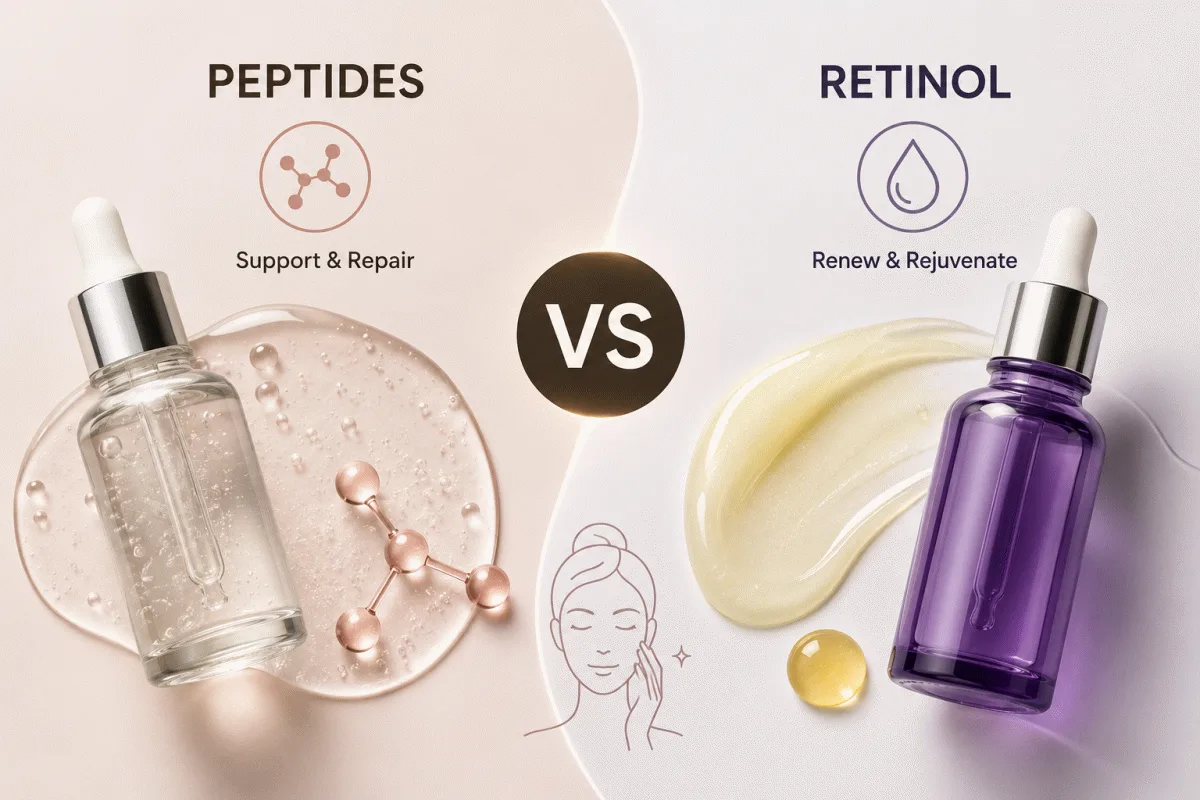
Peptides and retinol are among the most researched anti-aging skincare ingredients available today, yet they work in fundamentally different ways. While both aim to reduce visible signs of aging such as fine lines, wrinkles, and loss of firmness, they are not interchangeable. Retinol accelerates skin renewal and stimulates collagen production through vitamin A pathways, whereas peptides act as biological messengers that encourage the skin to repair and strengthen itself. Understanding how each ingredient works can help you choose the right one for your skin—or determine whether using both offers the greatest long-term benefit.

Quick Answer: Retinol boosts skin cell turnover and collagen production, making it one of the most effective ingredients for wrinkles, uneven skin tone, and photoaging. Peptides support collagen synthesis through cell-signaling pathways, helping improve firmness and skin barrier function with a lower risk of irritation. For many people, dermatologists recommend combining both ingredients in a well-planned skincare routine rather than choosing only one.
Key Takeaways:
  • Retinol remains one of the most clinically studied topical ingredients for improving wrinkles and sun-damaged skin.
  • Peptides help strengthen the skin barrier and encourage collagen production with excellent tolerability.
  • Retinol usually delivers faster visible improvements but commonly causes dryness during the adjustment period.
  • Peptides are suitable for most skin types, including sensitive and rosacea-prone skin.
  • Using peptides alongside retinol may improve skin comfort while supporting long-term anti-aging results.

How Retinol Actually Works

Retinol is a vitamin A derivative that is converted within the skin into retinoic acid, the biologically active form responsible for many of its anti-aging effects. Retinoic acid binds to specific retinoid receptors inside skin cells, triggering genetic pathways that increase epidermal cell turnover, stimulate collagen production, reduce collagen-degrading enzymes, and improve overall skin texture.

Decades of clinical research have established retinoids as one of the most effective topical treatments for photoaging. A double-blind, vehicle-controlled clinical trial published in the Journal of Dermatological Treatment demonstrated significant improvements in facial photoaging among participants using topical retinol. More recently, a large 2025 network meta-analysis published in Scientific Reports confirmed that topical retinoids remain among the most consistently effective ingredients for improving wrinkles, skin texture, and photodamage across multiple clinical studies.

However, effectiveness varies depending on formulation, concentration, product stability, and consistent long-term use. A systematic review published in the Journal of Clinical and Aesthetic Dermatology found that while many over-the-counter retinol products improved visible signs of aging, some trials reported only modest improvements compared with placebo, highlighting the importance of choosing well-formulated products.

The biggest limitation of retinol is tolerability. Because it accelerates skin renewal, many users experience temporary dryness, peeling, redness, irritation, or mild burning during the first several weeks. Dermatologists generally recommend introducing retinol gradually, using moisturizers to support the skin barrier, and applying broad-spectrum sunscreen every morning because retinoids increase photosensitivity.

How Peptides Actually Work

Peptides are short chains of amino acids that serve as signaling molecules within the skin. Rather than forcing rapid cell turnover, peptides communicate with fibroblasts—the cells responsible for producing collagen and elastin—to encourage tissue repair and collagen synthesis through separate biological pathways.

Different peptides perform different functions. Signal peptides stimulate collagen production, carrier peptides deliver essential trace minerals such as copper to support wound healing, while enzyme-inhibiting peptides may help reduce collagen breakdown. Modern peptide formulations often combine several peptide technologies to target multiple aspects of skin aging simultaneously.

One of the greatest advantages of peptides is their excellent tolerability. Unlike retinol, peptides rarely cause irritation, making them appropriate for sensitive skin, rosacea-prone skin, mature skin, and individuals with impaired skin barriers. Most peptide serums can safely be applied twice daily without requiring an adjustment period.

Retinol vs. Peptides: The Key Differences

Feature Retinol Peptides
Primary Action Accelerates cell turnover and stimulates collagen through retinoid receptors. Signals skin cells to repair and produce collagen.
Speed of Results Typically faster, with noticeable improvements after several weeks. Gradual improvements over consistent long-term use.
Irritation Risk Moderate to high during the adjustment period. Generally very low.
Best Time to Apply Nighttime only. Morning and evening.
Ideal For Wrinkles, acne, pigmentation, and photoaging. Sensitive skin, prevention, barrier repair, and hydration support.
Clinical Evidence Extensive, with decades of research. Growing evidence with promising clinical trials.

Who Should Reach for Retinol?

Retinol is an excellent choice for people whose primary goals include reducing fine lines, wrinkles, uneven skin tone, sun damage, acne, or enlarged pores. Because retinol directly influences skin cell turnover and collagen production, it remains one of the most effective over-the-counter ingredients for visible skin rejuvenation.

People with resilient or normal skin often tolerate retinol well, especially when introduced gradually. If you have never used a retinoid before, dermatologists generally recommend starting with a low concentration two or three nights per week before increasing frequency as your skin adapts.

Those with active eczema, severely compromised skin barriers, or extremely sensitive skin may need to restore barrier health before introducing retinol. Consulting a dermatologist is recommended if persistent irritation develops.

Who Should Reach for Peptides?

Peptides are ideal for individuals seeking gentle yet effective support for healthy skin aging. They are particularly beneficial for sensitive skin, rosacea-prone skin, mature skin, and anyone unable to tolerate stronger active ingredients.

Because peptides strengthen the skin barrier while encouraging collagen production, they work well as both preventive and corrective skincare ingredients. They can also complement moisturizers containing ceramides, hyaluronic acid, niacinamide, and glycerin to further improve hydration and resilience.

If your goal is maintaining healthy, firm, hydrated skin with minimal irritation, peptides are among the safest long-term ingredients available.

How Modern Skincare Formulas Have Improved

Recent skincare innovations have significantly improved both retinol and peptide formulations. Many modern retinol products now use encapsulated delivery systems that slowly release retinol into the skin, helping reduce irritation while maintaining effectiveness.

Peptide technology has also advanced considerably. Today's premium formulations frequently combine signal peptides, carrier peptides, neurotransmitter-inspired peptides, and enzyme-inhibiting peptides to target multiple pathways involved in visible skin aging. This multi-peptide approach may provide broader skin benefits than older single-peptide formulations.

Common Mistakes to Avoid

  • Using retinol with strong exfoliating acids on the same night: Combining retinol with glycolic acid, lactic acid, salicylic acid, or high-strength AHAs and BHAs may significantly increase irritation without providing additional anti-aging benefits.
  • Skipping sunscreen: Daily broad-spectrum SPF 30 or higher is essential when using retinol because increased photosensitivity can lead to irritation and additional sun damage.
  • Starting multiple active ingredients simultaneously: Introduce one new ingredient at a time so any irritation can be easily identified.
  • Using excessive amounts: More product does not produce faster results. A pea-sized amount of retinol is generally sufficient for the entire face.
  • Expecting overnight improvements: Collagen remodeling is a gradual biological process. Most visible improvements require consistent use for at least 8–12 weeks.
  • Assuming peptides replace retinol completely: Although peptides support collagen production, current evidence still places retinoids among the strongest topical ingredients for treating established photoaging.

Can You Use Peptides and Retinol Together?

Yes. For most healthy adults, combining peptides and retinol is not only safe but may also enhance an overall anti-aging skincare routine. Because the two ingredients work through different biological mechanisms, they complement rather than interfere with each other.

Many dermatologists recommend applying retinol during the evening while incorporating peptide serums or peptide-rich moisturizers either before retinol or during the morning routine. Peptides may help strengthen the skin barrier and reduce some of the dryness commonly experienced during retinol use.

If your skin is particularly sensitive, begin with peptides first for several weeks before gradually introducing retinol. This allows your skin barrier to become stronger before adding a more potent active ingredient.

How to Introduce Retinol Safely

  1. Choose a beginner-friendly retinol concentration if you are new to vitamin A products.
  2. Apply retinol only two or three nights each week during the first month.
  3. Use only a pea-sized amount on completely dry skin.
  4. Follow with a moisturizer containing peptides, ceramides, or other barrier-supporting ingredients.
  5. Apply broad-spectrum sunscreen every morning without exception.
  6. If irritation persists for more than several weeks, reduce application frequency or consult a dermatologist.

Evidence Strength

  • ★★★★★ Strong Evidence: Retinoids for photoaging, collagen stimulation, acne treatment, and wrinkle reduction.
  • ★★★★☆ Moderate Evidence: Peptides for improving skin firmness, hydration, barrier support, and early wrinkle prevention.
  • ★★★★☆ Moderate Evidence: Combining peptides with retinol to improve tolerability while maintaining anti-aging benefits.

The Bottom Line

Peptides and retinol should not be viewed as competing ingredients. Instead, they address skin aging through different but complementary biological pathways. Retinol remains the gold standard for accelerating cell renewal and improving visible signs of photoaging, while peptides strengthen the skin barrier and encourage collagen production with significantly less irritation.

If your skin tolerates retinol well, adding peptides can improve hydration, reinforce the skin barrier, and create a more balanced anti-aging routine. If you have sensitive or reactive skin, peptides provide an excellent starting point before gradually introducing retinol if needed.

Ultimately, the most effective skincare routine is one you can maintain consistently. Daily sunscreen, gentle cleansing, moisturization, and long-term adherence will usually have a greater impact on skin health than relying on any single active ingredient alone.

References

  • Kikuchi K, et al. Improvement of Photoaged Facial Skin in Middle-Aged Japanese Females by Topical Retinol: A Vehicle-Controlled Double-Blind Study. Journal of Dermatological Treatment.
  • Scientific Reports (2025). Comparative Efficacy of Topical Interventions for Facial Photoaging: Network Meta-analysis.
  • Journal of Clinical and Aesthetic Dermatology. Evidence for the Efficacy of Over-the-Counter Vitamin A Cosmetic Products in the Improvement of Facial Skin Aging: A Systematic Review.
  • Chang H, et al. (2025). Novel Cyclized Hexapeptide-9 Outperforms Retinol Against Skin Aging: A Randomized, Double-Blinded, Active- and Vehicle-Controlled Clinical Trial. Journal of Cosmetic Dermatology.